Lavreotiki Residency · 2025 · Attica, Greece
Hybrid
Ecologies
Encapsulations — 2025–6
Toward a studio practice of making-with the natural
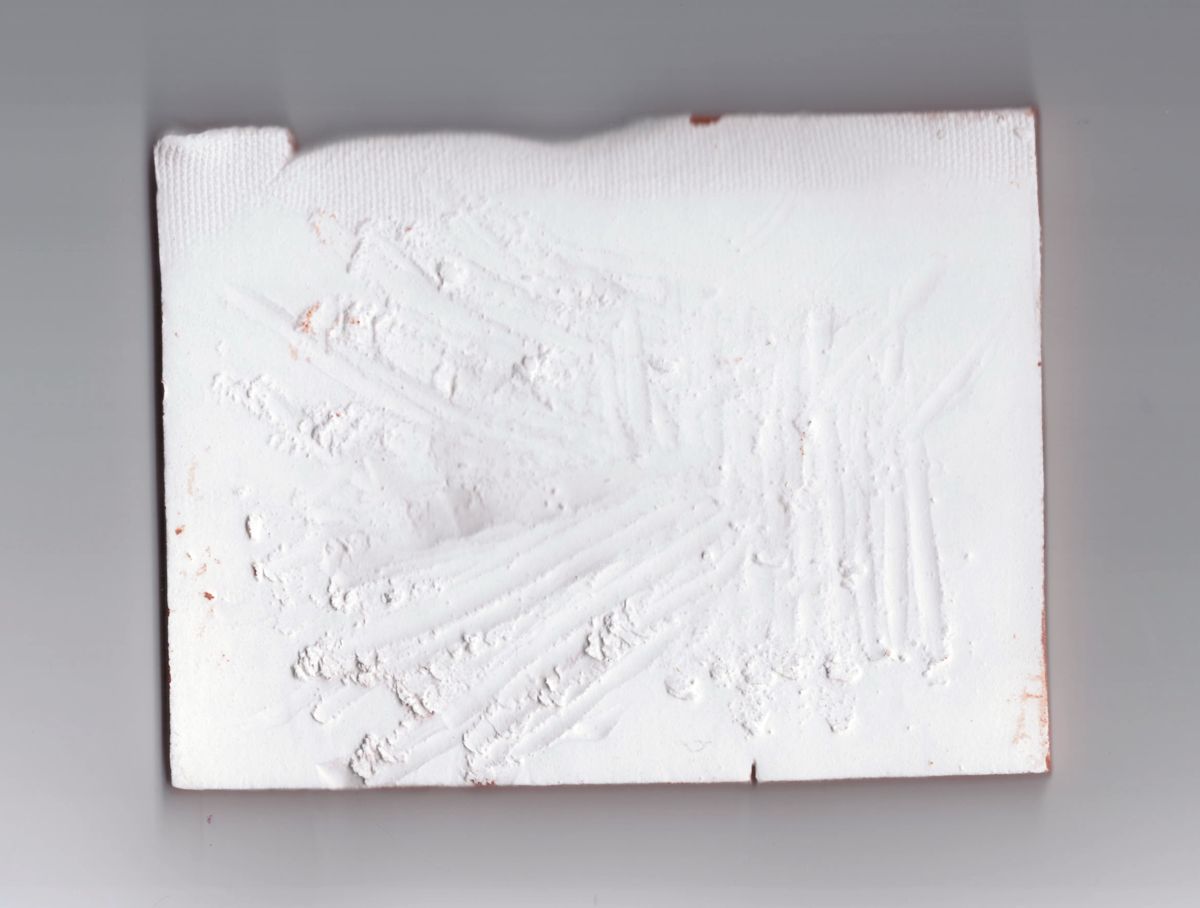
Lavreotiki Residency · 2025 · Attica, Greece
Encapsulations — 2025–6
Toward a studio practice of making-with the natural
During my residency in Lavreotiki, my intention was to explore the ecosystem of the region and to define a studio process in which the work would constitute a collaboration with the natural world.
The first thing anyone discusses about Lavrion is its geology. The mineral wealth of the area — known since antiquity — and the use of that richness as pigment were the initial impetus for the research, and became the core of the work that followed.
At the same time, the contamination of the region's soil by various elements, some natural and some man-made, raised the question of how to handle that raw material in the studio. From this came the idea of encapsulating those elements in glass, rendering them inert.
The process began in the summer of 2025 with the collection of soil samples from the wider Lavrion area, to explore the range of color each could yield in ceramics. To avoid further handling of the polluted soil, some samples were analyzed and then recreated as pigment in the studio, and added to glazes on ceramic tiles.
The forms of the tiles are in dialogue with the themes my work approaches — the Anthropocene, biomimicry, interspecies collaboration — as explored in the notebook drawings and the process tiles.
The Anthropocene and Ecologies
Human activities have altered the Earth’s climate and ecosystems at an unprecedented rate, leading to profound and often irreversible changes. Garbage has become a normalized presence within the natural environment, as we gradually convince ourselves that it is not pollution, but simply another part of the world around us. Made literal in the beach-found foam tiles (PR-01, PR-02) where a found man made object is transposed to ceramics.
Observation, Collaboration and Biomimetics
One important aspect of this work engages with the field of biomimetics — the study of how animals and insects construct forms that can inspire new methodologies, materials or technologies. This series of works is informed by close observation of the natural world — an attempt at collaboration with animal and insect life. Their ingenuity, precision, and dedication in building nests, shelters, and habitats have inspired a deep sense of admiration and wonder. One might imagine a speculative future in which swarms of bee-inspired robots build homes for humanity.
Material Process and Studio Practice
Collecting materials — soil, stones, organic matter — has been part of my practice for many years, particularly in ceramics, where the "hunt" for wild materials can produce unexpected results. Observation of natural structures and forms enters the studio the same way: as process, as restriction, and sometimes as an occasion to develop new materials.
Encapsulations
Ceramic tiles · variable dimensions · 2025–6
The work developed out of a series of hikes in the wider Lavrion area, during which earths were collected.
The starting point was the region’s severe contamination, and the way it interacts with living organisms. From there came the use of these earths as glazes — the encapsulation of those substances within glass.
The forms of the tiles arise from observing nature in Lavrion — insect nests, imprints, traces — but also from their relation to the marks humans leave on the environment, bringing out relations of symbiosis and interdependence.
The work is accompanied by a collection of research material — maps, analyses, photographs and more — which functions as a second route, this time through the development of the work.
The geological wealth of Lavrion has been used as a source of pigments throughout its history. Below are some examples of the different pigments the minerals of Lavrion can provide — hematite and iron ochre from Kamareza, limonite from Legrena, manganese from the Maria mine, azurite and malachite from Kamareza.
The photographs below were taken by the artist during a group visit to the monastery of St Paul at Palaiokamariza in 2025.
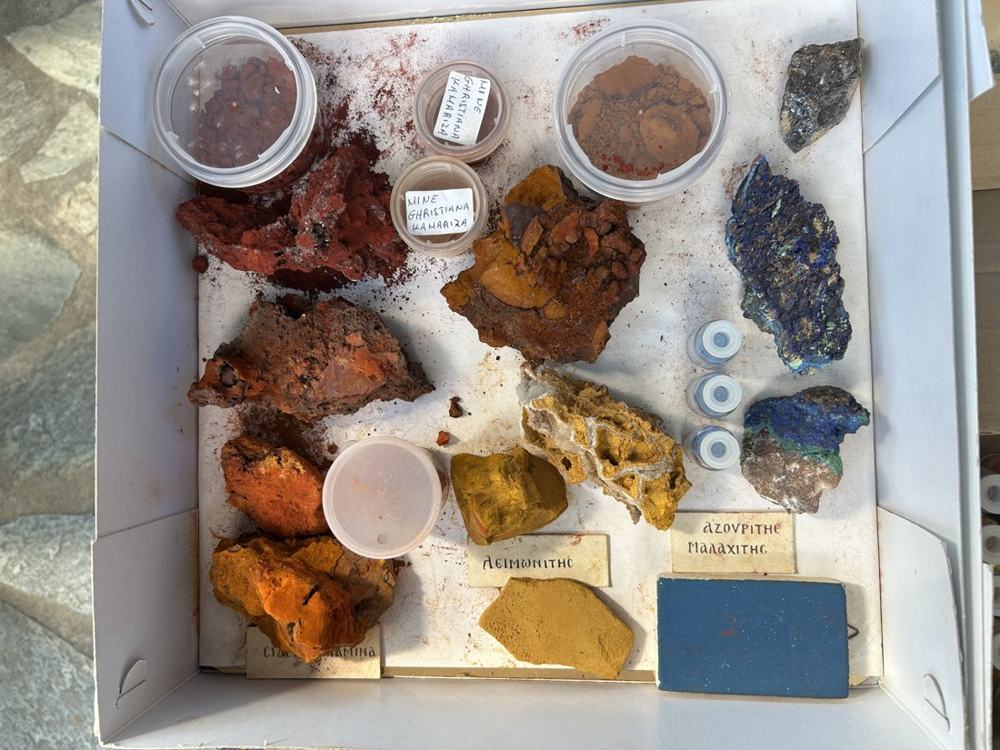
Samples of the mineral stones. Iron ochre and hematite (deep red) upper left, limonite (yellow-ochre) center, azurite and malachite (blue-green) right, with ground pigment already decanted into pots. Hand-lettered Greek labels name the material — Λειμωνίτης (limonite), Αζουρίτης / Μαλαχίτης (azurite / malachite) — and the vial labels read “Mine Ghristiana Kamariza.” The blue tile at lower right is a fresco test swatch.
See alsoGT-01, UID 10Collected specimens
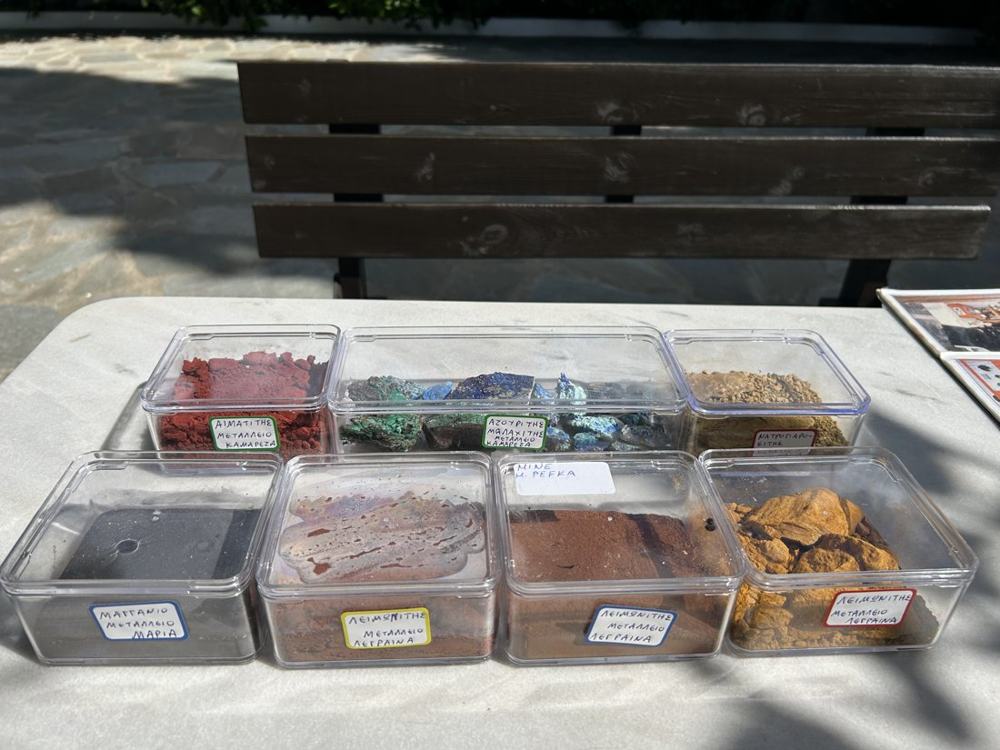
The pigment library, each box labeled with mineral and mine of origin. The boxes contain pulverised minerals:
hematite from Kamareza (deep red), azurite/malachite from Kamareza (blue-green crystals), natrochalcite (sandy ochre), manganese from the Maria mine (black), and three separate limonites from Legrena — a mottled iron-stain, a red-brown, and a coarse yellow-ochre.
See alsoManganese blackGT-01, UID 10
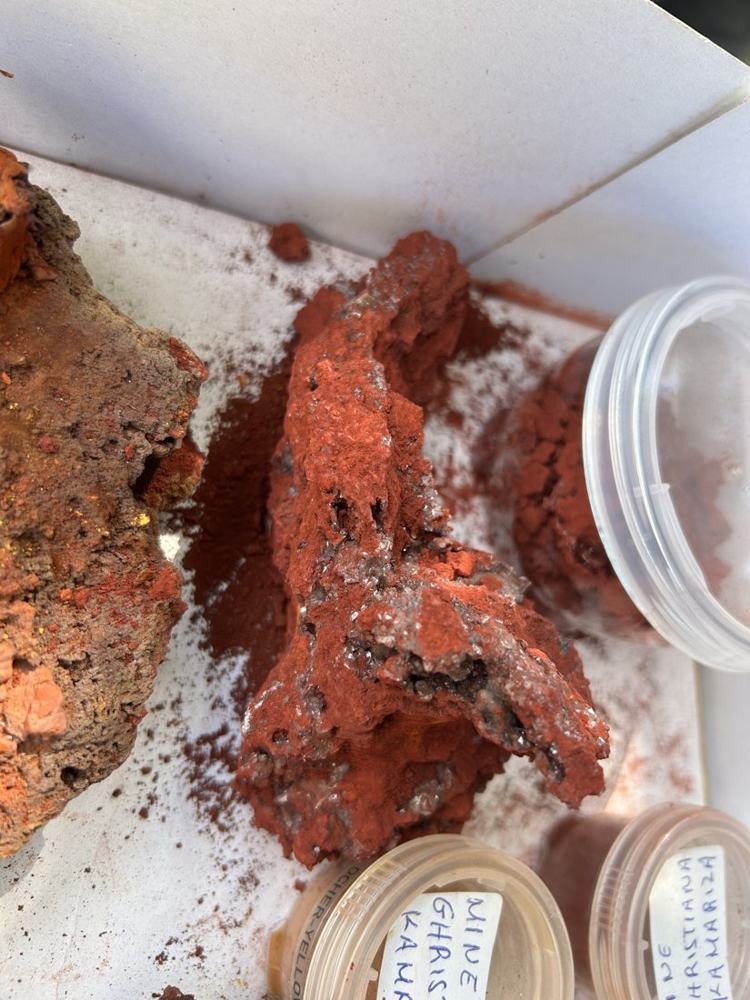
Close on the raw hematite before grinding.
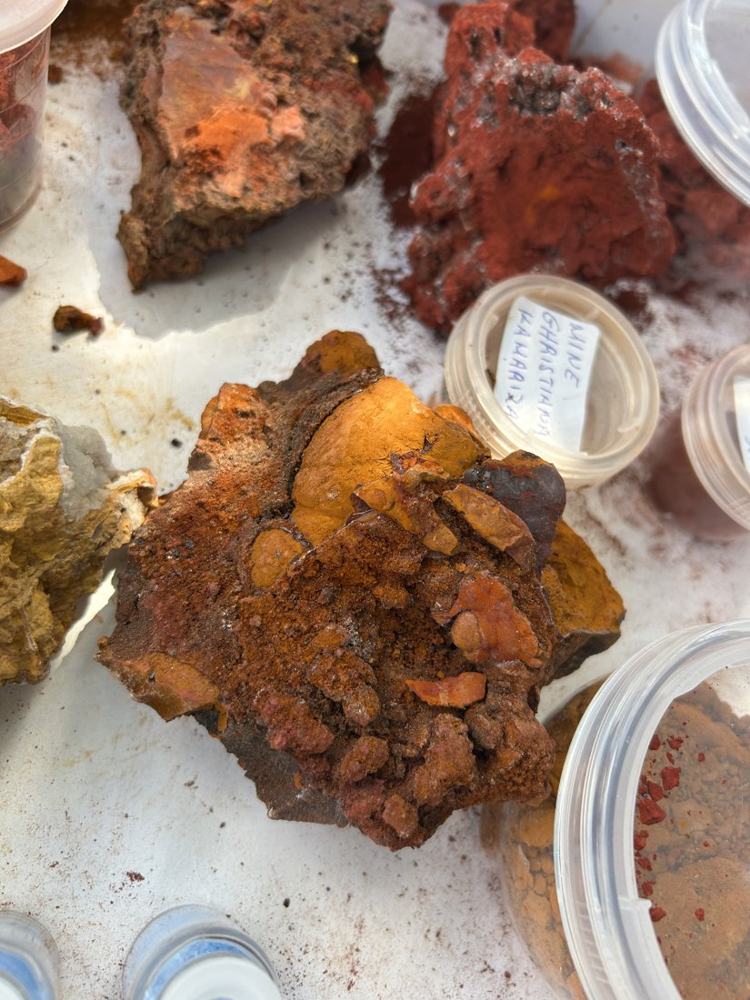
Goethite/limonite crust showing the full ochre range within a single specimen: yellow through orange to red-brown, over a darker iron core.
See alsoYellow ochreN1, page 0
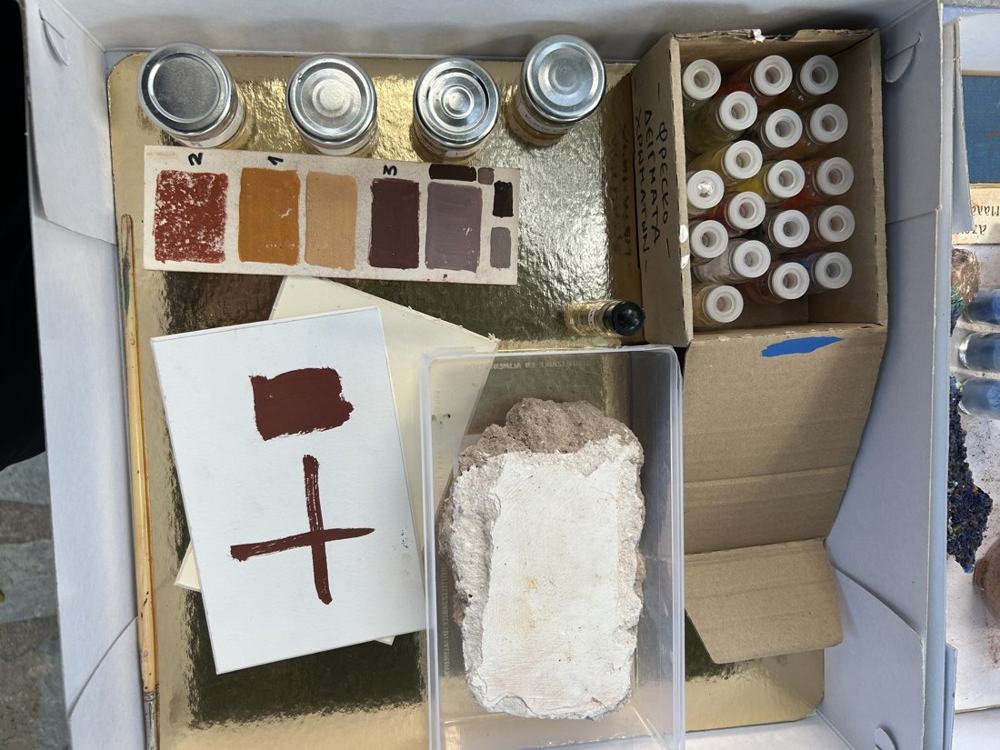
This is how the various minerals are used after grinding — applied as color in fresco decoration.
See alsoLichen on limestoneN1, page 77
→ Field collection of the same material: the collection map (azurite/malachite) · glaze recipes: NB-24 · contamination cross-reference: DOC-09. Transliterated mine and mineral names (Kamareza, Legrena, Natrochalcite) are read from the handwritten labels and are worth checking against a mineralogy reference.
The full soil collection dataset — 38 georeferenced points across four field days, June to October 2025. Dashed circles mark the initial areas of interest and functioned as a guide to locating the spot(s) of the soil collected, each drawn at a 350 m radius.
The georeference of the soil collection spot was made with Memento, with additional information attached to it such as type of sample ex. rock, soil, plant etc., color of sample, and date. The soil sample location is sometimes paired with photographs from the field, the photograph is attached.
Basemap: CARTO. Areas of interest can be toggled top-right.
Coordinates WGS 84, as recorded by the field GPS. Point IDs are the shapefile
UniqueId and are a separate series from the SC photo references. The data process was performed with QGIS.
Using clay as an added material in glazes is common practice. The experiments here follow the same logic: clay collected around Lavrion is added in a fixed ratio to a formulated glaze recipe. Because the soils vary in the ceramic colorants they contain, each one gives the fired glaze a different color.
Four initial tests take the collected soil directly into glaze at 10% by weight — the soil itself acting as the pigment — the same ratio across all four.
Knowing what pollutants and heavy metals the soil carried led the work toward a different method: chemical analysis, then replication of the colorants in a safe form.
Each tile is named for the survey point its material came from, so the fired result can be read back against the ground it was lifted out of — click a point number to find it on the map above.
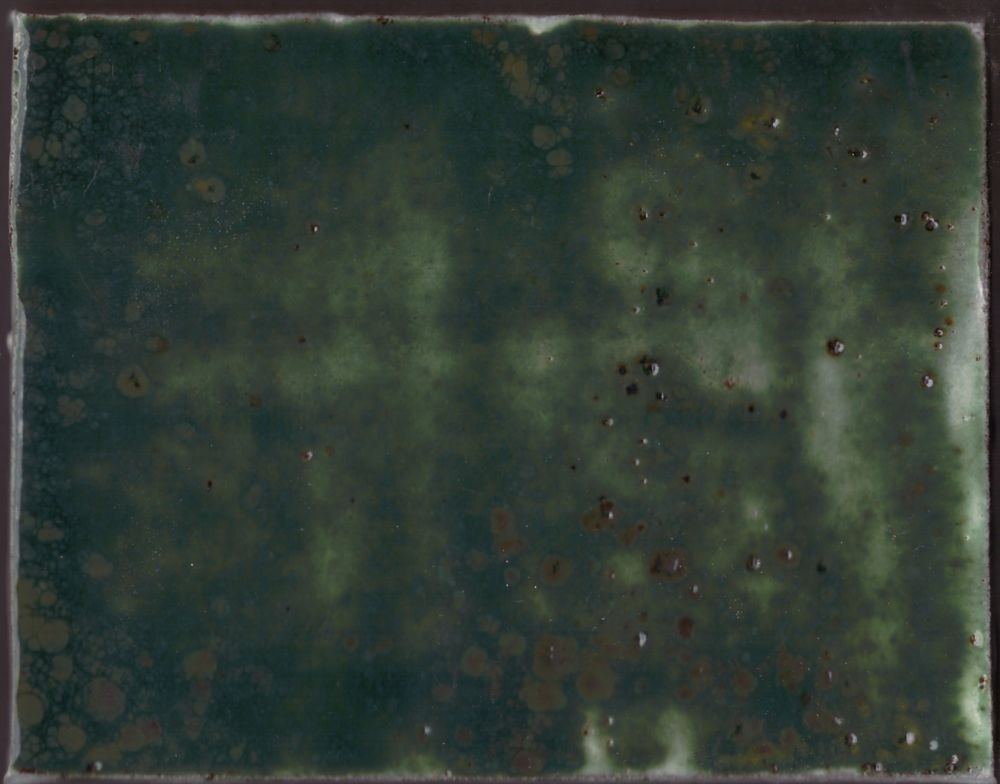
Fired from the material at Point 10, the one collection point recorded in the field simply as “stones — small and green.” That is the azurite and malachite also photographed at the collection map and boxed in MIN-01 and MIN-03. A deep glossy green-teal, pooling darker toward the edges, with rust-brown burst bubbles where iron impurities or high saturation of Copper (maybe the grain size has a role in this) blew through the melt and a band of fine crawling down the left margin.
See alsoSA-00 soil samples
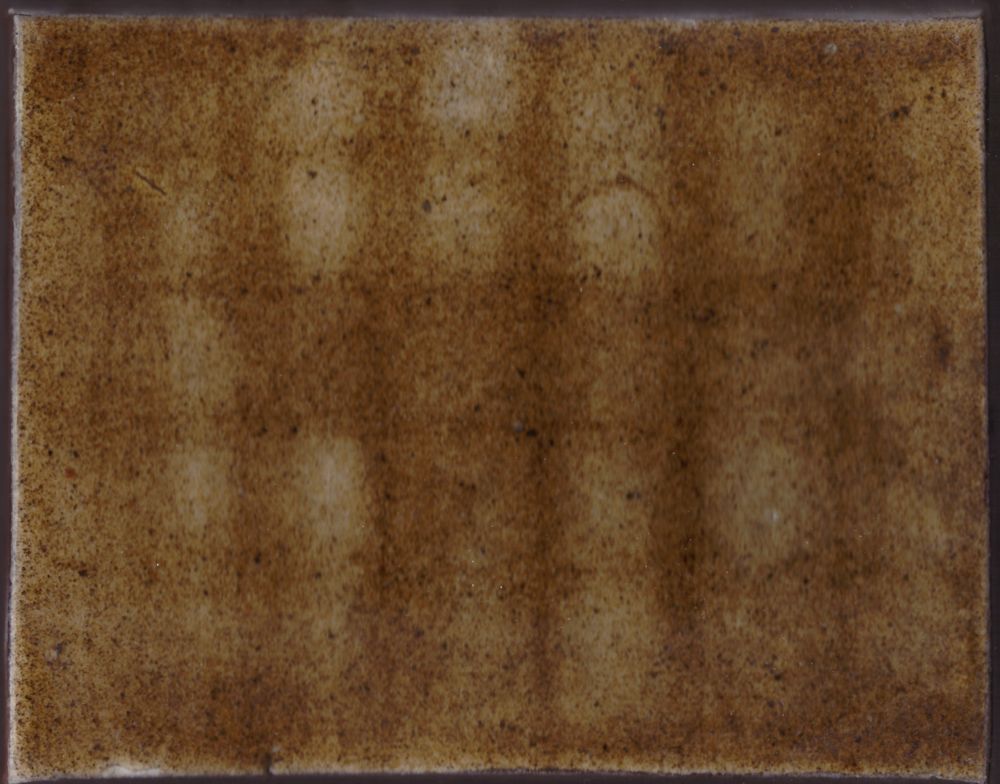
From Point 16, logged as ochre topsoil. A warm mid-brown semi-matte surface with heavy dark speckle and a distinct vertical banding where the wash was laid on. The largest color shift from raw material to fired result of the four.
See alsoSA-02, UID 16Sample pots
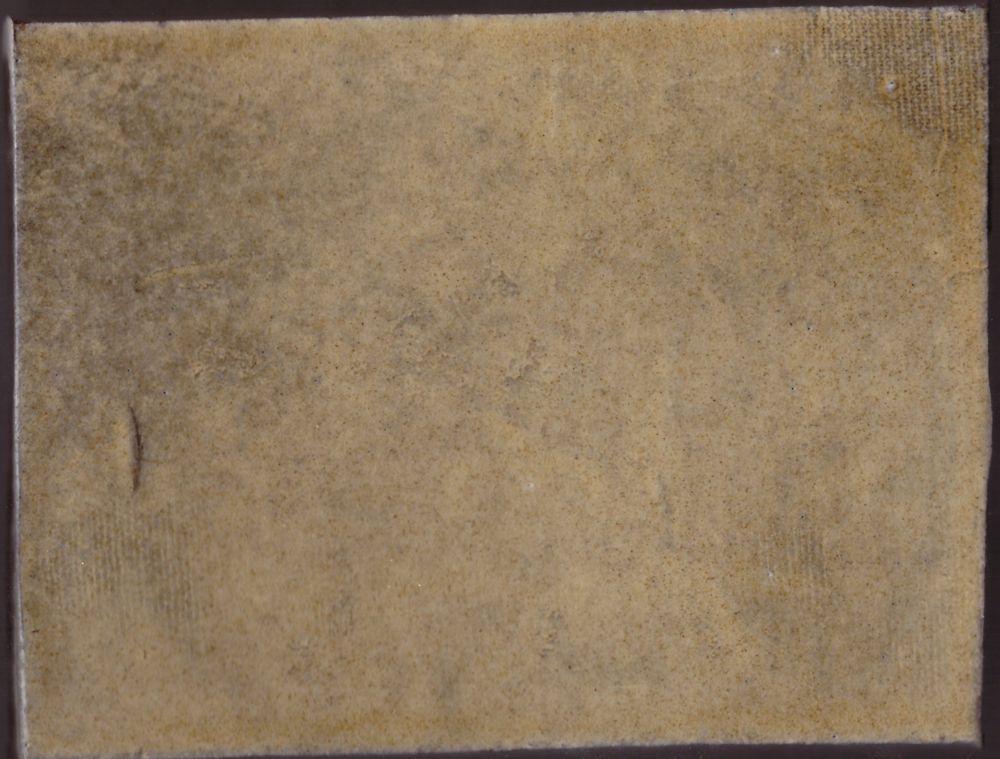
From Point 18, recorded as red ochre. It fires to a pale brown, far lighter than the raw material suggests.
See alsoRed ochreHematite mass
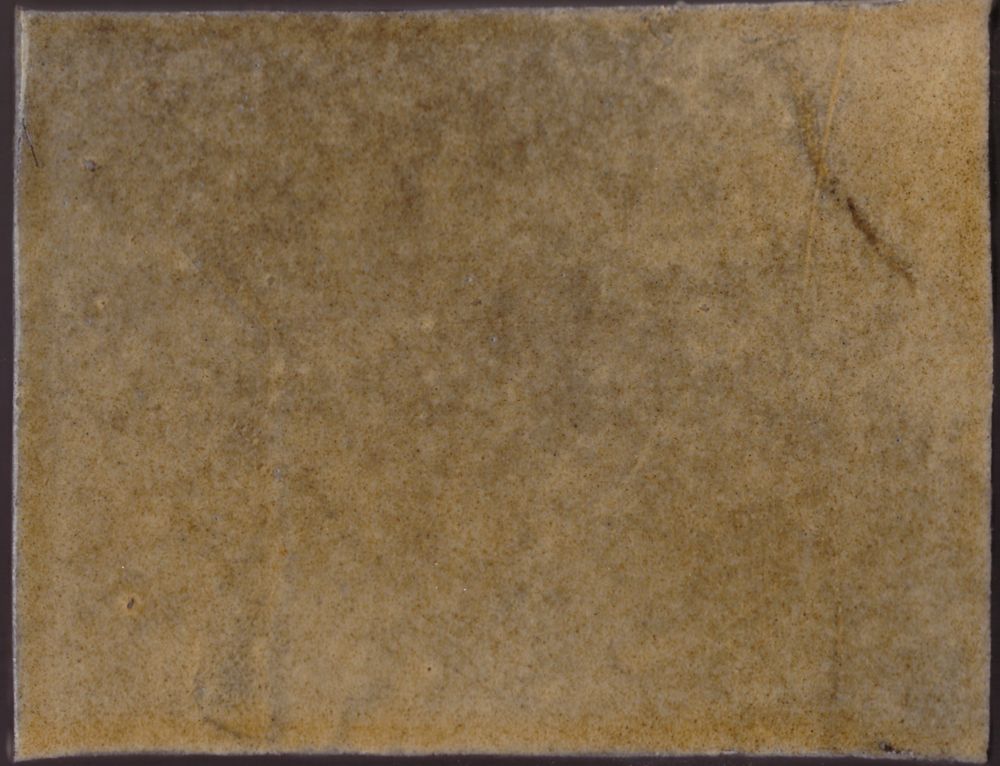
From Point 14, topsoil with small stones. A flat matte brown. Its parent sample was analyzed as SA-01 (UID 14).
See alsoSample pots
→ Raw material: Colorants · elemental composition of samples 14 and 16: Soil Analysis · collection points: interactive map. Samples 10, 14 and 16 were also selected for XRF; sample 18 was not, and samples 25 and 33 were analyzed but never made into tiles.
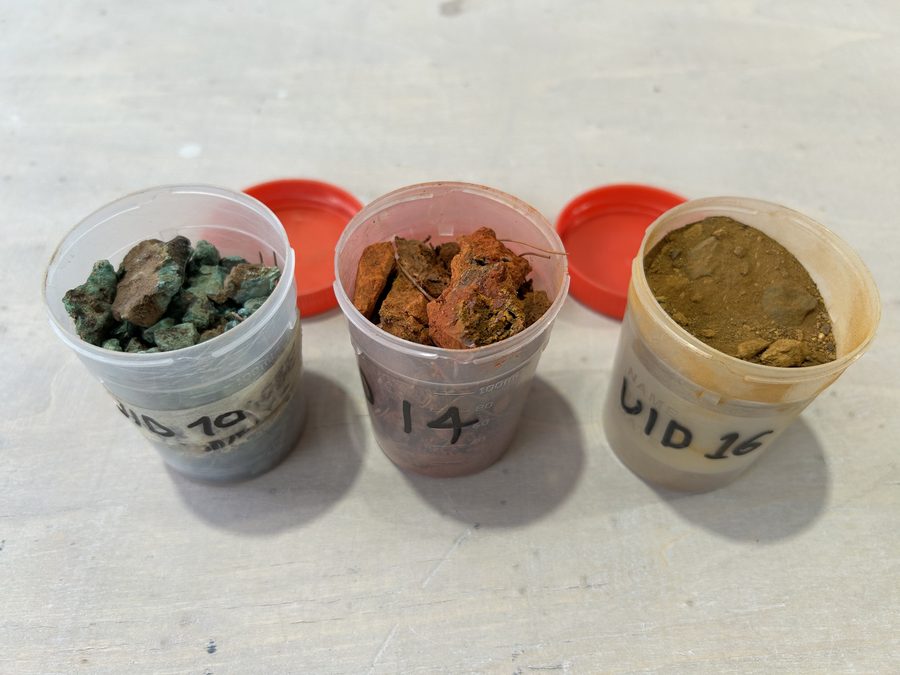
Samples collected during a walking survey of the Lavreotiki region, summer 2025. The distinct colors — teal-green (copper minerals), iron-red (hematite/goethite), olive-gray — are directly visible in the raw material, before analysis confirms the elemental composition.
See alsoSample potsGT-01, UID 10
The soil analysis was performed by the Directorate of Mineral Resources and Mining (ΔΟΠΜΕ) of the Hellenic Survey of Geology and Mineral Exploration (ΕΑΓΜΕ). The analysis used a Thermo Scientific Niton XL5 Plus handheld analyser, fitted with a 5 W X-ray tube (50 kV / 5 W, Ag anode) and a silicon drift detector (1 μm graphene window).
| Sample | Reading | Duration (s) | σ | Units |
|---|---|---|---|---|
| UID 14 | 1 | 120.19 | 2 | ppm |
| 2 | 120.04 | 2 | ppm | |
| 3 | 120.15 | 2 | ppm | |
| average | 360.38 | |||
| UID 16 | 1 | 120.05 | 2 | ppm |
| 2 | 120.14 | 2 | ppm | |
| 3 | 120.05 | 2 | ppm | |
| average | 360.24 |
The reference method followed is EPA Reference Method 6200, Field Portable X-Ray Fluorescence Spectrometry for the Determination of Elemental Concentrations in Soil and Sediment.
The dominant presence of iron (Fe) and elevated arsenic (As) and lead (Pb) reflect the region’s historic mining legacy. See the distribution of total arsenic (As) in overburden
Classification after the Digitalfire Ceramic Oxide Periodic Table. Hover a role to isolate it, click to lock one or more. Glass formers cannot appear here — XRF does not detect Si, Al or B.
SA-01 · UID 14 — Average readings 1630–1632
Ceramic roles (per ceramist periodic table):
See alsoPoint 14GT-04, UID 14Sample pots
SA-02 · UID 16 — Average readings 1634–1636
High S and Ca suggest limestone/sulfide geology. Elevated Pb and As connect to heavy metals research and impact on pollinators in urban environments.
See alsoPoint 16GT-02, UID 16Sample pots
Note: XRF does not detect light elements (O, Si, Al). 32 elements screened; 27 detected in UID 14, 22 in UID 16. Percentages reflect detected fraction only.
The elements detected in the Lavreotiki soil are, almost exactly, the constituents of the most notorious colours in European painting. Read as a contamination report the list is a warning; read as a pigment chest it is a palette. Each colour below is grouped by the element or element pair it requires, with the measured values from SA-01 UID 14 and SA-02 UID 16 set against it, and every historical claim referenced in the bibliography.
The oldest poisons in the paintbox. Both minerals occur where arsenic and sulfide ores weather together — the same association that puts arsenic in the Lavreotiki overburden.
The nineteenth century’s brilliant greens, and its most domestic poison. Both elements are present together in UID 14.
A brassy, almost metallic yellow, mined rather than manufactured. Roman writers including Vitruvius and Pliny call it auripigmentum. Effectively finished as a painter’s colour once chrome and cadmium yellows arrived.
ConservationReacts with copper- and lead-containing pigments to form dark sulfides, so treatises from Cennini onward advise keeping it apart — advice that analysis shows was not always followed. Photo-oxidises to white arsenolite, after which the arsenic migrates through paint and varnish.
UID 14 — As 0.47% · S 0.30%
UID 16 — As 0.18% · S 3.19%
Orpiment’s orange-red congener, found in the same deposits and routinely intergrown with it in hand specimens.
ConservationVisible light of roughly 500–670 nm converts it to yellow pararealgar — established by Douglass, Shing and Wang (1992) and found in paintings by Corbeil and Helwig (1995). Badly altered passages go yellow, then pale, as pararealgar degrades on to white arsenolite.
UID 14 — As 0.47% · S 0.30%
UID 16 — As 0.18% · S 3.19%
Made by Carl Wilhelm Scheele in 1775 and published in 1778, then adopted at once for paint, wallpaper and printed cloth — a yellow-green cheaper and brighter than anything before it.
ToxicityArsenical papers caused documented poisonings, chiefly through dust and flaking particles. The volatile-gas mechanism proposed by Gosio in 1891, and the overall death toll, remain disputed — Cullen and Bentley (2005) call the lethal-gas account an urban myth.
UID 14 — Cu 0.24% · As 0.47%
A cleaner, bluer green that largely replaced Scheele’s. The same compound was sold as Paris green and used as insecticide, fungicide and rat poison — deployed against the Colorado potato beetle from the 1860s.
NoteA pigment and an insecticide were one substance under two names — worth holding beside work made in collaboration with insects.
UID 14 — Cu 0.24% · As 0.47%
The one group the two published analyses cannot fully support, and the one closest to this practice, because it began as a glass and glaze colour rather than a paint.
The nineteenth century’s answer to lead white — the whites adopted because they were not poisonous. Zinc is in UID 14; barium in UID 16.
A colourant for glass and ceramic for at least three and a half thousand years, identified in Egyptian, Mesopotamian, Babylonian, Greek, Roman and Celtic material. It reaches majolica glazes around 1500 and oil painting only about 1600, peaking 1750–1850.
ProvenanceA kiln product for three millennia before it was ever ground as a paint — made at temperature, in the same register as the glaze work here.
UID 14 — Pb 0.25% · Sb not among reported values
UID 16 — Pb 0.26% · Sb not among reported values
Cooler and more transparent than lead white. Trialled at Dijon around 1780 and patented in Britain in 1796, but only commercially significant after Winsor & Newton’s Chinese white of 1834 and Leclaire’s mid-century process.
ConservationAdopted because it was safe to handle and did not blacken in sulphurous air. In oil it forms brittle films; zinc soap formation causes cracking, delamination and paint loss in severe cases.
UID 14 — Zn 0.52%
Barely a colour. Its refractive index of about 1.64 against linseed oil’s 1.48 leaves almost no hiding power, which is what makes it an extender. Barytes is the ground natural mineral; blanc fixe the precipitated grade.
AnalysisBarium in a sample is a routine marker for dating and for detecting adulteration in nineteenth-century paint.
UID 16 — Ba 0.06%
Zinc sulfide and barium sulfate co-precipitated into a single white, roughly 30:70, first sold in 1874 as Orr’s white — the two elements of this group combined.
NoteBoth constituent elements appear here, though in different samples — Zn in UID 14, Ba in UID 16.
UID 14 — Zn 0.52% · UID 16 — Ba 0.06%
Lead is present in both samples. In the history of painting it is not one colour but several, separated by how far the metal is taken and which crystal phase results.
The ground of European painting for two millennia. Made by the stack process: lead coils in porous pots over vinegar, the pots embedded in fermenting tanbark or dung for heat and carbon dioxide, over weeks to months.
ToxicityOccupational lead poisoning among colourmen and painters is one of the best-documented harms in the history of the trade.
UID 14 — Pb 0.25% · UID 16 — Pb 0.26%
A dense orange-red made by roasting lead white or litharge further. In classical Latin minium meant cinnabar; the name transferred to the lead oxide only in the medieval period.
ConservationDarkens to plattnerite or scrutinyite, or blackens to lead sulfide, or whitens by carbonation — which pathway dominates depends on binder, humidity, light and micro-organisms, and the mechanism is not fully understood.
UID 14 — Pb 0.25% · UID 16 — Pb 0.26%
The yellow phase of lead monoxide, a warm pure yellow, and a stage on the way to minium.
PracticeStill the standard lead flux in low-temperature glaze chemistry, where its low melting point does the work it once did for colour.
UID 14 — Pb 0.25% · UID 16 — Pb 0.26%
Massicot’s other polymorph, the two separated by a transition around 489–580 °C. Red as a mineral; as a ground pigment yellow to yellow-orange, slightly more orange than massicot.
CautionHistorical sources use massicot and litharge loosely and often interchangeably, so a name in a treatise is weak evidence for which phase was actually used.
UID 14 — Pb 0.25% · UID 16 — Pb 0.26%
The oldest and the safest of the colours here, and overwhelmingly the largest fraction of what was collected — iron is 59% of the detected material in UID 14.
Hydrated iron oxide, among the first pigments used anywhere. Natural yellow ochre is a goethite-dominated mixture rather than a phase-pure mineral.
LocalDocumented in the Pigments section — iron ochre from Kamareza, limonite from Legrena.
UID 14 — Fe 59.45% · UID 16 — Fe 43.08%
Yellow ochre with the water driven off: 2 FeO(OH) → Fe₂O₃ + H₂O above about 250 °C. Firing an ochre red is the shortest route from geology to colour there is.
CautionBetween roughly 300 and 800 °C the resulting red is almost independent of temperature and duration, so the shade cannot be tuned by firing alone.
UID 14 — Fe 59.45% · UID 16 — Fe 43.08%
An iron earth carrying manganese, which pulls it from red toward cool brown. The manganese content is what separates umber from ochre.
PracticeManganese is a primary drier, catalysing the crosslinking of oil films — which is also why umber-rich passages can grow brittle and crack early.
UID 14 — Fe 59.45% · Mn 0.09%
UID 16 — Fe 43.08% · Mn 0.08%
The black of cave painting. Analysis of Palaeolithic blacks finds a range of manganese phases — romanechite, hollandite, cryptomelane, manganite, todorokite, birnessite — with pyrolusite present in some samples but not dominant.
LocalManganese from the Maria mine is already in the pigment row. In glass it serves both as a decolouriser against iron green and, at higher loading, as a purple-to-black colourant.
UID 14 — Mn 0.09% · UID 16 — Mn 0.08%
Elements are not compounds. XRF reports which elements are present, not how they are bonded. Arsenic and sulfur in the same sample does not mean orpiment is in that sample. These pairings say the region contains the ingredients, not the pigments.
Percentages are partial. All values are fractions of the detected material only. Oxygen, silicon and aluminium are invisible to XRF, so these figures cannot be read as whole-soil concentrations, nor compared directly to regulatory limits without conversion.
Two samples, not a survey. UID 14 and UID 16 are two points from a walking survey of many. The absence of antimony from their reported values is not evidence of its absence from the region — 32 elements were screened and only the largest are published for each.
Swatches are approximations. Each colour is a rendered approximation of the historic pigment at full strength. They are reference marks, not measurements, and no substitute for a made sample. See the Pigments section for photographs of the actual local minerals.
This chapter follows the work as it develops rather than as it finishes — the tests, the mockups and the studio decisions that sit behind the finished pieces. The method is consistent across all of it: small quantities of clay applied by hand onto a central structure and built up in layers, mirroring the way a swallow or a mud wasp assembles a nest. Some surfaces are cast directly from things the landscape had already worked on; others are made to be colonised. The soil analysis and the ground pigments feed straight into this stage, and the contamination map below is part of the same working knowledge — it is why the material is handled the way it is.
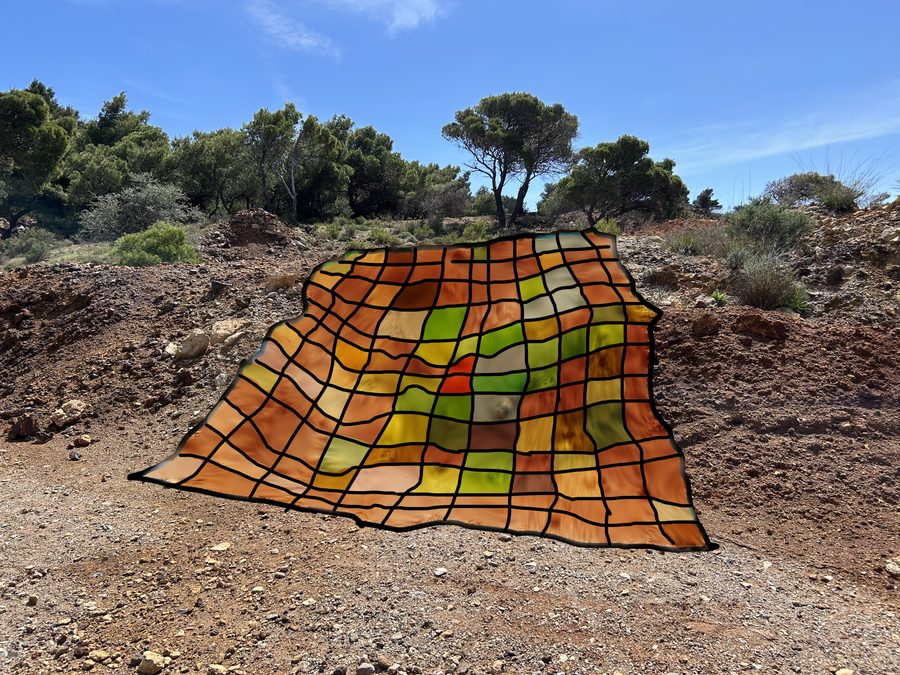
Mockup of the proposed Tiles work for 2026 — a glass grid work placed in the Lavreotiki landscape. The grid references the GIS sampling system; the colors derive from the soil pigment analysis. Visualised in situ against the iron-red Attic terrain.
A ceramics glazed surface that is meant to protect and provide housing to insects.
→ Links: GN-03 (soil sampling/chromatologio) · SA-01 UID 14 · SA-02 UID 16 · GN-01 (glass/toxins)
See alsoCollection mapCollected specimensPlain glass — the controlN1, page 32
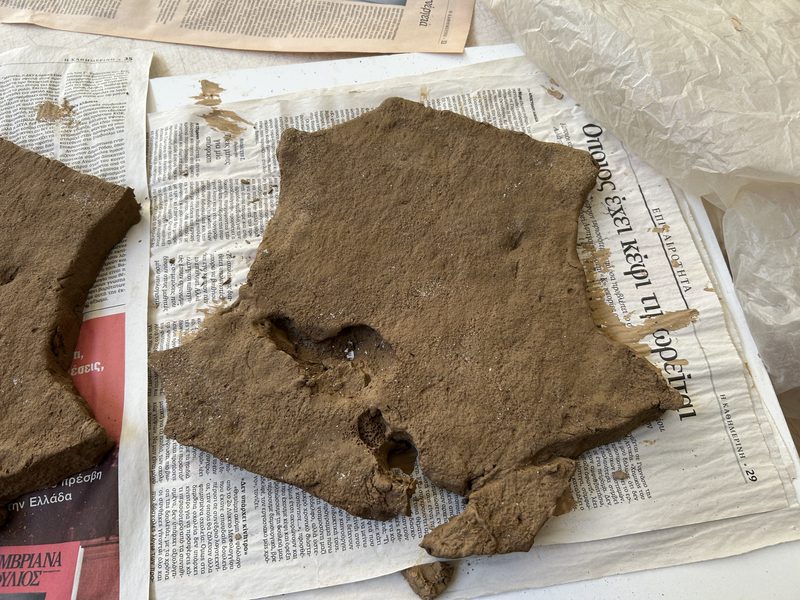
Cast from polyurethane foam found on a beach, corroded by weather and insects. The insect voids are preserved in clay. Literal co-authorship between the artist and the natural world — the weather, the insect are co-makers.
→ Links: GN-02 (bee/insect collab) · EX-03 (collaboration) · EX-07 (disconnection) · GN-04 (building blocks)
See alsoEroded sandCut pineEX-01
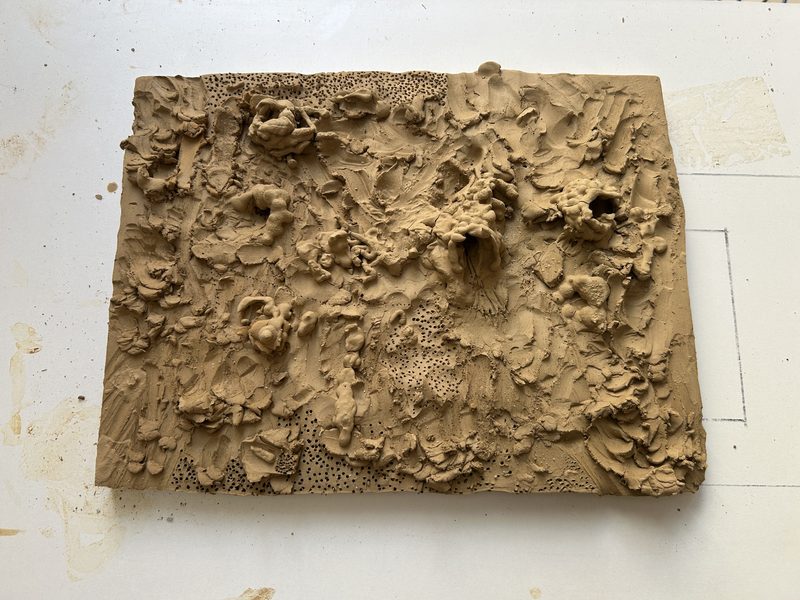
Emulates the movements and nests of insects. A dialogue between found perforations (insect-made) and hand-applied clay lumps (artist-made) — additive and subtractive processes intertwined. Connected to the Tiles idea.
→ Links: GN-02 (bee/insect collab) · GN-03 (plates) · EX-03 (technique) · PR-01
See alsoWasp-colonised rockDrill base plateBored woodN1, page 64
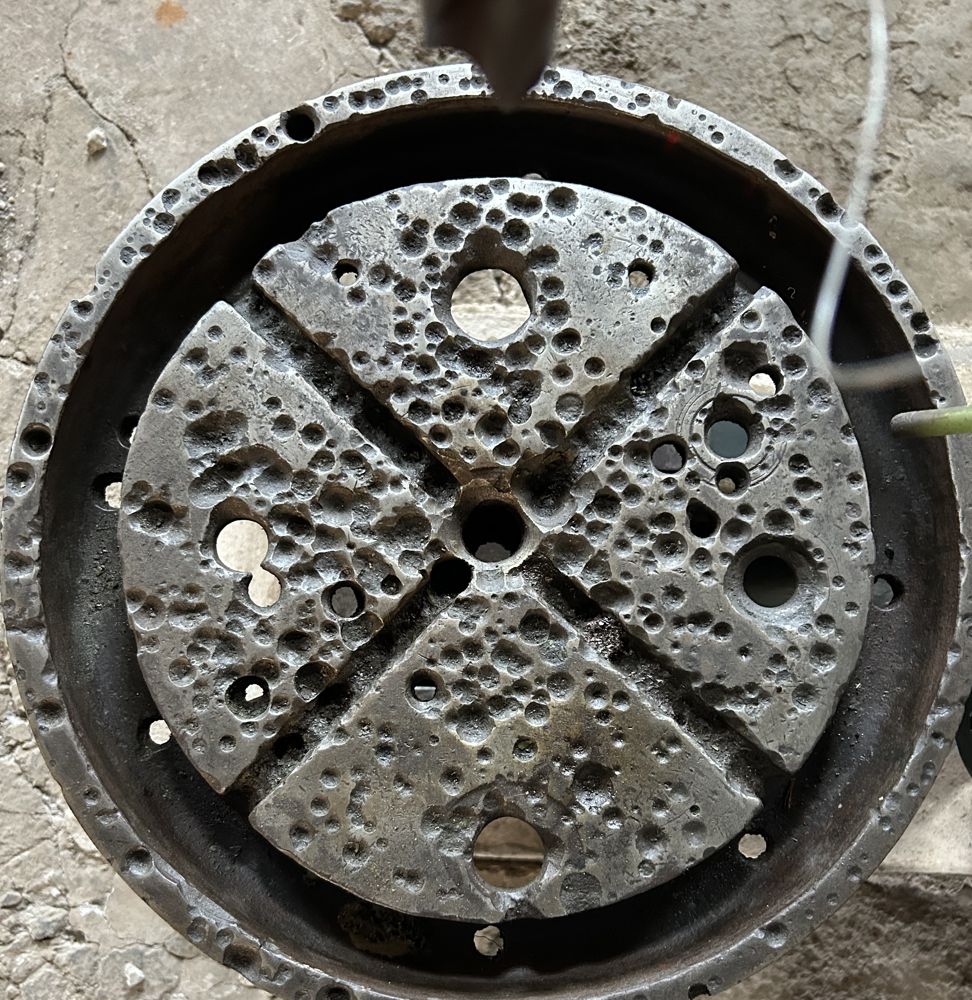
Metal shop, Lavrion. A four-jaw chuck seen from above, every surface — jaws, body and outer rim alike — pitted with hundreds of drill marks at varying diameters and depths. Decades of repeated, purposeful boring recorded on a single face. Set against the bored wood and stone below, the point of the observations becomes visible rather than asserted: the drill and the insect leave the same kind of mark.
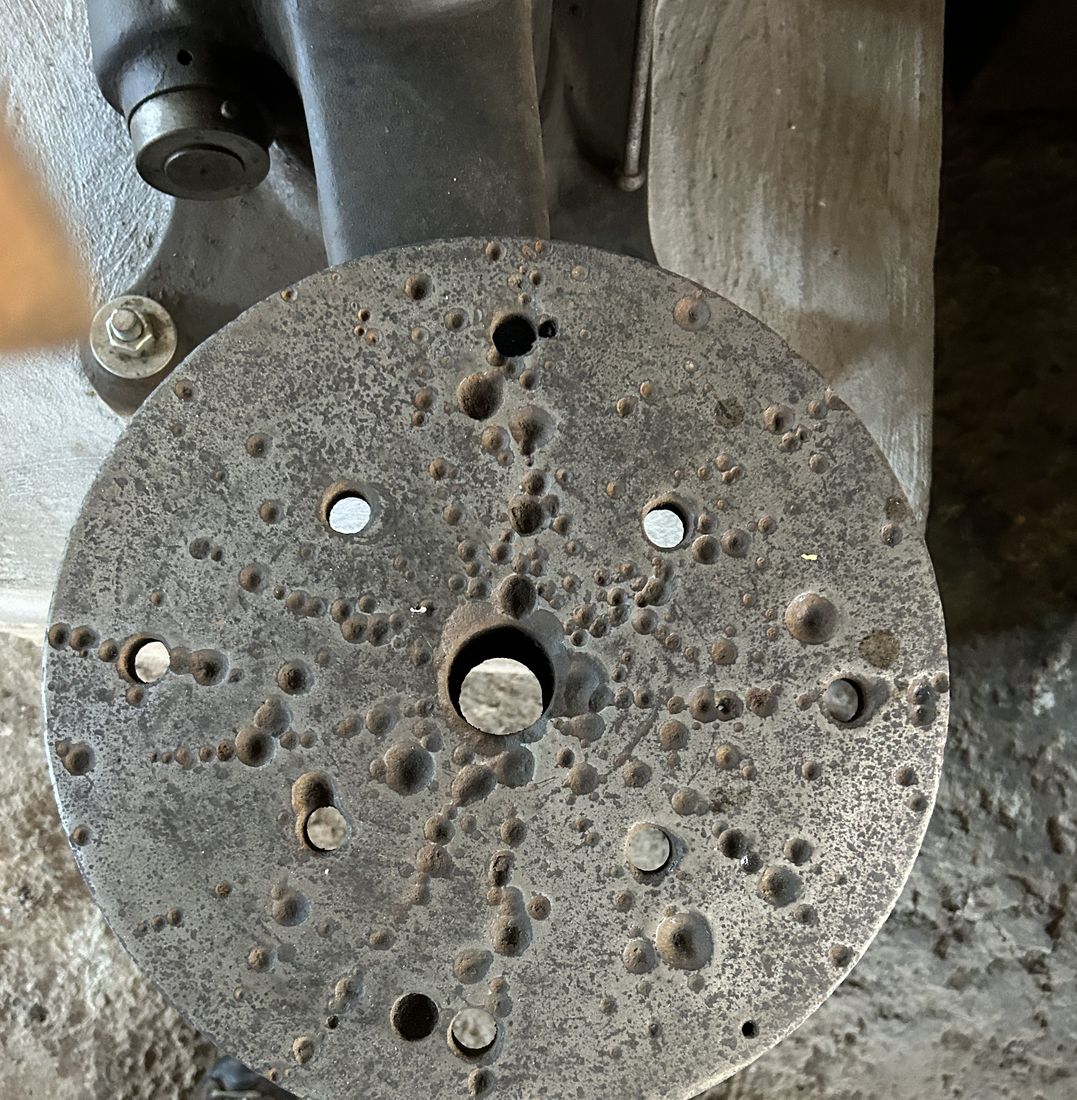
The flat steel table beneath the chuck, photographed the same day. Its whole face is pitted with bore marks at every diameter, overlaid by radiating scored arcs where workpieces have spun against it, around a central through-hole and a ring of location holes. The chuck records the boring; the table records everything that was bored on it. Two surfaces of one machine, both keeping the same account.
See alsoDrill base platePerforated wall
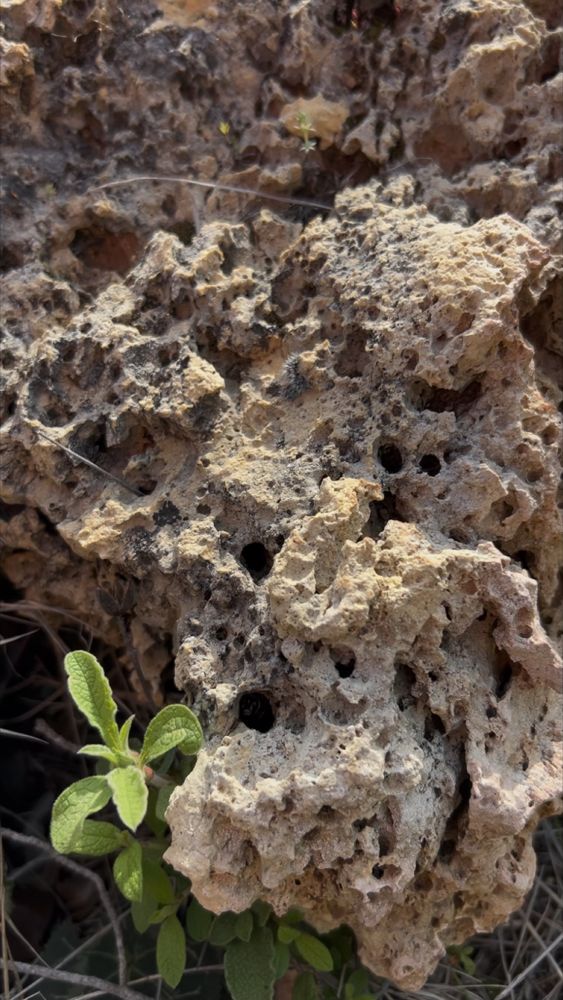
Pale calcareous rock worked at two scales: fine pitting throughout, and a scatter of larger round bores roughly a centimeter across where wasps have colonised the stone. Some of the finer texture is solution weathering in the limestone; the deep round holes are the building. The same behavior as the drill plate, in a different substrate.
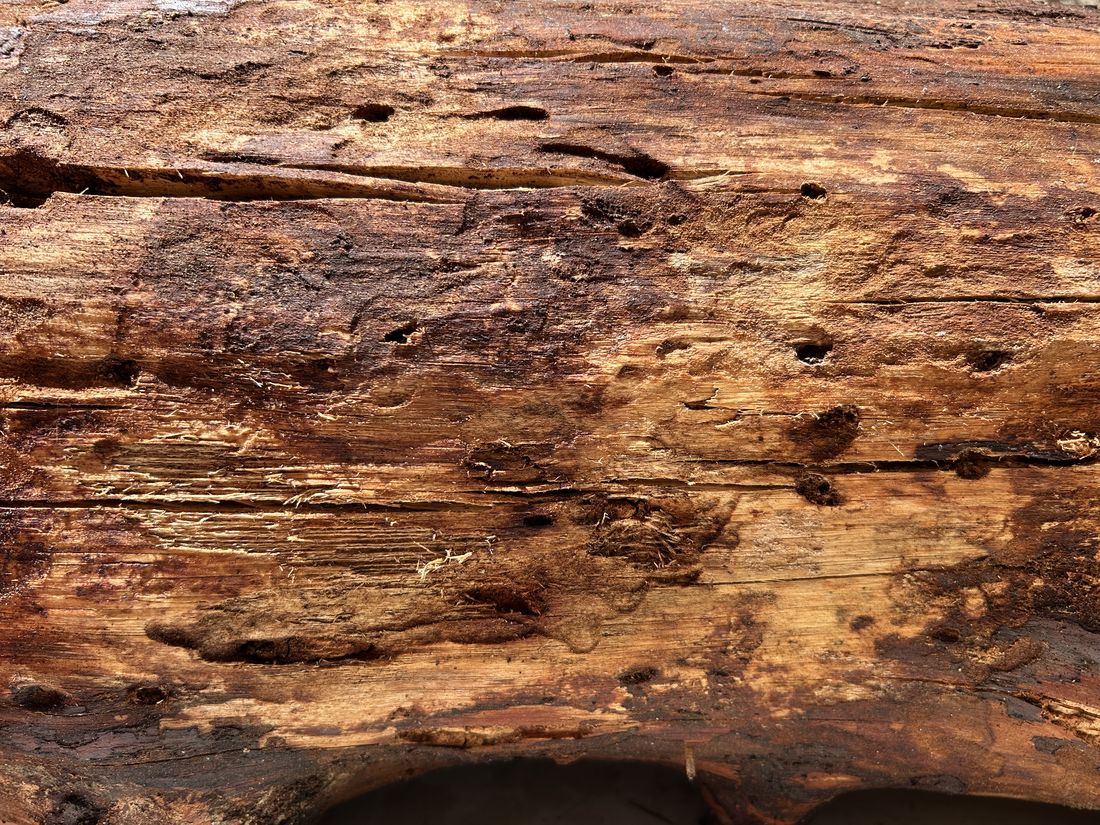
A split length of weathered timber, the soft summer growth eaten away to leave the harder bands standing in ridges, and a scatter of round exit holes driven clean through the grain. Wood does not resist boring the way stone does; the same behavior that leaves a shallow pit in limestone leaves a tunnel here. The insect works to the material, not against it.
See alsoCut pineResin, the cut
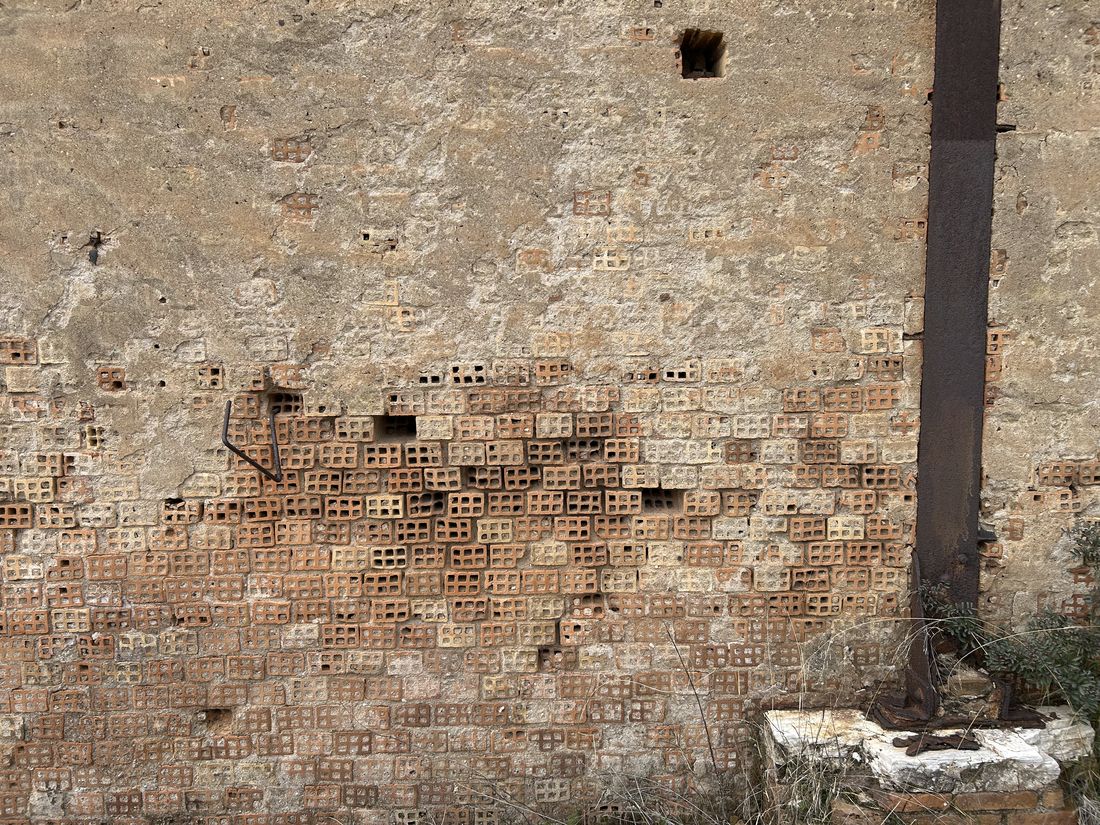
Render fallen away over the lower two-thirds of a wall to expose hollow extruded brick beneath, so the face reads as several thousand small rectangular voids in rough courses. A rusted post runs down the right; three or four deep isolated holes survive higher up where the render still holds. The same accumulation in an industrial register — voids in their hundreds, made by manufacture rather than by boring, and visually indistinguishable at a distance from comb.
See alsoComb eaten by wax mothDrill tableBedded limestone face
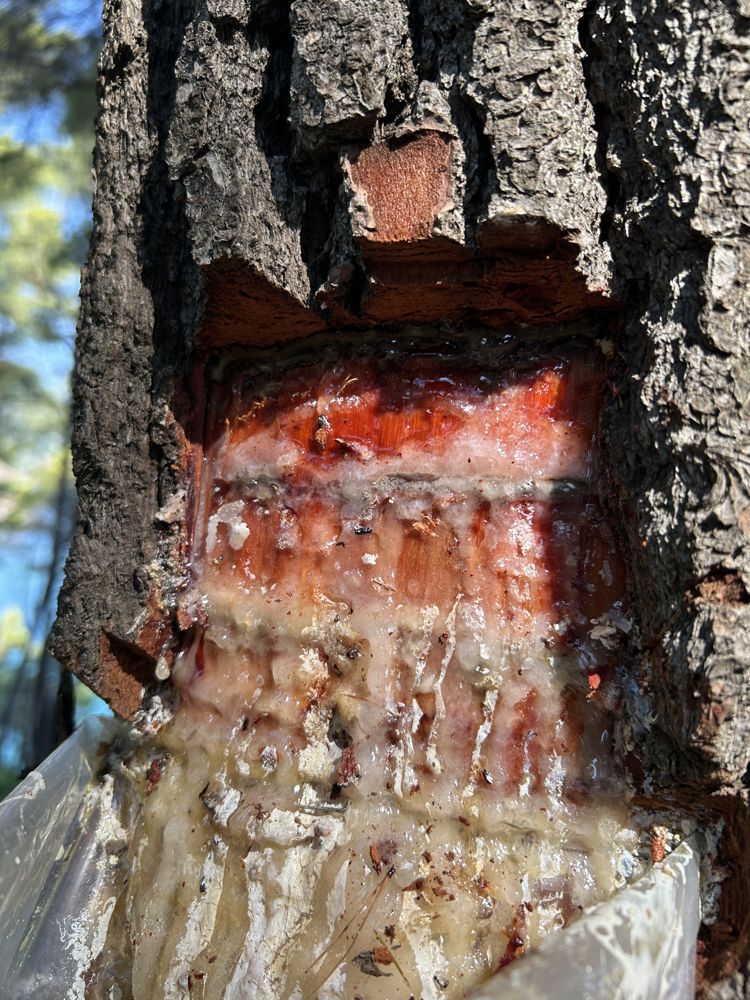
A rectangular window chopped through pine bark to expose the heartwood, banded in horizontal axe strokes, with fresh resin running down over it into a collection bag. Human subtraction and the tree’s additive response on one surface — the incision echoing the glaze bands of NB-24, the hardened ridges reading like coiled ceramic construction.
See alsoThe weathered faceCut pine
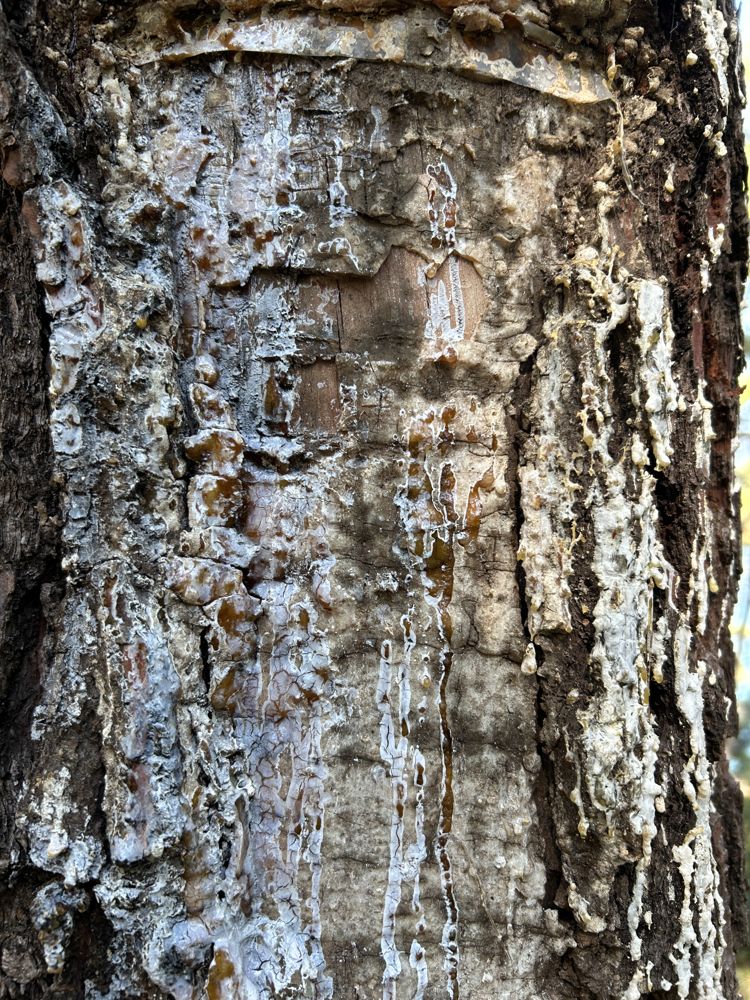
The same practice years on: resin dried to white and amber crusts running the full height of the trunk in vertical ribbons, accumulating over the cut rather than healing it. The amber-gold is close to the WK-01 gold lustre.
See alsoThe cutCoil-built forms
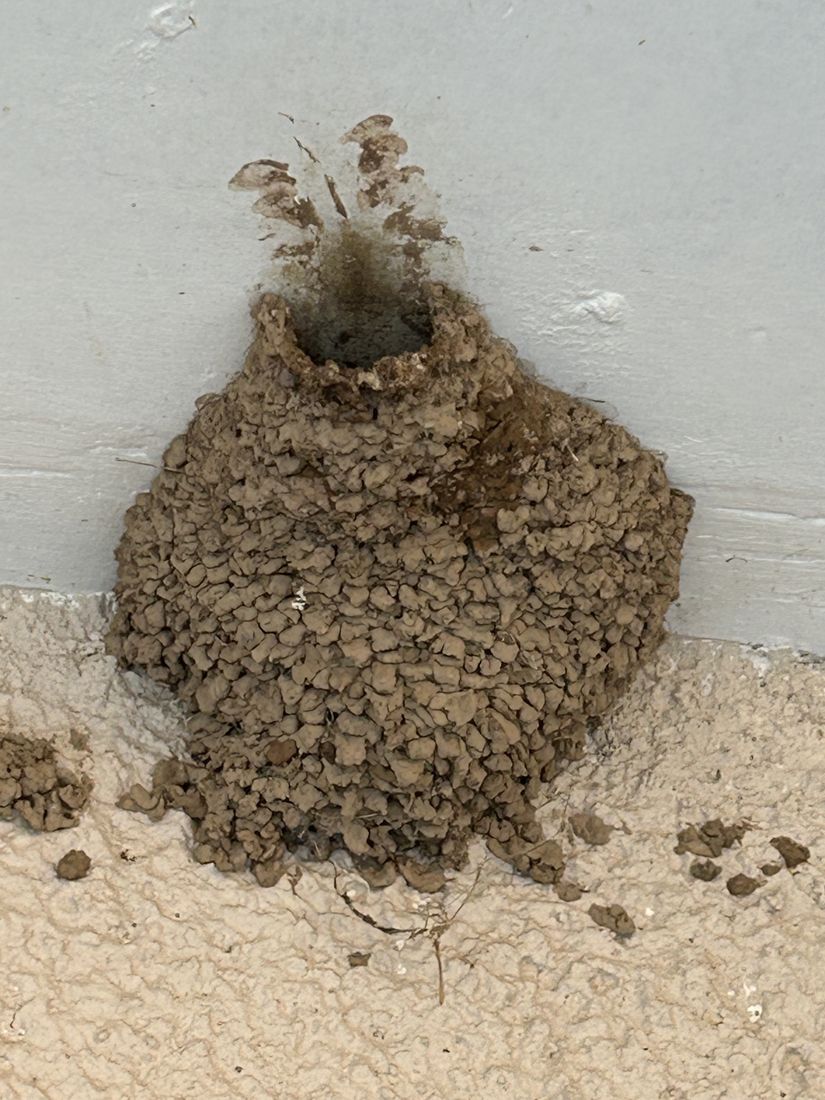
Built into the angle where a rendered wall meets a painted beam, from several hundred individual mud pellets — each one a separate beakful, pressed on wet and left proud, so the surface reads as aggregate rather than render. A narrow entrance at the crown with feathers and dry grass worked into the lining; loose pellets on the ledge below and a second start abandoned at the left. This is the method the studio practice describes: small quantities applied by hand onto a central structure and built up in layers, with no armature and no smoothing.
See alsoCoil-built landscapeHoneycomb on a clay barSwallow nestN2, page 81
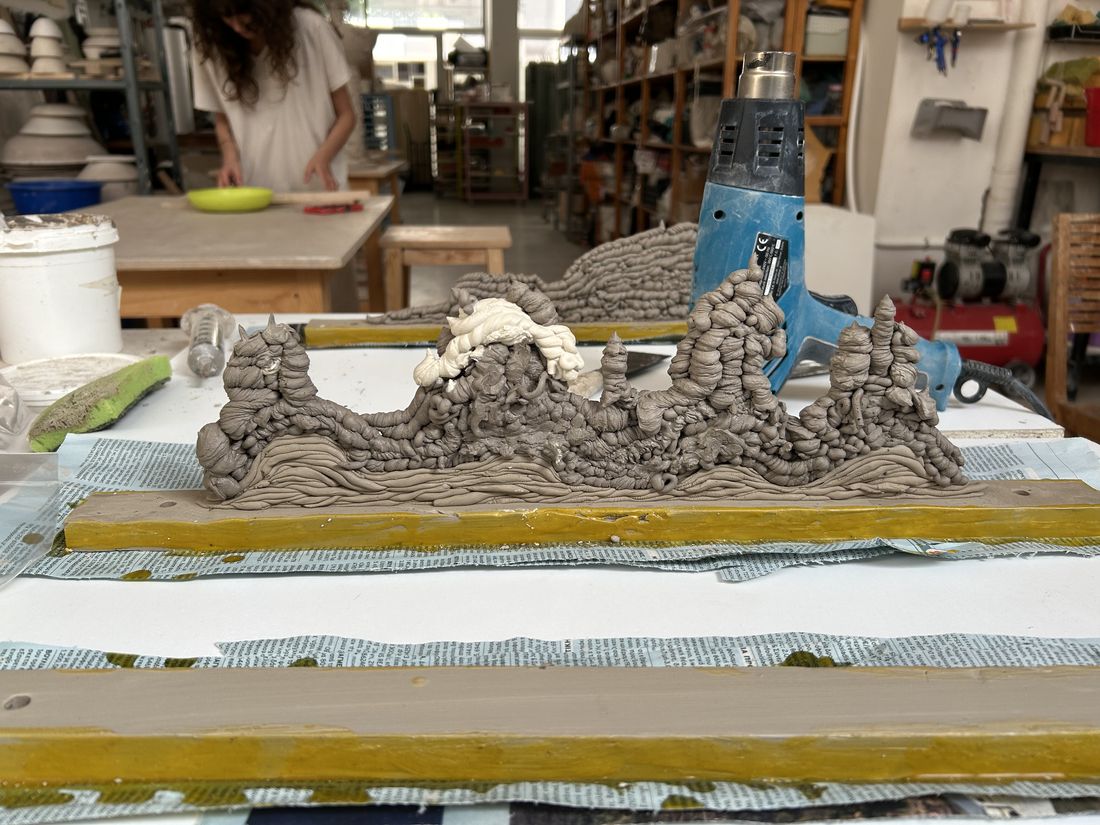
Gray clay laid coil on coil on a plaster batt, taped off along a straight datum line, with the ridges rising and dropping into a saddle. Each course is left legible; nothing is blended into the one below. Photographed mid-build, the heat gun still in frame — the drying is part of the construction, since each course has to firm before the next will stand on it.
See alsoCoil-built forms, driedMud nestEroded faceWorked slab, from above
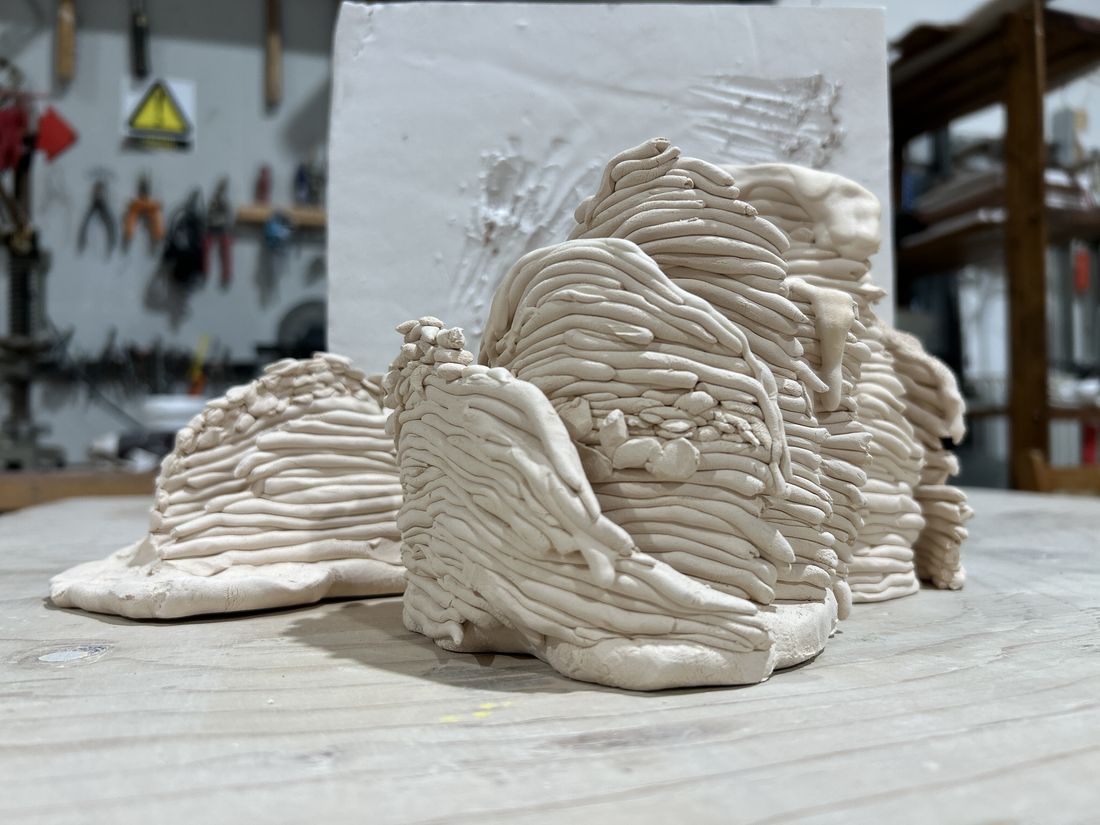
The same method in white clay, several masses stood together on the studio table: long coils laid one on another, unsmoothed, with clusters of pebble-sized lumps pressed into the flanks. The form mimics the shape of the bees comb.
See alsoIn progressEroded sand
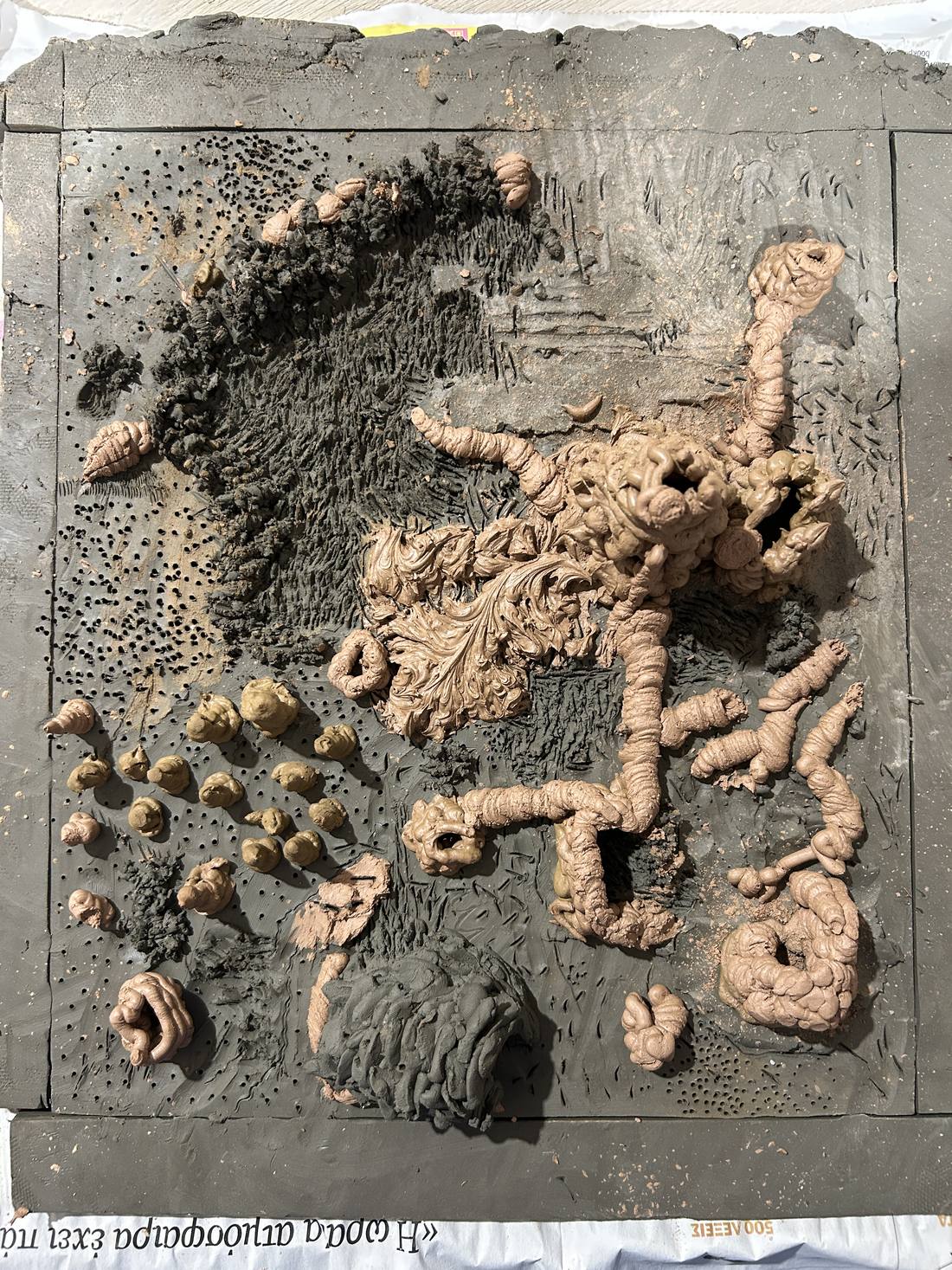
A grey slab seen square from above, the whole surface worked: fields of pin-holes, combed and scored passages, a row of small tan spirals like a colony of snails, and a mass of coiled tubes crossing the middle with open mouths where they end. Two clay bodies — the grey ground and the pale coils on it — kept unmixed, so what was built reads apart from what it was built on. Photographed wet, in direct sun. The plan view does what the ground-level views cannot: it shows the piece as a map.
See alsoIn progressDrill base plateArsenic distributionN1, page 73
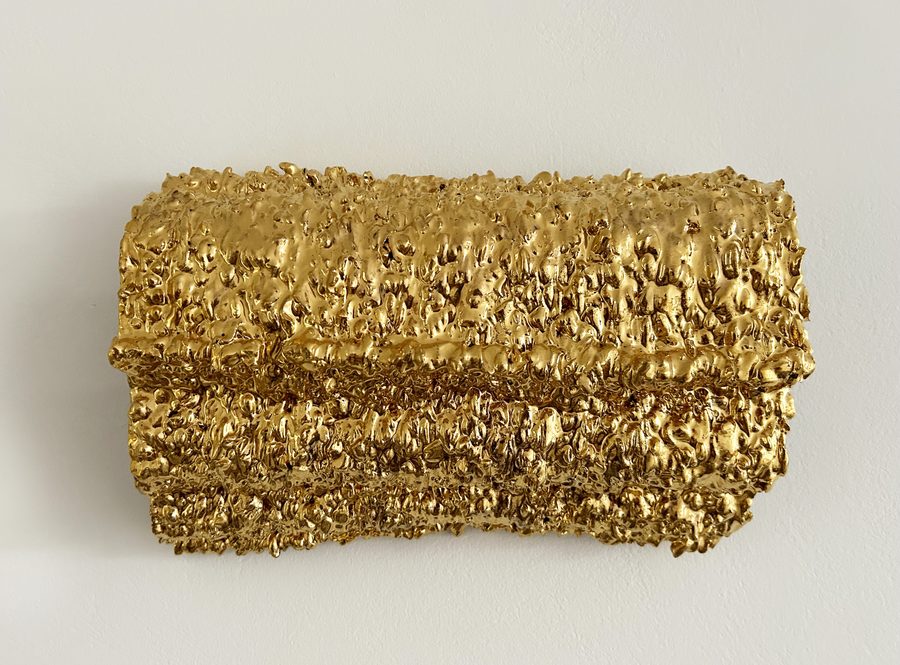
Swallow nest, 2024. Ceramics.
Dimensions 36 × 27 × 14 cm.
Built layer by layer, small quantities of clay applied incrementally with one hand, mirroring the nesting behavior of swallows and mud wasps. Finished with a gold lustre applied over a glaze. The finished work, set here among the things it is made from: the mud nest, the comb, and the coil-built forms at the stage before firing.
See alsoMud nestCoil-built formsCoil-built landscape
Photo courtesy of the artist.
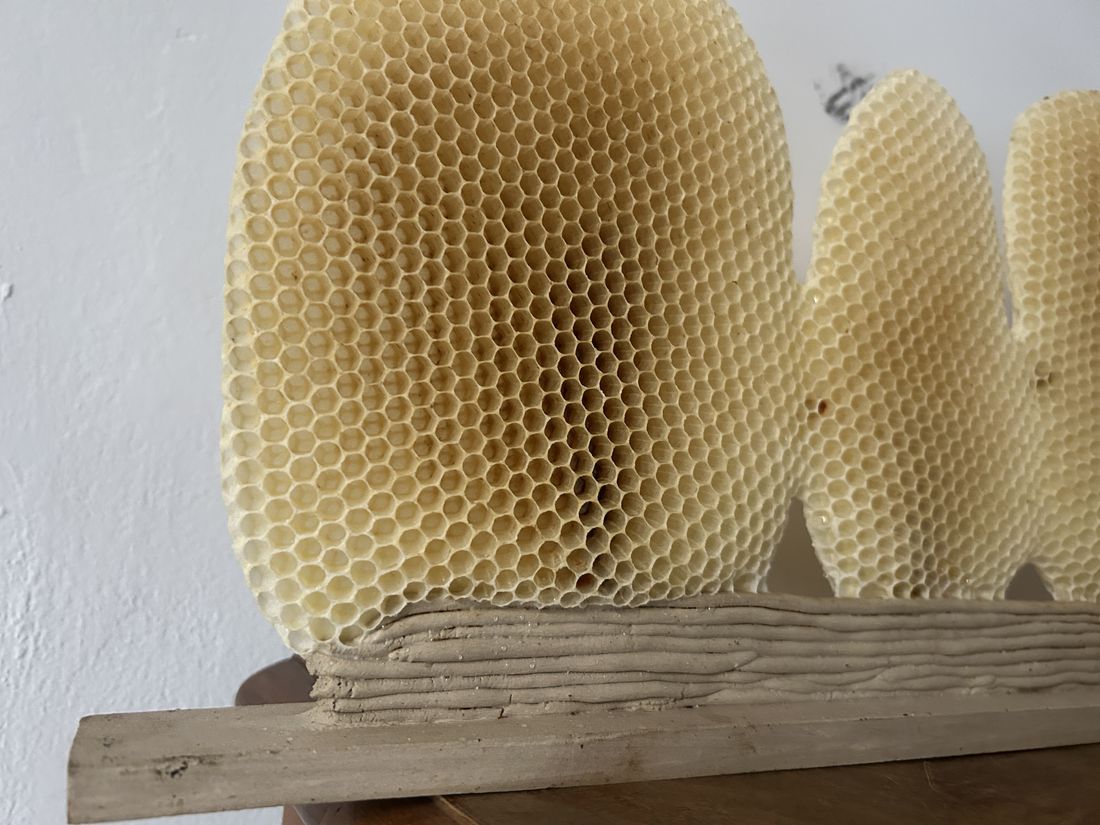
Beeswax comb — three or four ovoid combs drawn down side by side — built directly onto a hand-coiled clay bar. The coil lines and finger pressure in the clay are clearly visible along the underside, with fresh honey beading where the two meet. The support is artist-made and the bees accepted it; what they built on it is entirely their own. Collaboration here means offering a surface, not a plan.
See alsoWild comb in a hiveN1, page 24N1, page 29N2, page 81
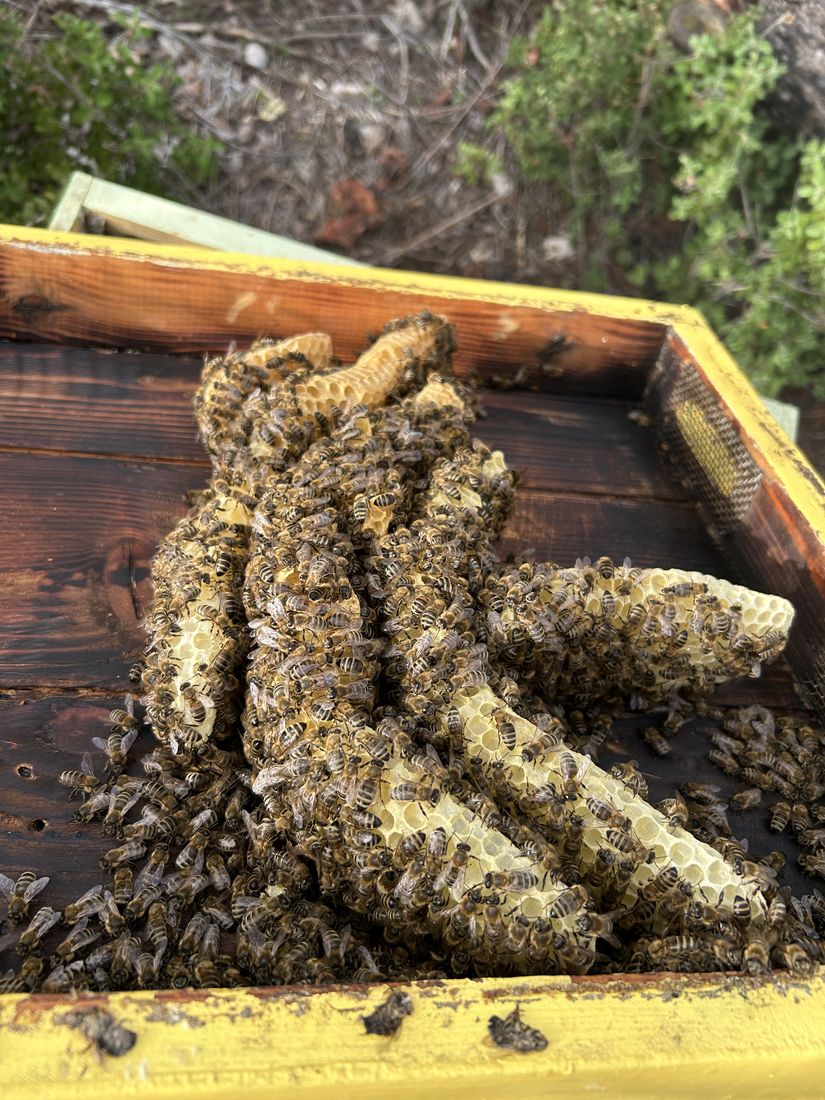
Looking down into a hive box: bees covering pale comb built freely across and between the frames, several tongues hanging in irregular ovoid shapes rather than in the flat sheets the frames intend. The counterpart to the clay bar — here the support is the beekeeper’s, and the geometry offered is refused just as readily. The bees take the structure and ignore the drawing.
See alsoHoneycomb on a clay barComb eaten by wax mothN1, page 21
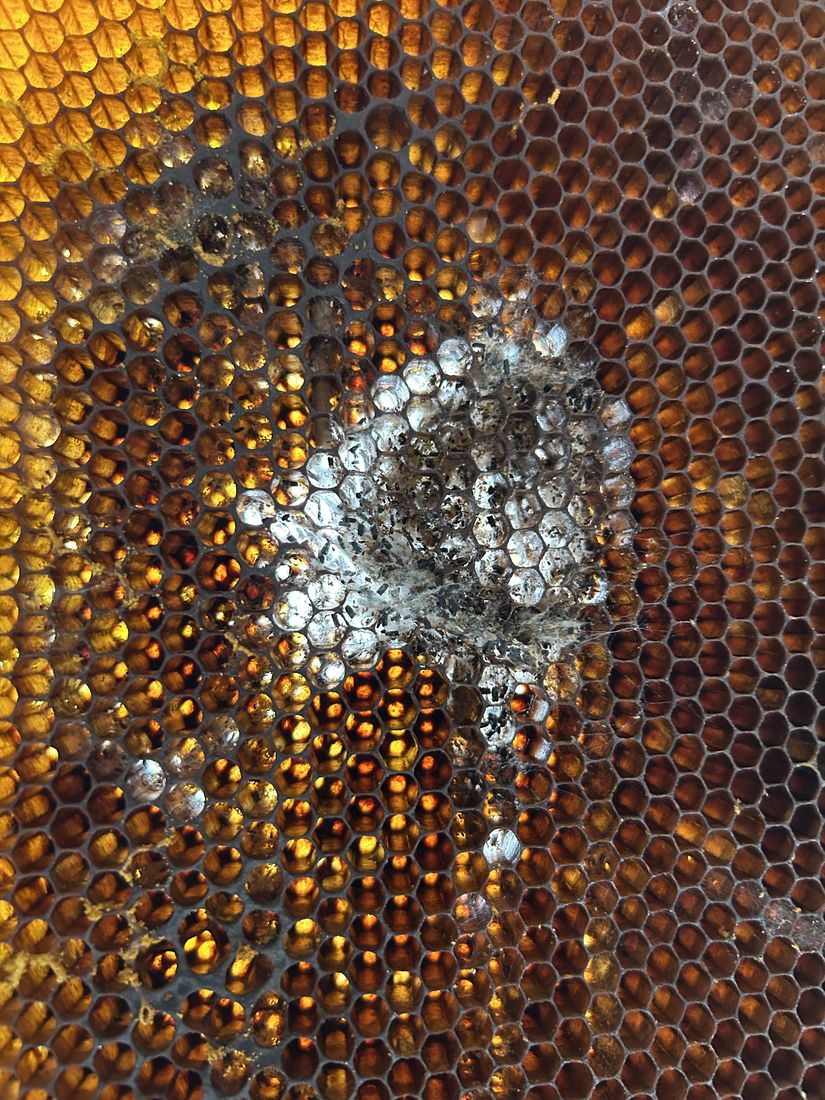
Comb at close range, the wax reading amber yellow. The hexagonal order is not drawn out in advance; it is what results when many small deposits are made adjacent to one another under even pressure. The same logic as the pellets, the coils and the dabs — order as a by-product of repetition. The gap in the center is the work of wax moths eating the wax of the comb.
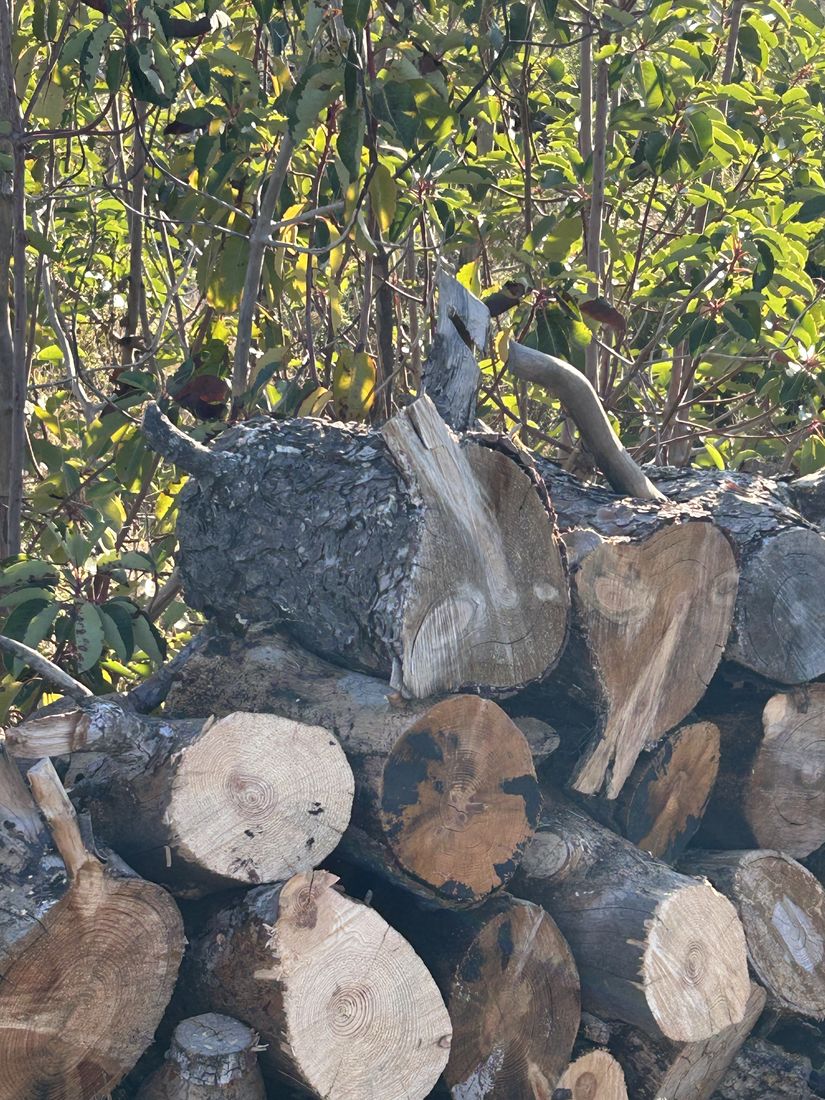
Felled and cross-cut pine stacked against evergreen scrub, every sawn face showing concentric growth rings, sharply legible on the fresh cuts, with heavy dark staining spreading irregularly from the center of several. One round at the top still wears its plated bark, a cut branch stub and a bare limb rising out of it. The rings are an accumulated record too — but of time, laid down by the organism itself, with no maker at all. It also closes the resin sequence above: the same species, at the other end.
See alsoResin, weathered faceEroded face
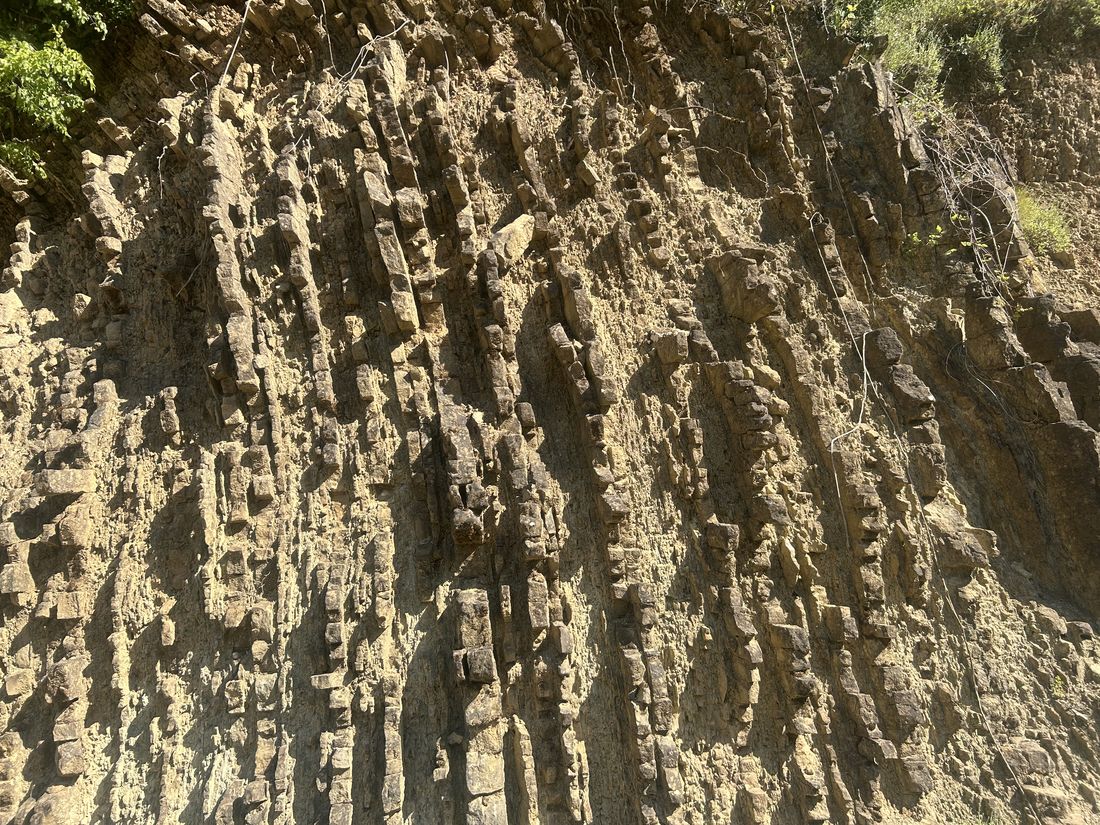
A near-vertical bank of soft sediment cut into close parallel rills by run-off, the harder bands standing proud between them, scrub holding on at the crown. Nothing has bored this and nothing has built it; water has removed material along the lines of least resistance and left a fluted surface indistinguishable, at this scale, from a made one.
See alsoEroded sandCoil-built landscapeBedded limestone face
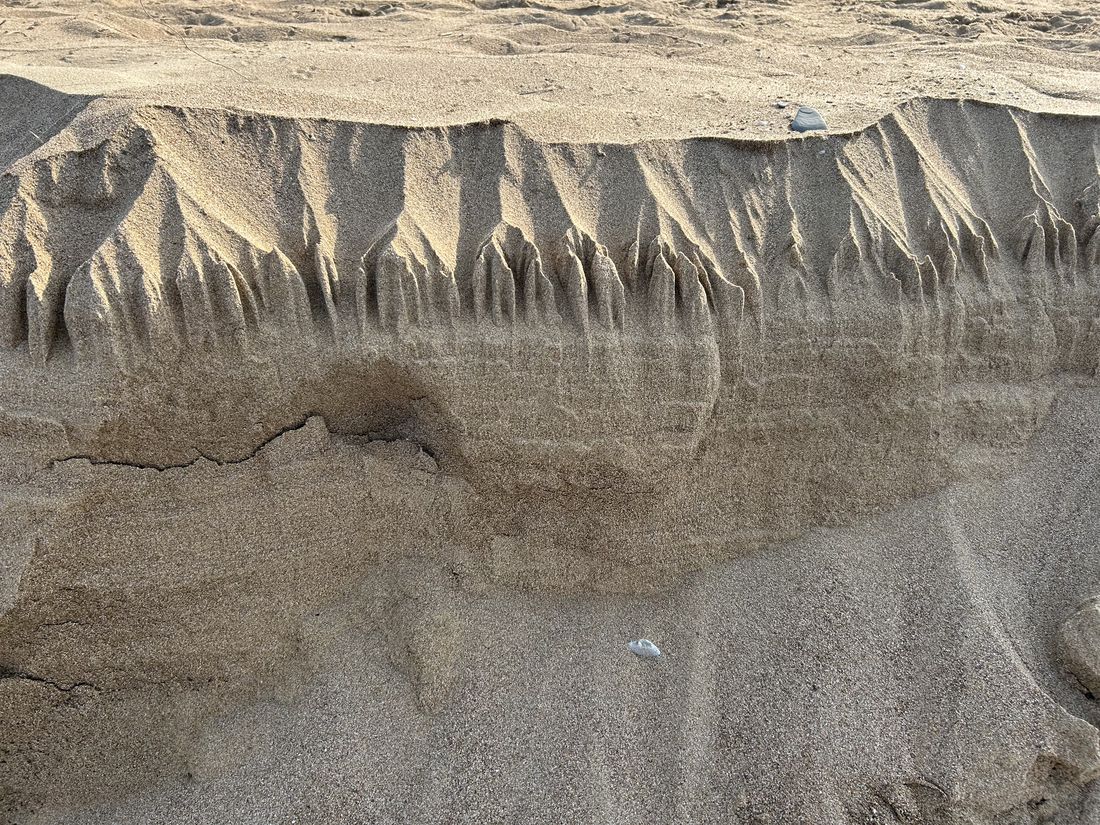
The same process in miniature at the top of a beach: a meter of cut sand bank fluted into vertical channels, with the tide-worked surface below cutting across them at an angle. Two different rates of removal meeting on one face. Read next to the coil-built forms, the resemblance is uncomfortable and deliberate — addition and subtraction arrive at the same silhouette.
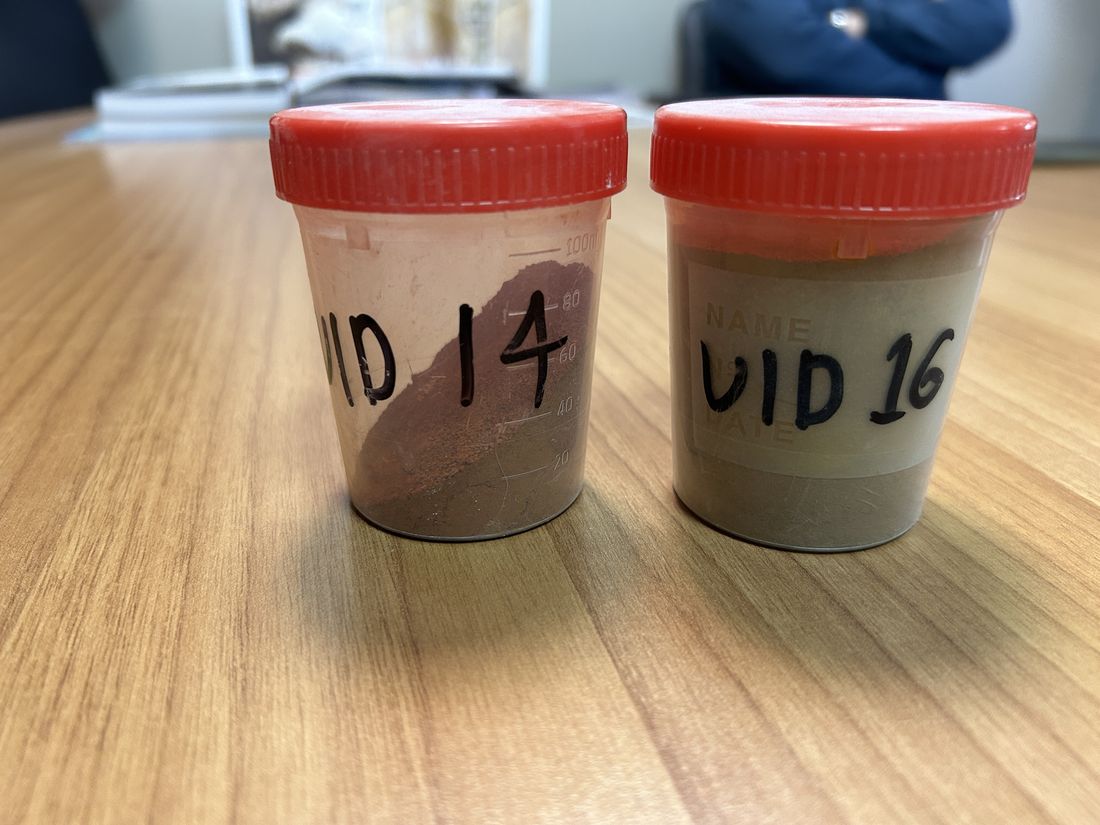
Two 100 ml specimen pots, hand-marked in pen, part-filled to around the 40–60 ml graduations. UID 14 holds a red-brown iron-rich soil, close to the hematite end of the range; UID 16 a pale gray-olive one, visibly settled into layers. These are the only images on the site showing the samples as samples — in the containers they were analyzed in, before grinding. Both are cited in the soil analysis.
See alsoSoil analysisCollection mapGlaze testsCollected specimens
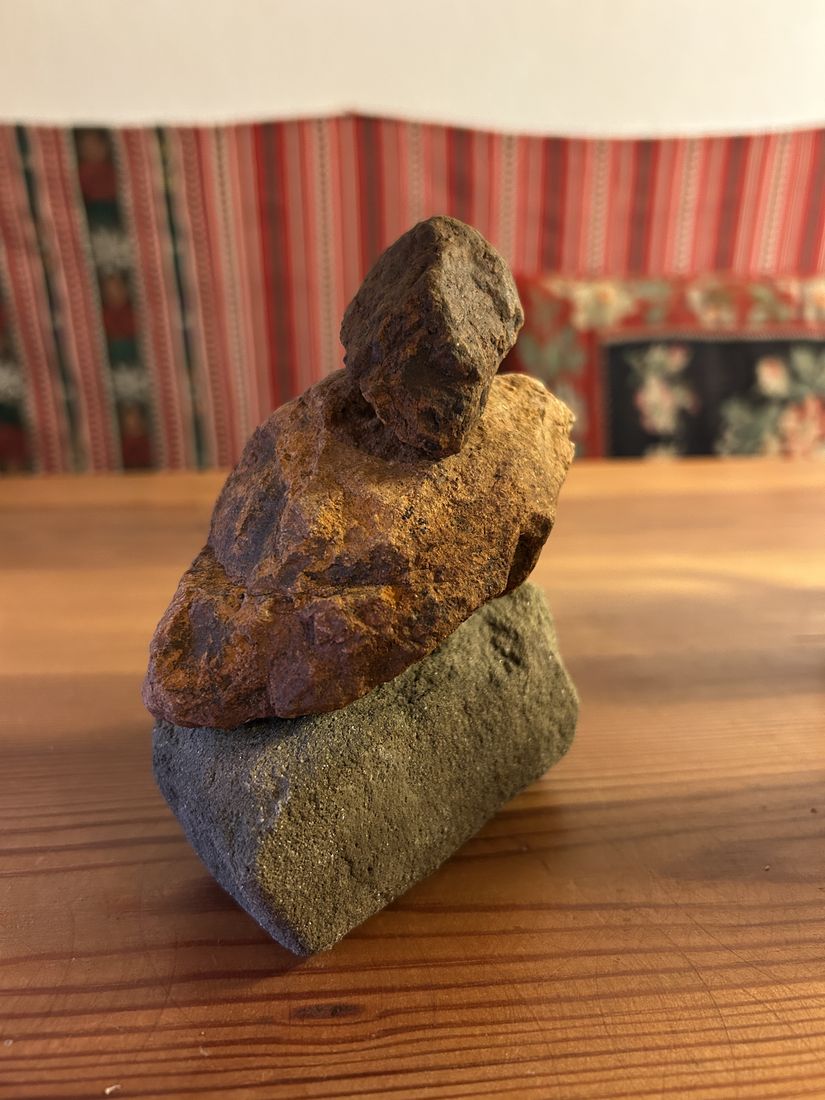
Three pieces stacked on a table at home: a green-gray block with a sandy, glittering surface; an iron-stained mass above it running through ochre, rust-orange and violet-purple; a smaller dark lump balanced on top. The purple-to-ochre range in the middle piece is the visible source of much of the pigment palette. Deliberately unlabelled — the mineral identifications are not yet settled.
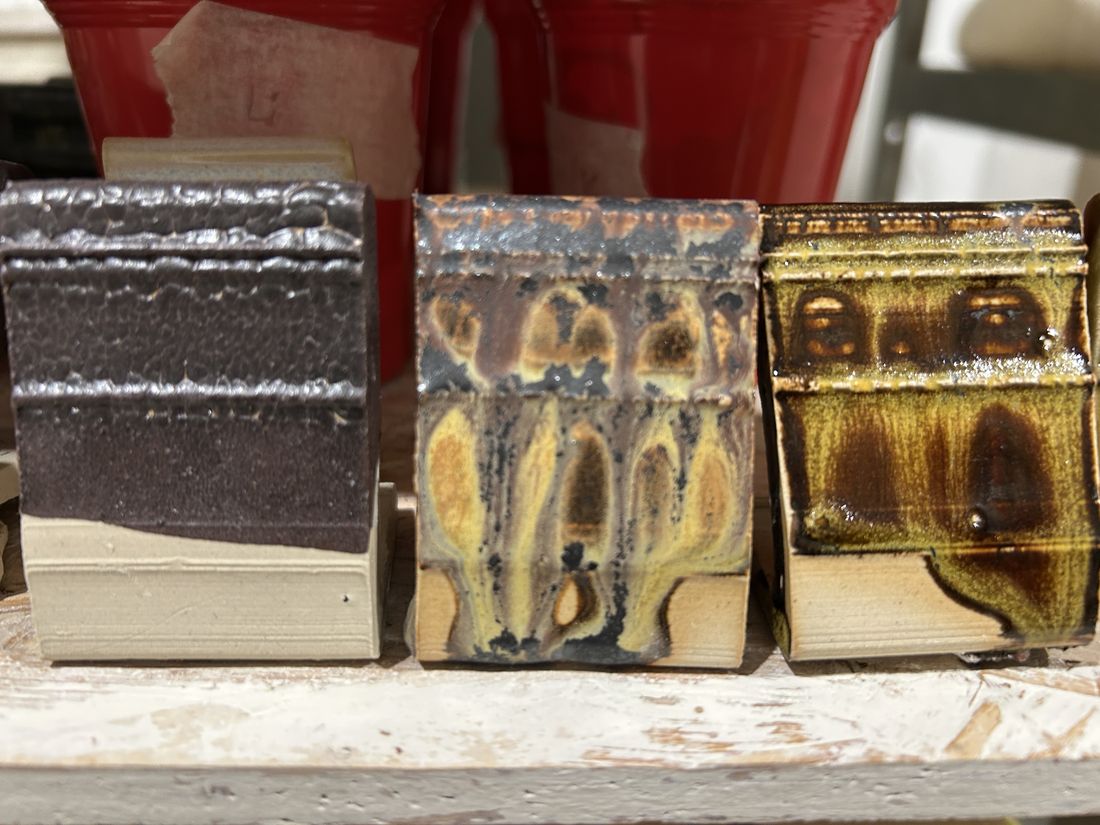
Three fired blocks on a kiln batt: one flat aubergine-brown, matt and dry-surfaced with a beaded run at the shoulder; one violently variegated in yellow, orange, black and gray, the glaze pulled into tongues and run down over the horizontal throwing lines; one amber to dark brown, glossy and heavily fluid, pooling at the foot. Each stops in a clean horizontal line partway down, leaving raw clay below. Results, not swatches — see the glaze tests.
See alsoGlaze testsSample potsEX-03 Material processPlain glass — the controlN1, page 77
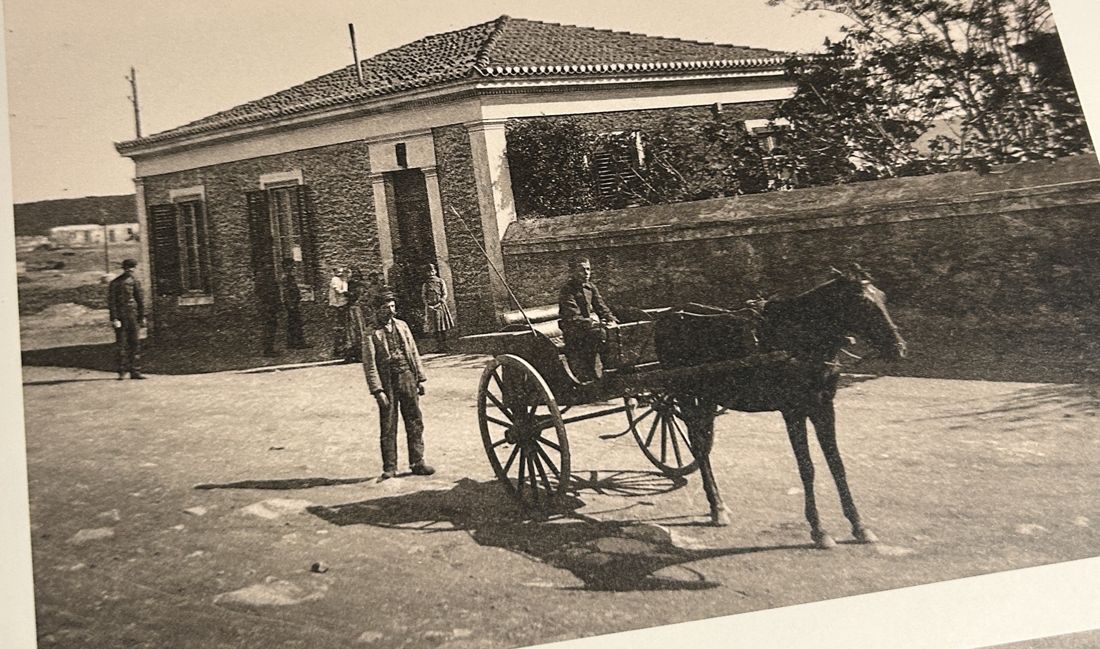
Horse cart, stone building, and workers — the town as it stood during the height of mining operation. Note the square pyramid shape of the roof.
See alsoThe Serpieri HouseOpen-cast mine workingsEX-01N1, page 65
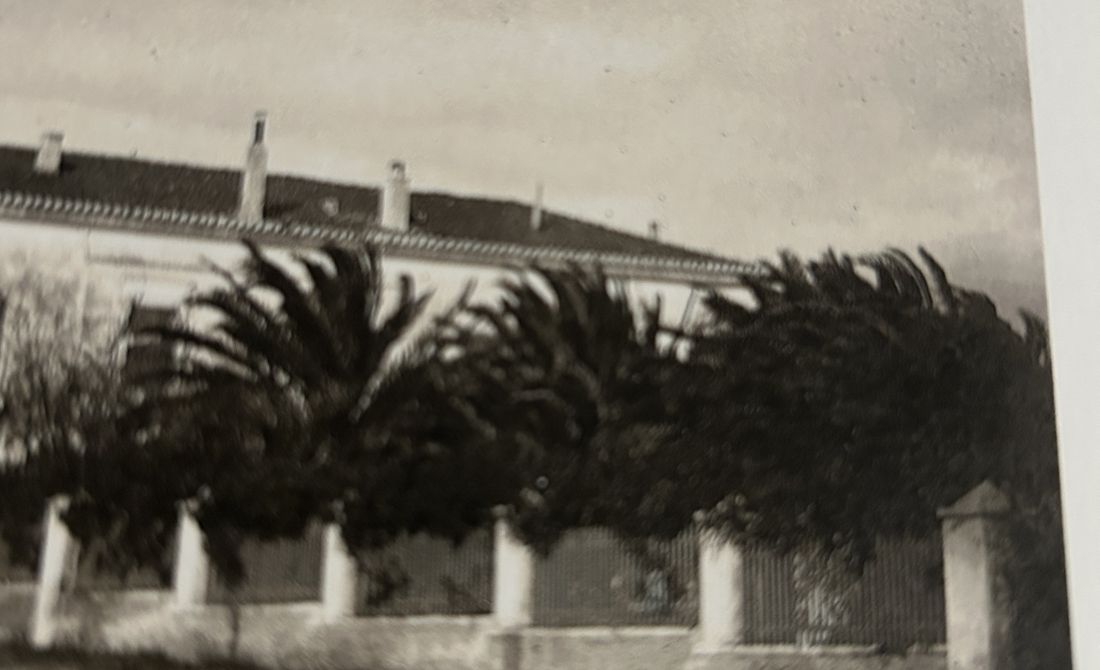
A closer view along the same frontage: the tiled roof, the run of chimneys, the palms and the iron railing between rendered piers. Note the shape of the stone wall.
See alsoStreet Scene, LavrionPigmentsN1, page 65N1, page 66
Kostas G. Manthos, Lavrion: the Rumble of Time («Λαύριο, η βοή του χρόνου»). Reproduced from the published album.
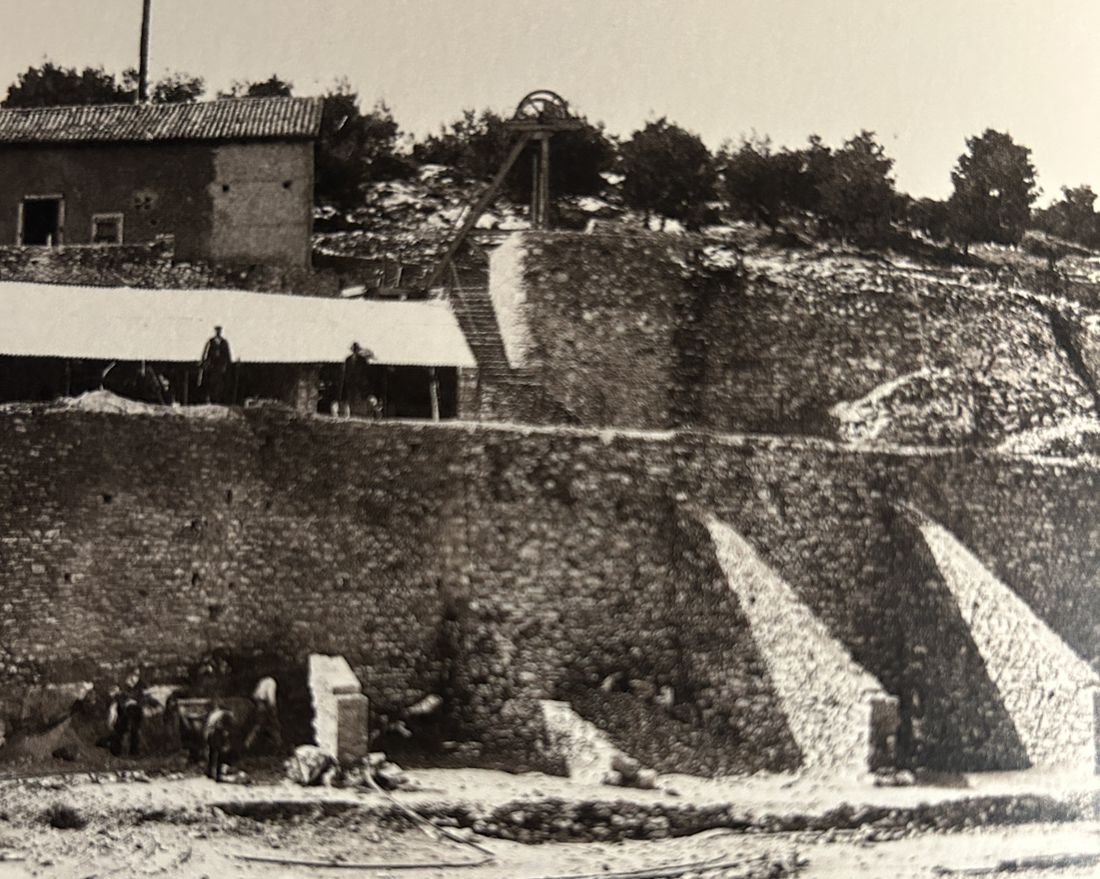
Tiered stone retaining walls, workers, and a mine headframe. The visible terracing anticipates the layered, incremental building method used throughout the ceramic works.
See alsoArsenic mapSoil analysisN1, page 1
Kostas G. Manthos, Lavrion: the Rumble of Time («Λαύριο, η βοή του χρόνου»). Reproduced from the published album.
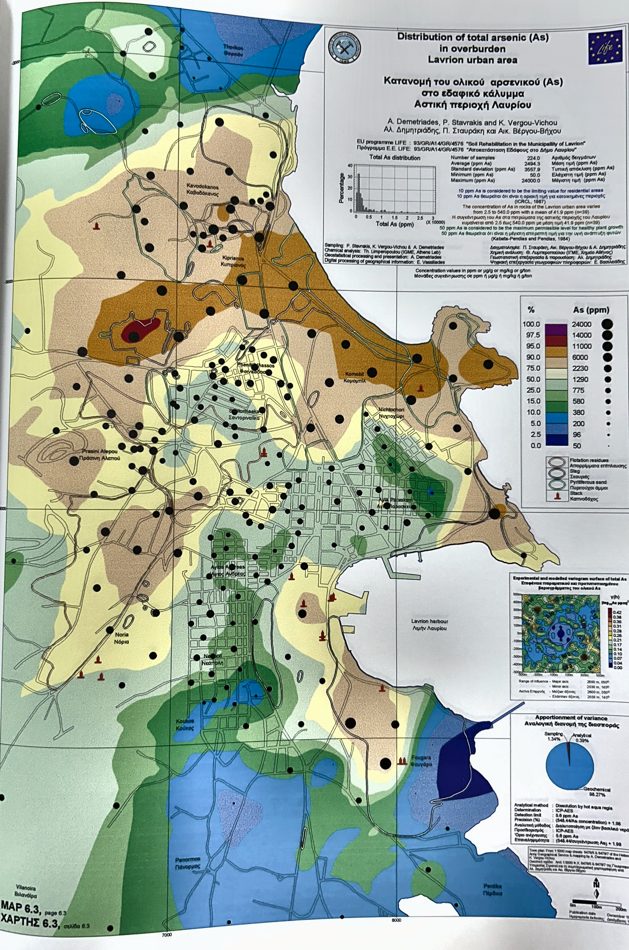
The plate behind the arsenic figures above. 224 samples across the Lavrion urban area: average 2,494.3 ppm, maximum 24,000 ppm, minimum 50 ppm. The map records 10 ppm as the limiting value for residential areas (ICRCL, 1987) and 50 ppm as the maximum permissible for healthy plant growth (Kabata-Pendias & Pendias, 1984) — so the average across the town is roughly 250× the residential limit and 50× the agricultural one. The orange and red bands north-west of the harbour mark the worst ground; the soil collected for this work comes from the wider peninsula around it.
A. Demetriades, P. Stavrakis & K. Vergou-Vichou, EU LIFE programme 93/GR/A14/GR/4576, Soil Rehabilitation in the Municipality of Lavrion, Map 6.3, December 1998. Chemical analysis: Th. Limperopoulou (IGME, Athens). Reproduced from the published atlas.
See alsoSoil analysisCollection mapOpen-cast mine workingsPalette, arsenicN1, page 17
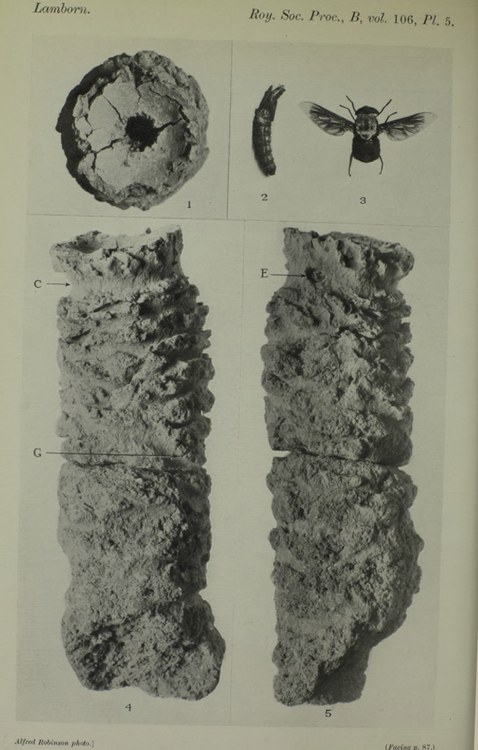
Five figures on one plate. 1 — the nest seen end-on, a thick collar of dried mud cracked radially around a single central opening. 2 — the larva. 3 — the adult, stout-bodied and dark, wings spread. 4 and 5 — two views of the nest tube, a rough cylinder raised in irregular horizontal courses, with lettered points marking features in the wall (C and E at the rim, G partway down). The tube is this chapter’s argument in a century-old scientific illustration: a structure with no armature, built up course by course out of worked mud, and photographed as evidence rather than as an image. Set it beside the mud nest and the coil-built forms — the same construction, recorded by three different disciplines.
See alsoMud nestCoil-built formsHoneycomb on a clay barWasp-colonised rock
Lamborn, Roy. Soc. Proc., B, vol. 106, Pl. 5 (facing p. 87). Photographs by Alfred Robinson. Retrieved from royalsocietypublishing.org; the download stamp in the original left margin has been cropped away.
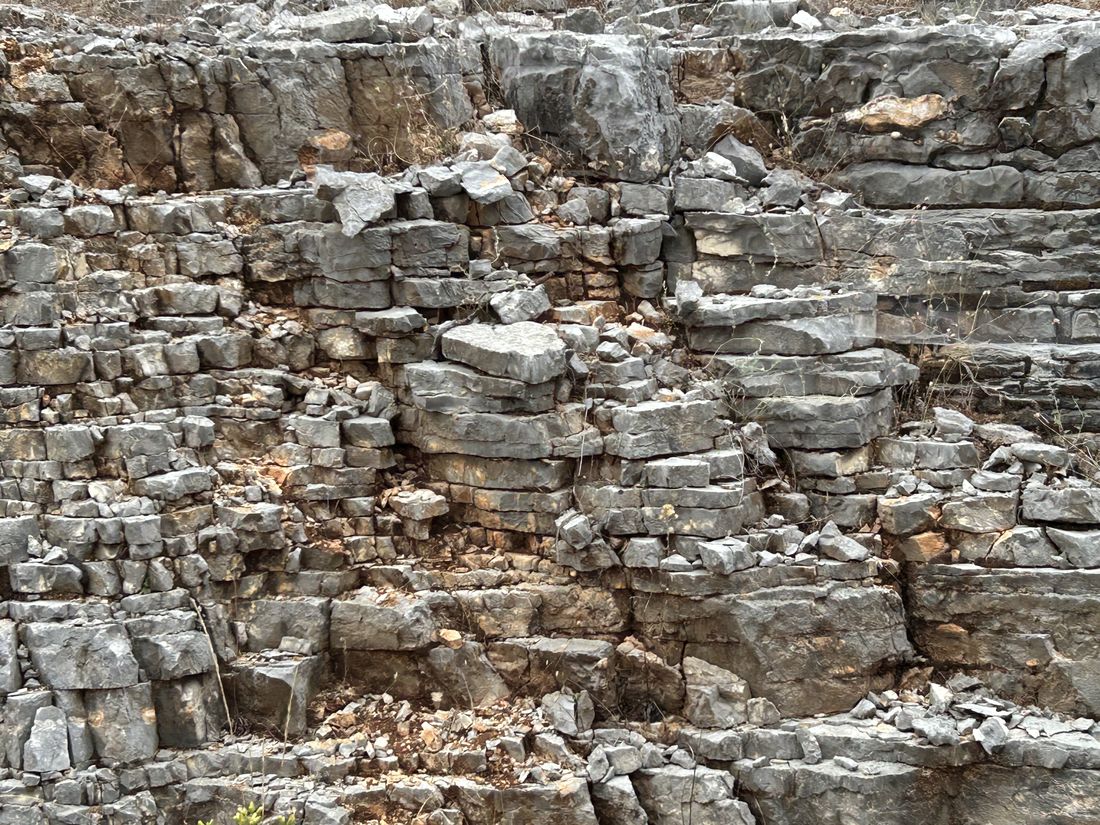
A worked face of thin, near-horizontal limestone beds, each one a few centimeters deep, breaking into blocks along joints that run square to the bedding. The result is indistinguishable from coursed masonry — regular courses, staggered vertical joints, even a rubble infill where a bed has collapsed. Nothing laid it. The courses are sedimentation, the joints are stress, and the resemblance to a built wall is entirely the eye’s. Read against the perforated brick wall and the coil-built forms, this is the third term: a made-looking surface with no maker, at architectural scale.
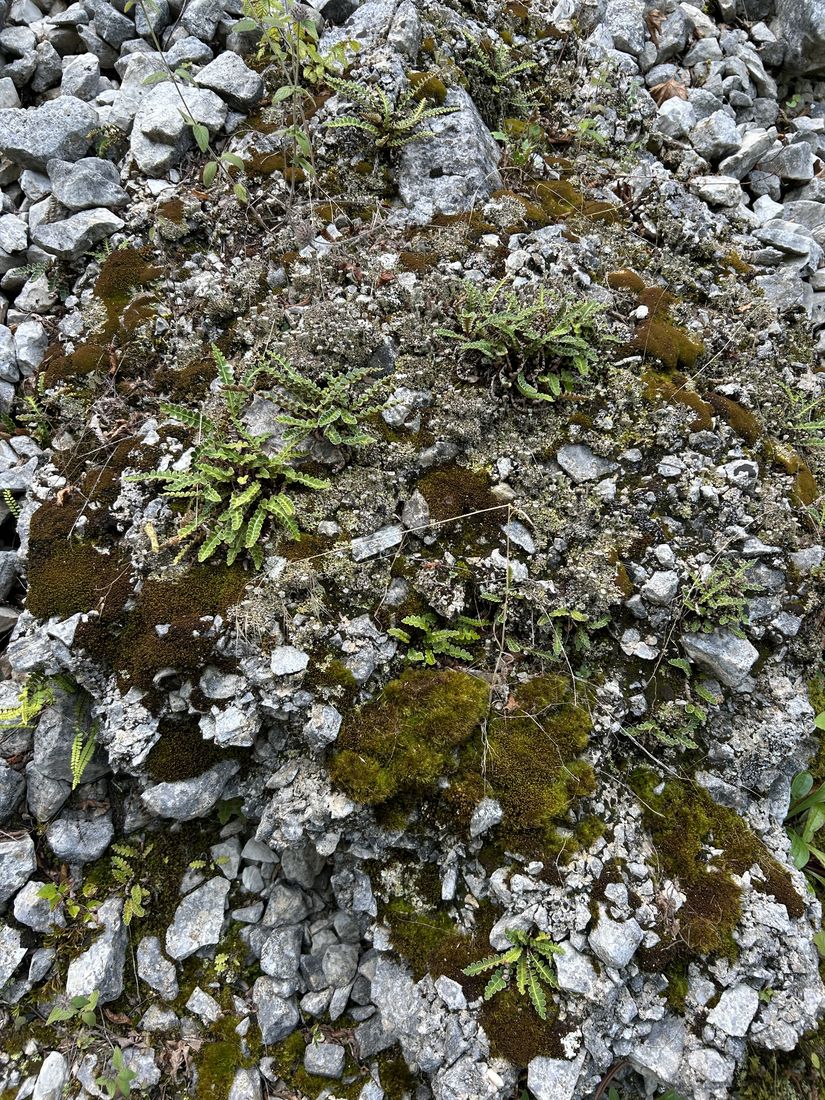
Broken limestone gravel taken over by cushions of moss in rust-brown and green, pale crustose lichens spreading flat across the chip surfaces, and small ferns rooted in the fines between. Every organism here is working on the same material the soil samples came from, and doing to it slowly what grinding does quickly — opening the stone, holding moisture, making earth. The greens, ochres and rust-browns are the pigment palette occurring in place, on the rock rather than out of it.
See alsoCollected specimensLichen on limestoneCollection mapMud nest
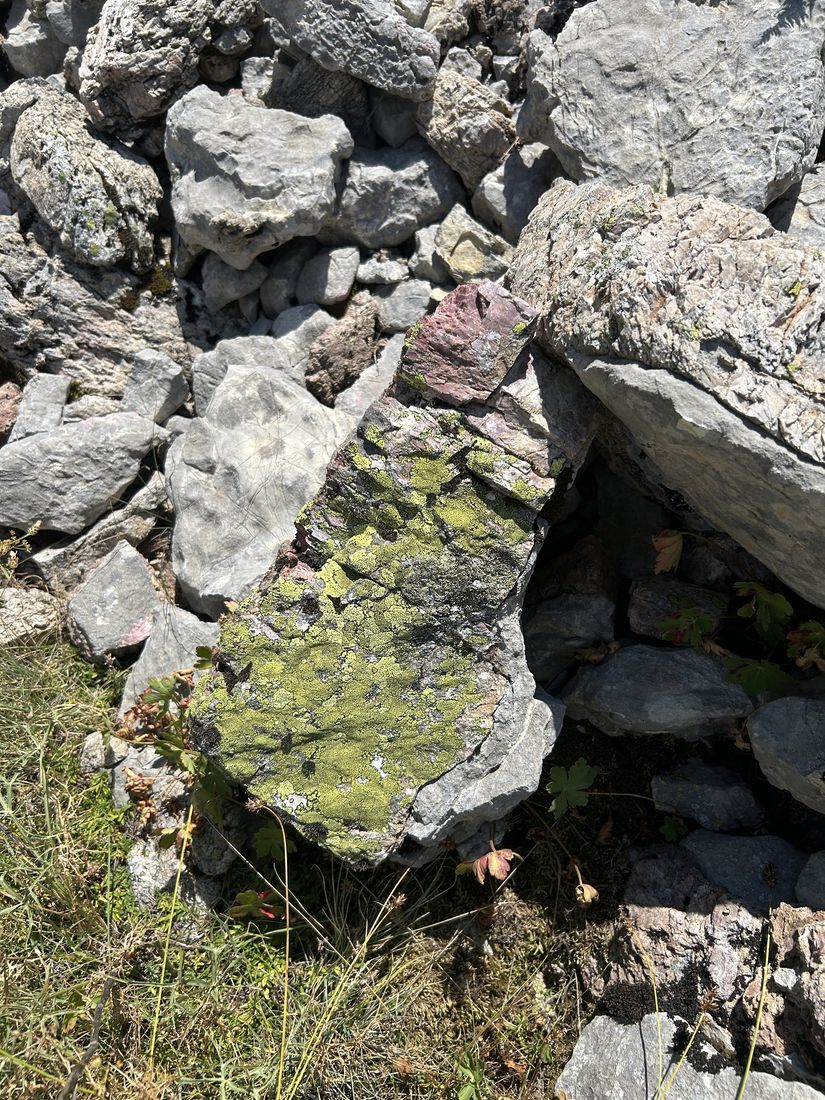
An angular block lying in scree, its upper face carried almost entirely by a vivid yellow-green crustose lichen that has spread to the edges of the stone and stopped, with black patches where a second species has taken hold and a darkening at the joints. The rock beneath shows the same violet-purple and dull red staining as the collected specimens. A void opens under the slab at the right. The lichen is doing what everything else in this chapter does — accumulating on a surface over a long time — but it is also a color laid onto stone, which is the whole subject of the work.
See alsoColonised screeCollected specimensPigmentsWasp-colonised rock
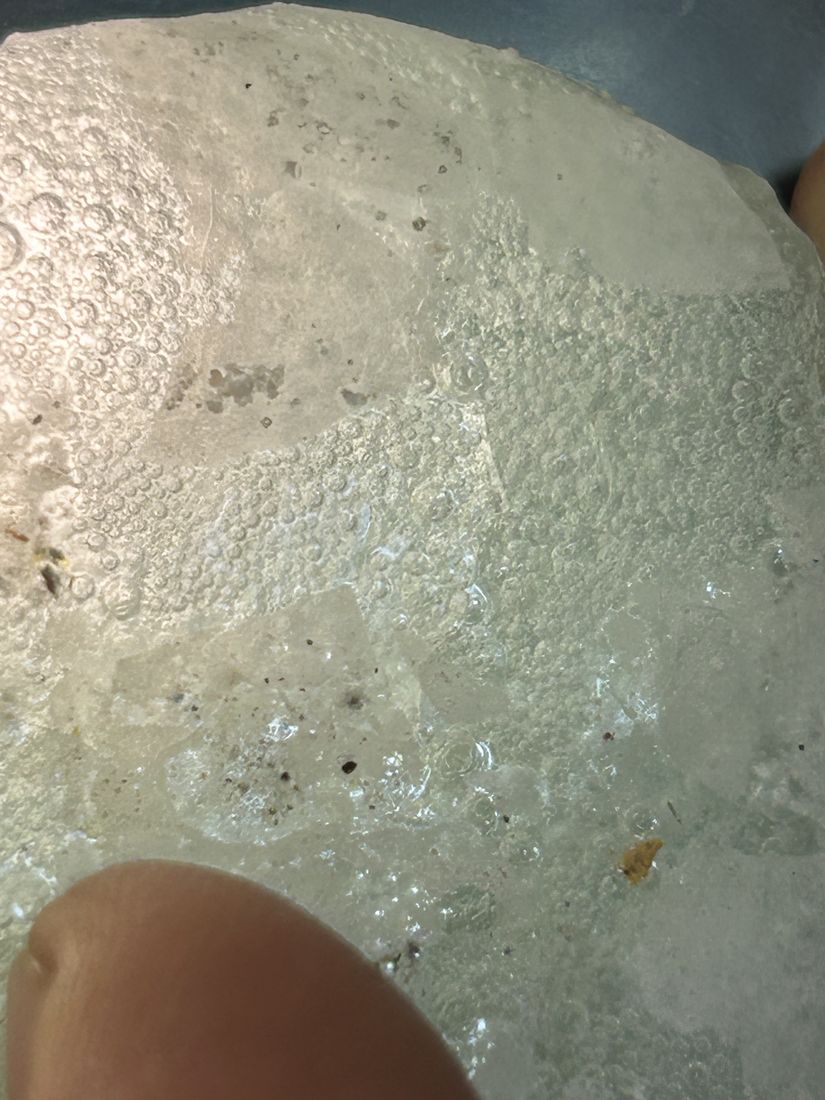
The glass on its own, before any soil goes into it. A fused disc held at the edge, near-colorless with a faint green cast, dense with trapped gas at two scales — a fine seed through the whole mass and larger voids gathered toward the center. Every other glaze plate here shows a result; this is the baseline those results are measured against, and the material the encapsulation actually happens in.
The batch is fritted rather than melted from raw materials, and Frit 3110 — a high-soda, low-alumina frit with a very low softening point — is known to trap bubbles. The peak of 973 °C is a ceramic temperature, roughly cone 07 and well above a standard COE 96 fuse; the anneal at 515 °C sits on the COE 96 annealing point. The schedule is itself a hybrid: fired as ceramic, annealed as glass.
| Frit 3110 | 73% |
| Frit 3134 | 20% |
| Silica | 5% |
| Kaolin | 2% |
| seg | rate °C/hr | target °C | soak min |
|---|---|---|---|
| 1 | 120 | 120 | 0 |
| 2 | 80 | 650 | 0 |
| 3 | 90 | 870 | 60 |
| 4 | 60 | 973 | 30 |
| 5 | FULL | 870 | 60 |
| 6 | FULL | 515 | 30 |
The revision raises the peak to 1050 °C to fine the melt — viscosity falls with temperature, so trapped bubbles can rise and burst — and replaces the free fall from peak with a controlled 100 °C/hr descent, so the glass keeps clearing while it is still mobile. Everything below 870 °C is unchanged; the schedule as fired is tabled with the resulting plate. The result of the revised firing is shown in the next plate.
See alsoGlaze test blocksGlaze testsEX-05 EncapsulationsTiles 2026
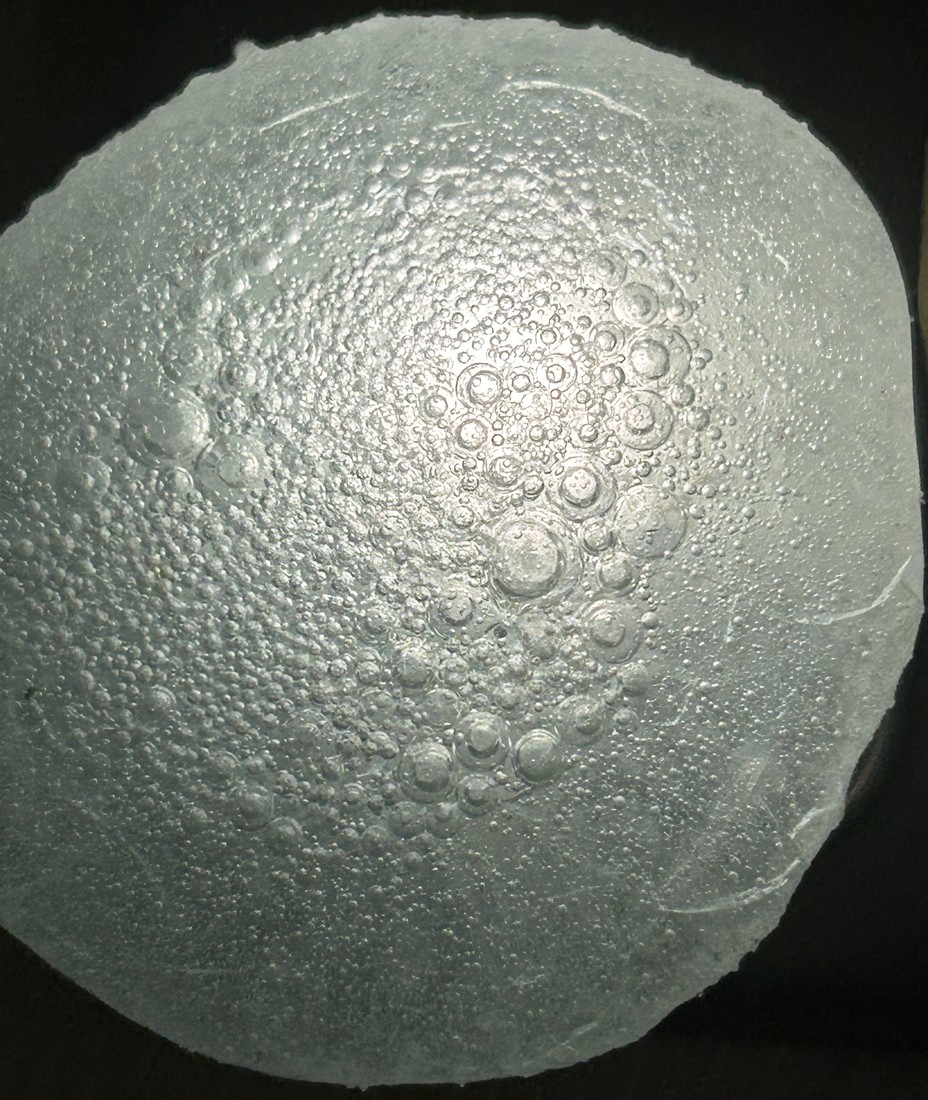
The same batch taken through the revised schedule set out on the control plate, and photographed against black with the light behind it, so the body is read through rather than off the surface. The disc has pulled to a rounded blank with a chipped, granular rim, and faint striations cross it where the melt flowed and stopped.
The gas has not gone, but its character has changed. In place of an even seed through the whole mass the bubbles are now discrete and graded — a coarse cluster gathered at the center, thinning outward into finer seed toward the rim, the larger voids falling into loose rings. That is what fining looks like: at 1050 °C the melt thins enough for small bubbles to merge and climb, and the controlled descent keeps them moving while the glass is still soft. Fewer and larger, and on their way out, rather than many and fixed.
| seg | rate °C/hr | target °C | soak min |
|---|---|---|---|
| 1 | 120 | 120 | 0 |
| 2 | 80 | 650 | 0 |
| 3 | 90 | 870 | 60 |
| 4 | 100 | 1050 | 30 |
| 5 | 100 | 973 | 30 |
| 6 | FULL | 870 | 60 |
| 7 | FULL | 515 | 30 |
Not a like-for-like comparison. The control is reflected light on a gray kiln shelf; this is transmitted light on black. The two plates show the material under opposite lighting, so what is legible between them is the pattern of the gas, not its density.
See alsoPlain glass — the controlGlaze test blocksGlaze testsEX-05 Encapsulations
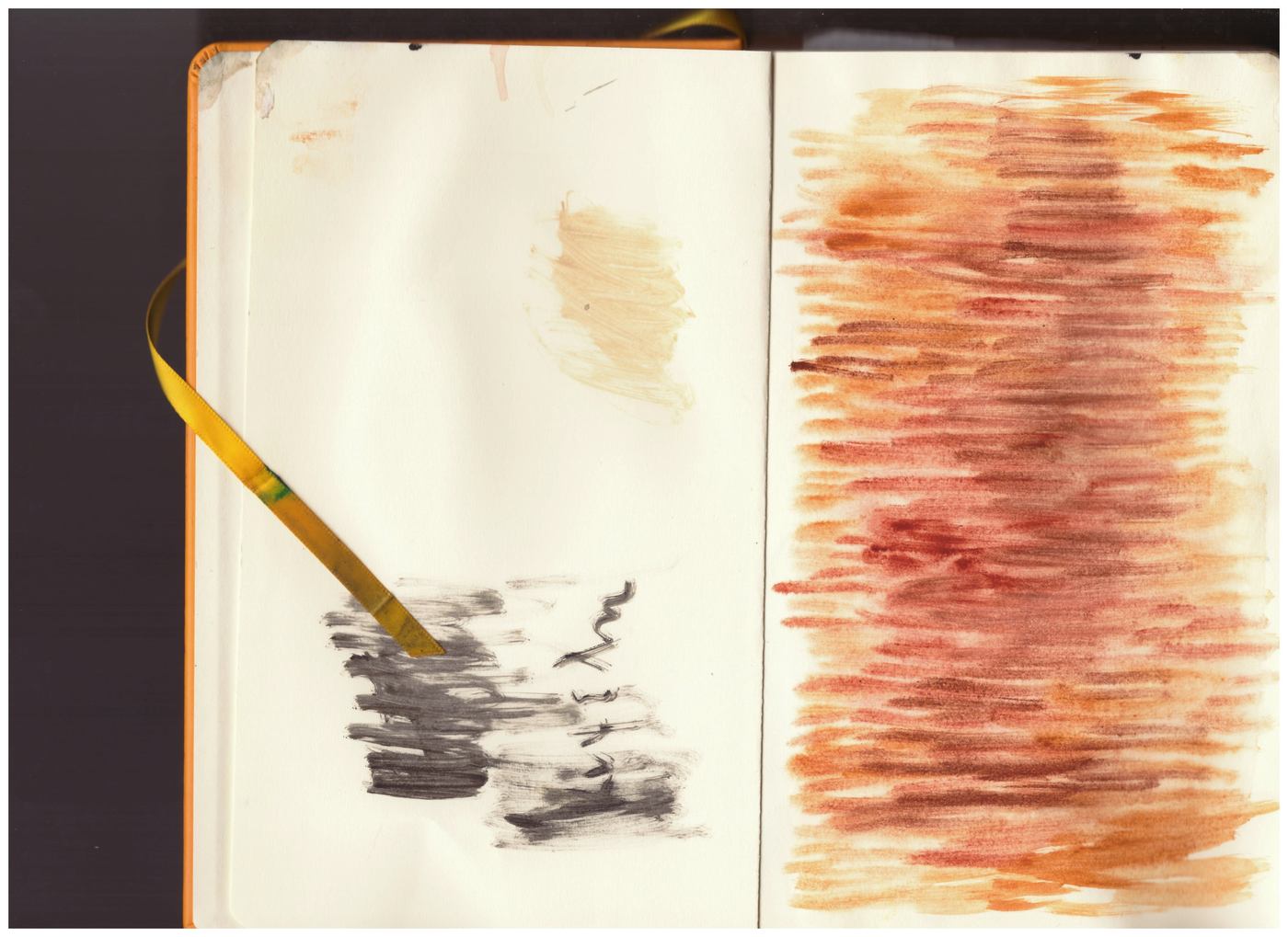
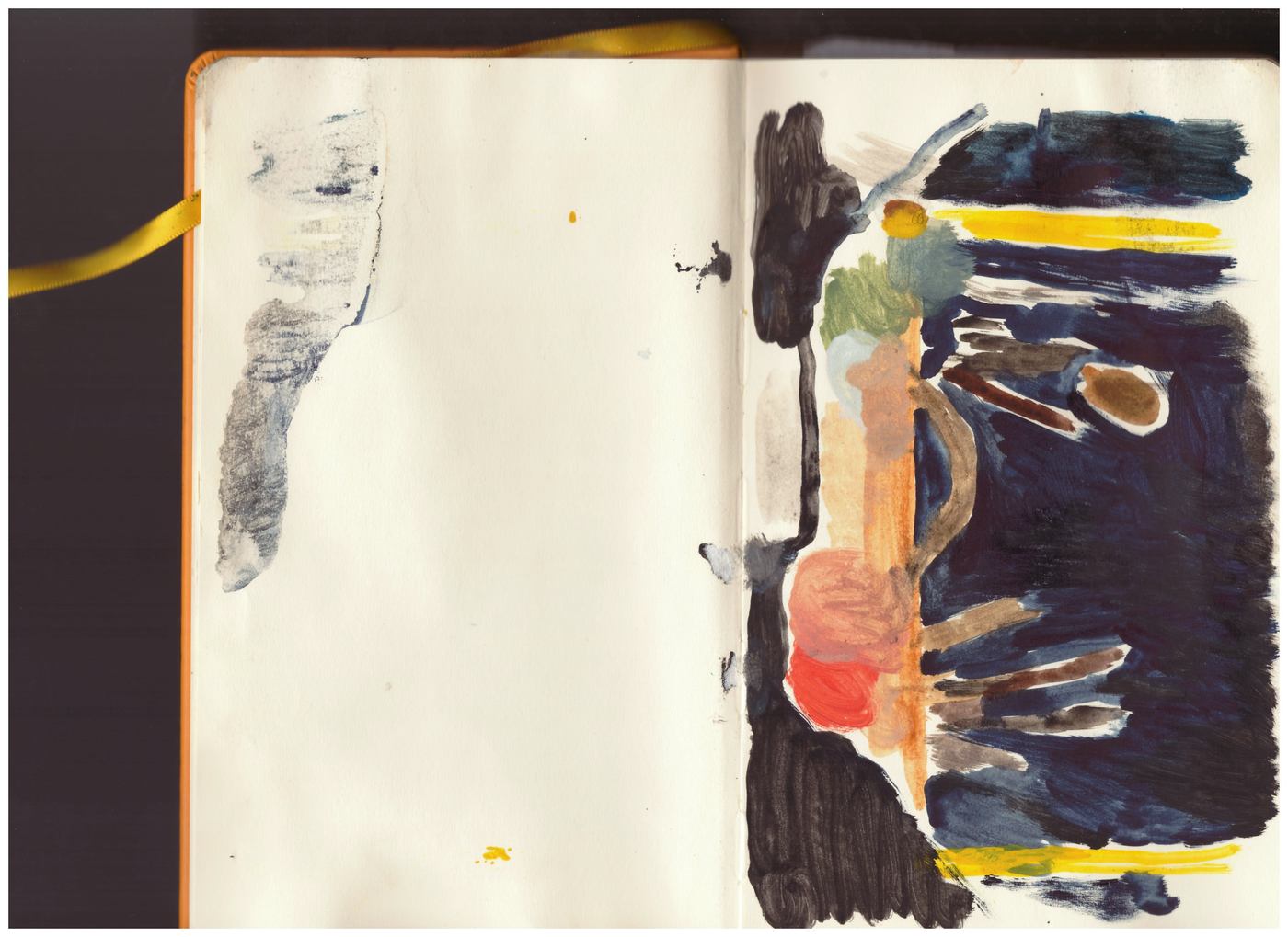
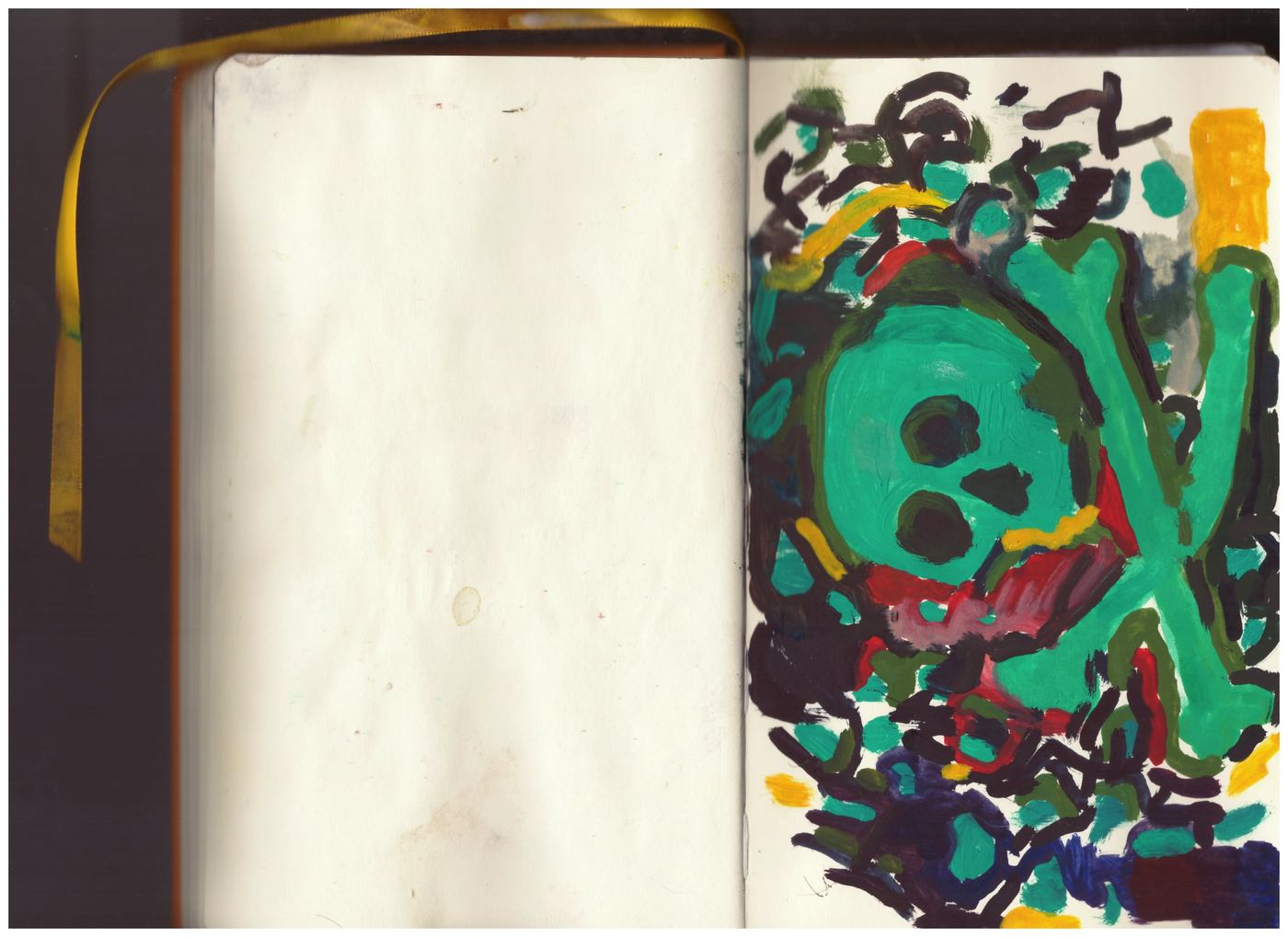
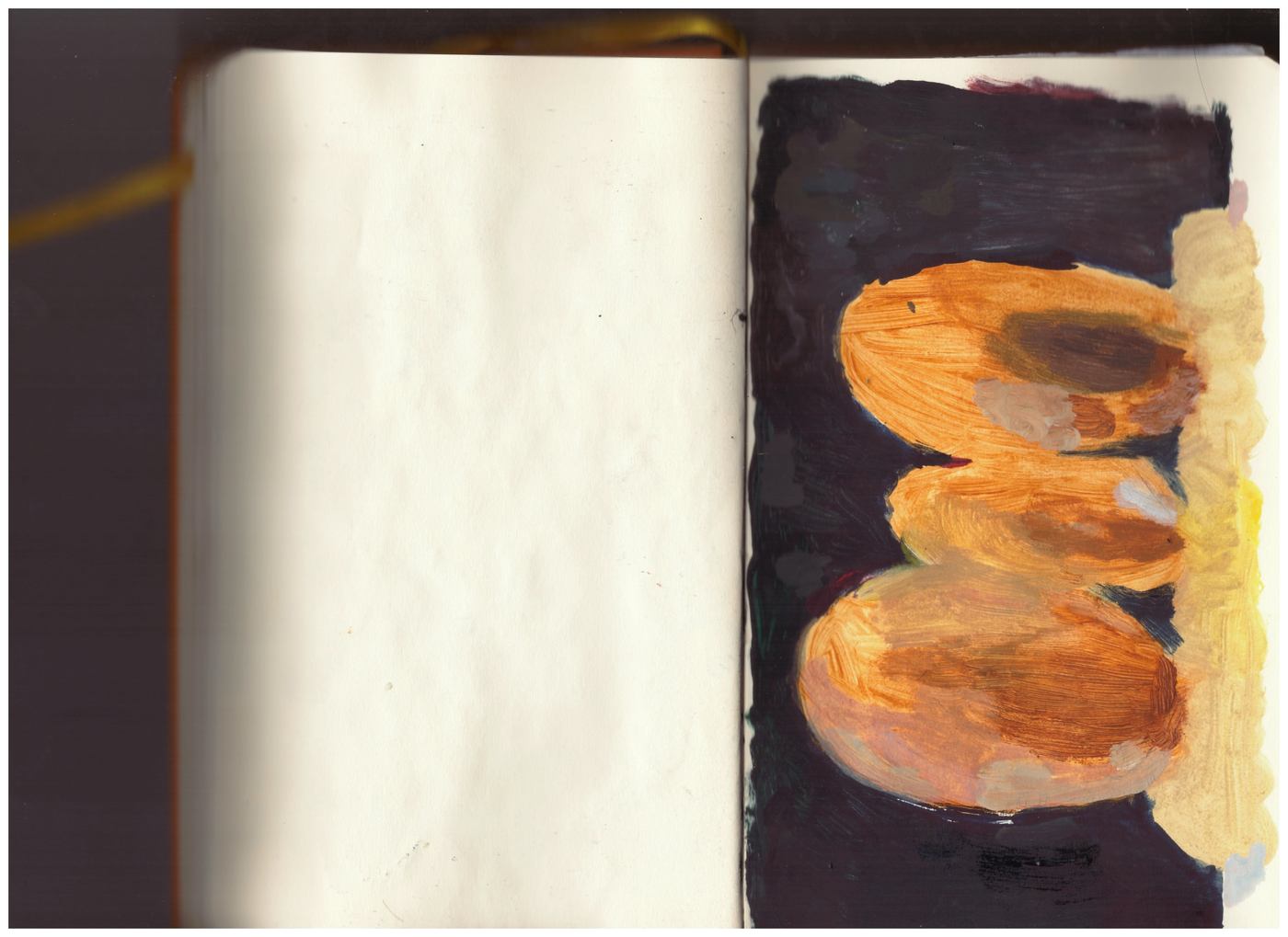
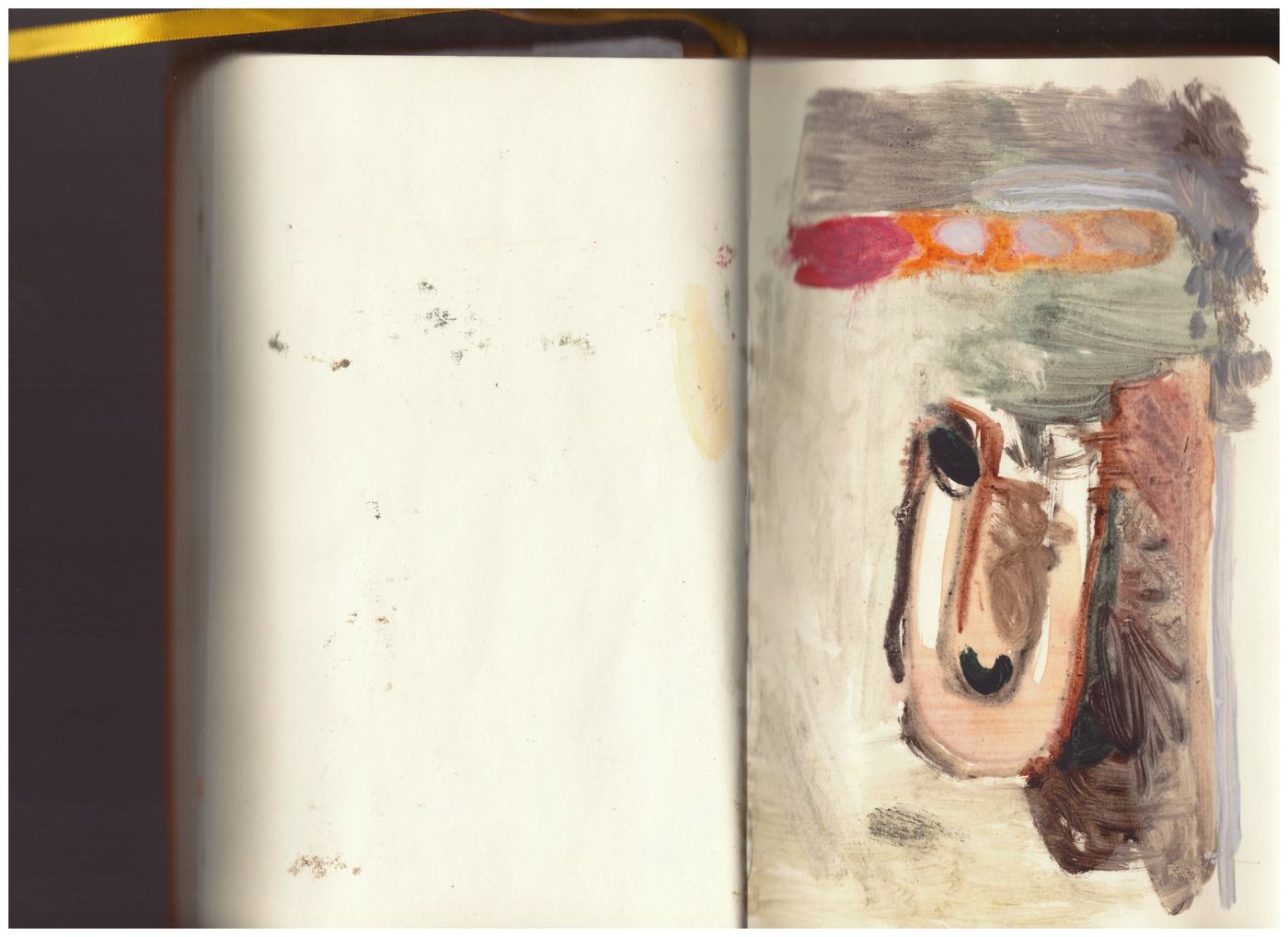
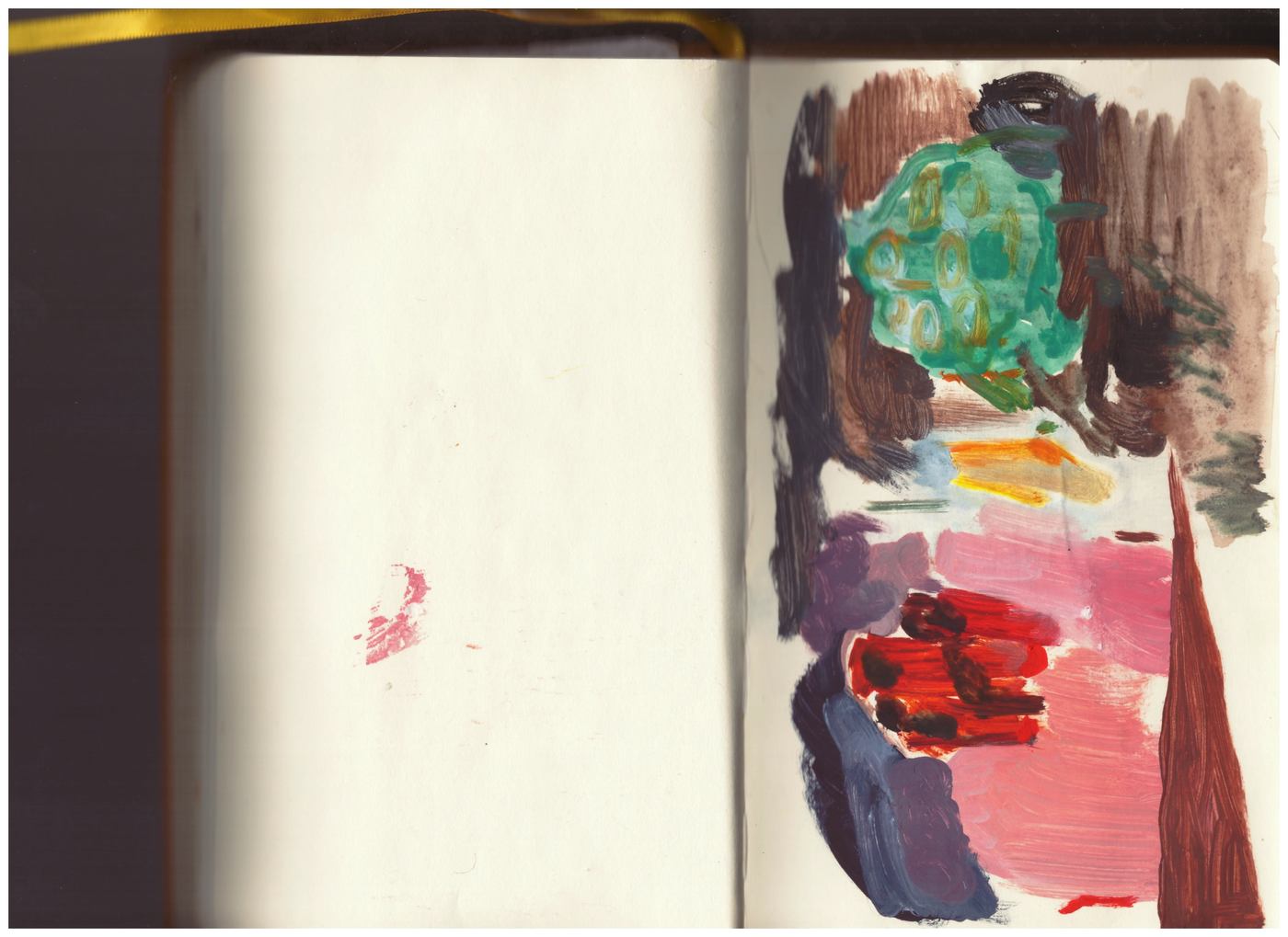
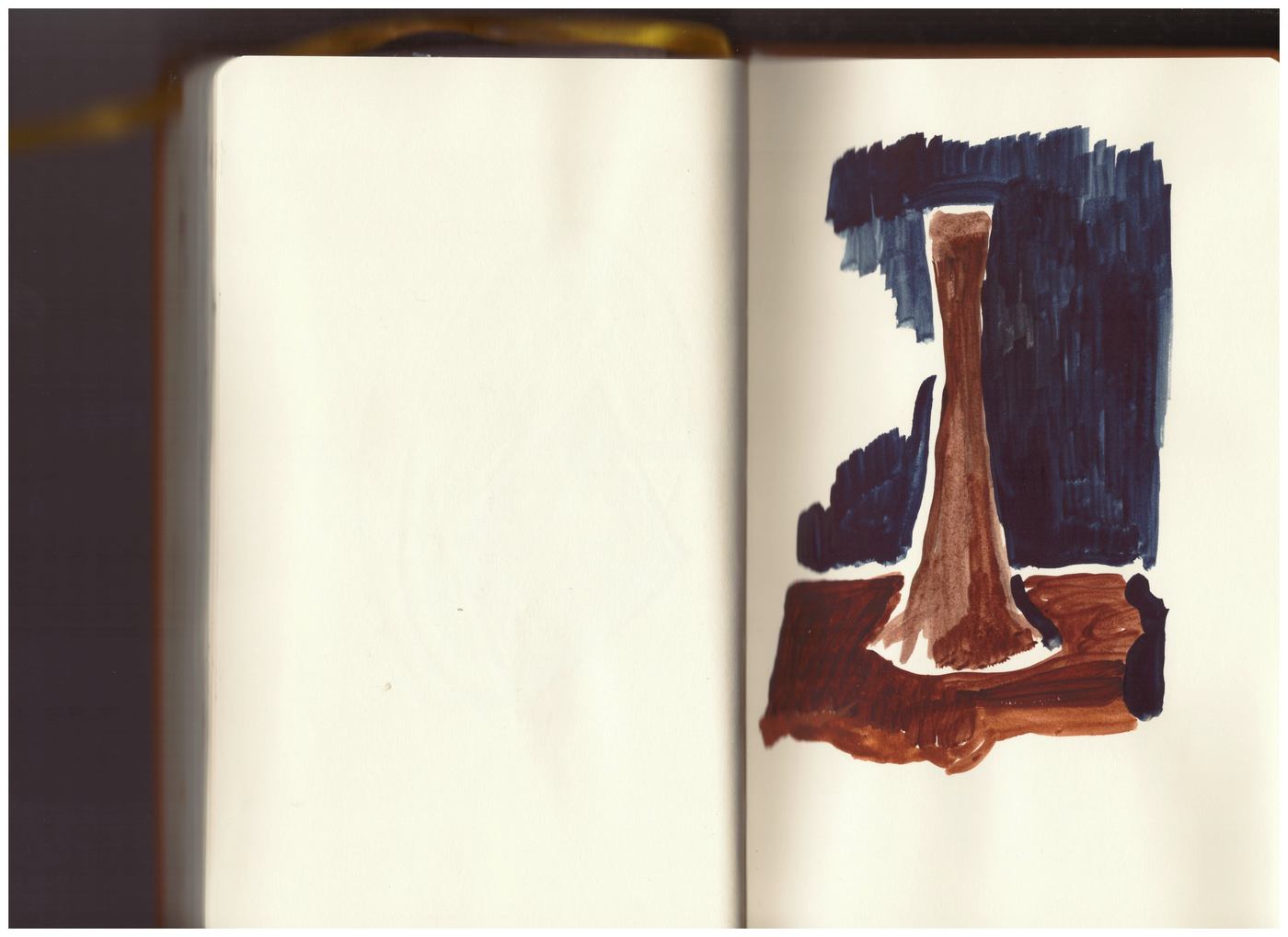
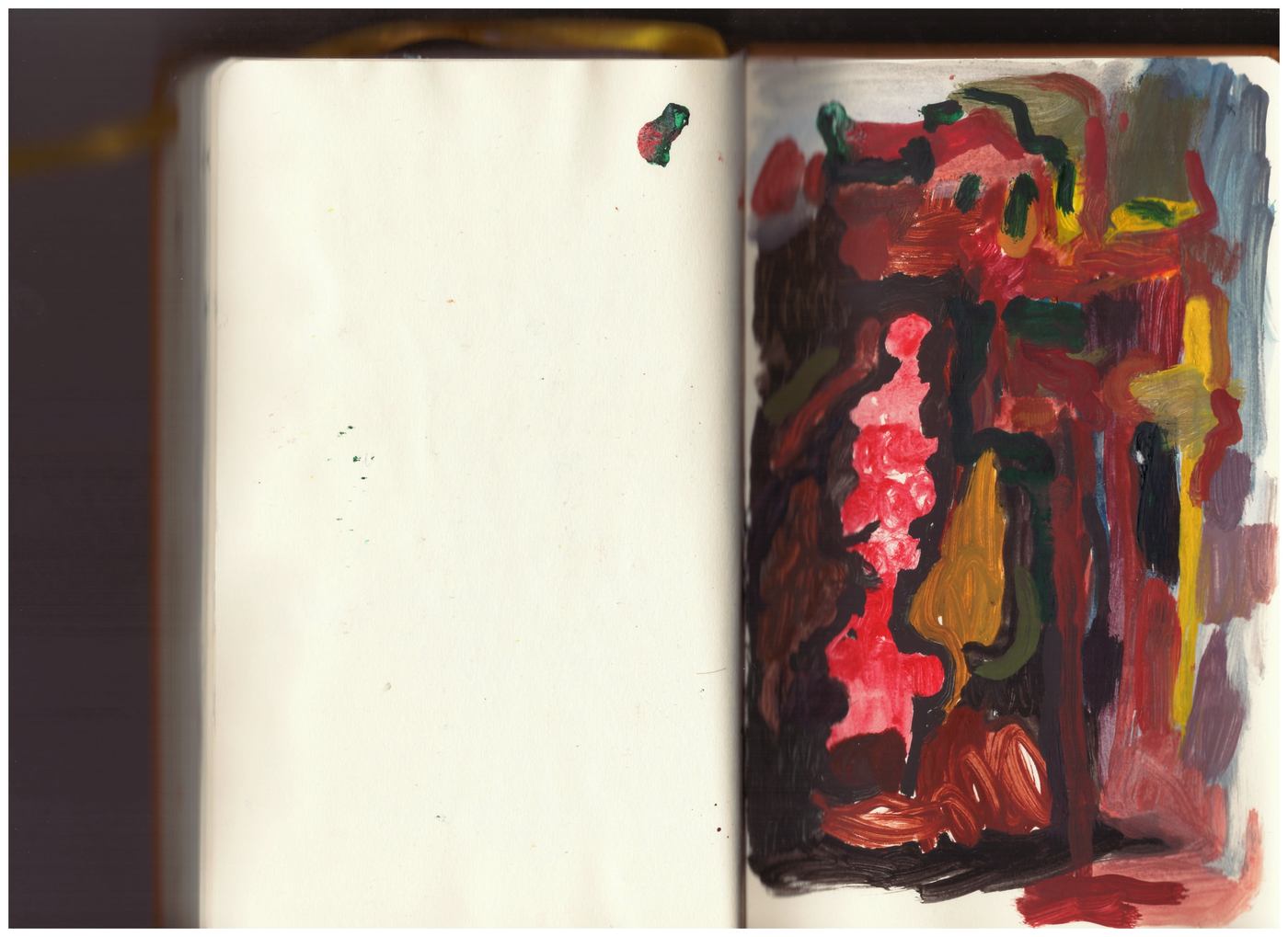
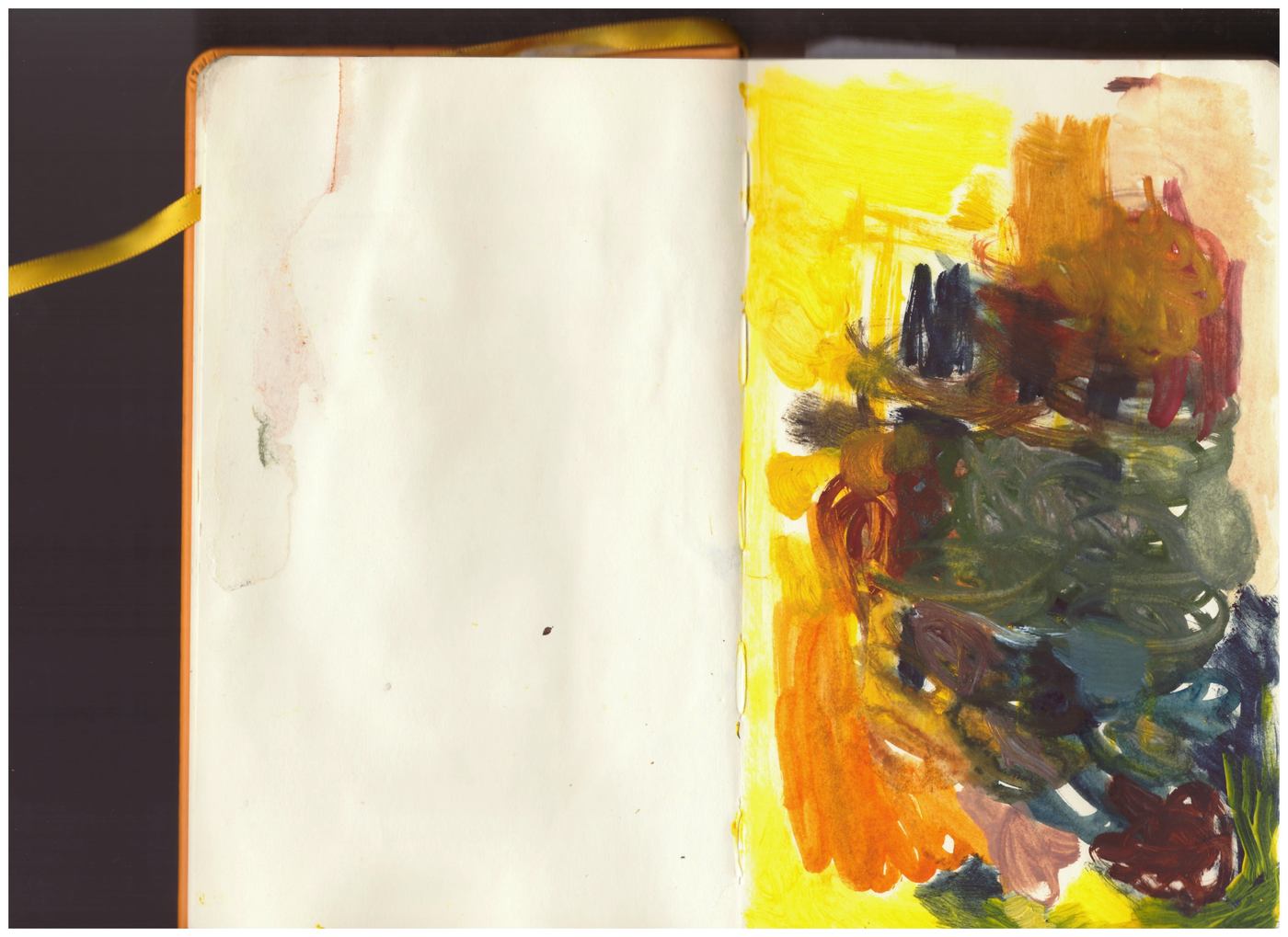
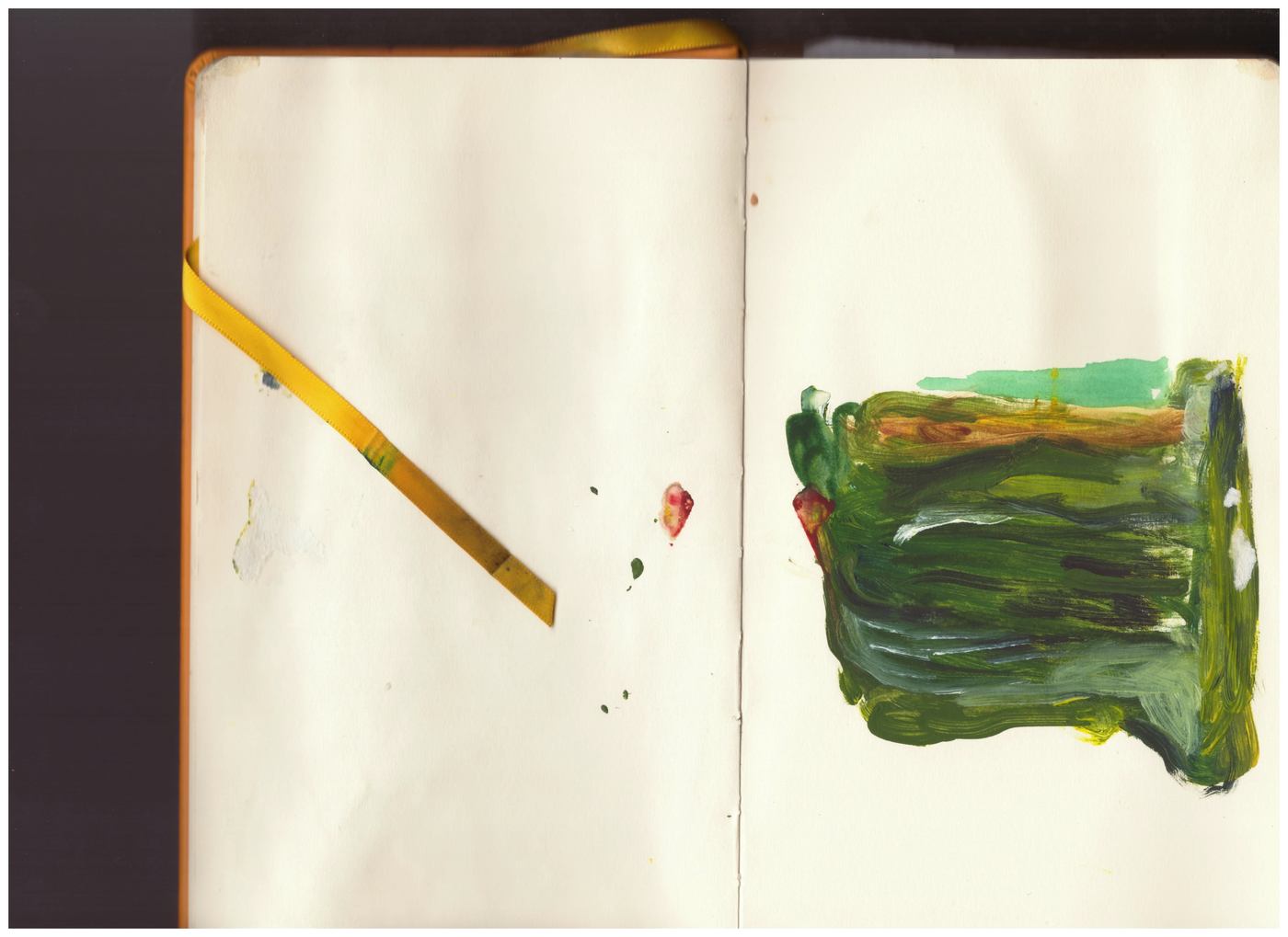
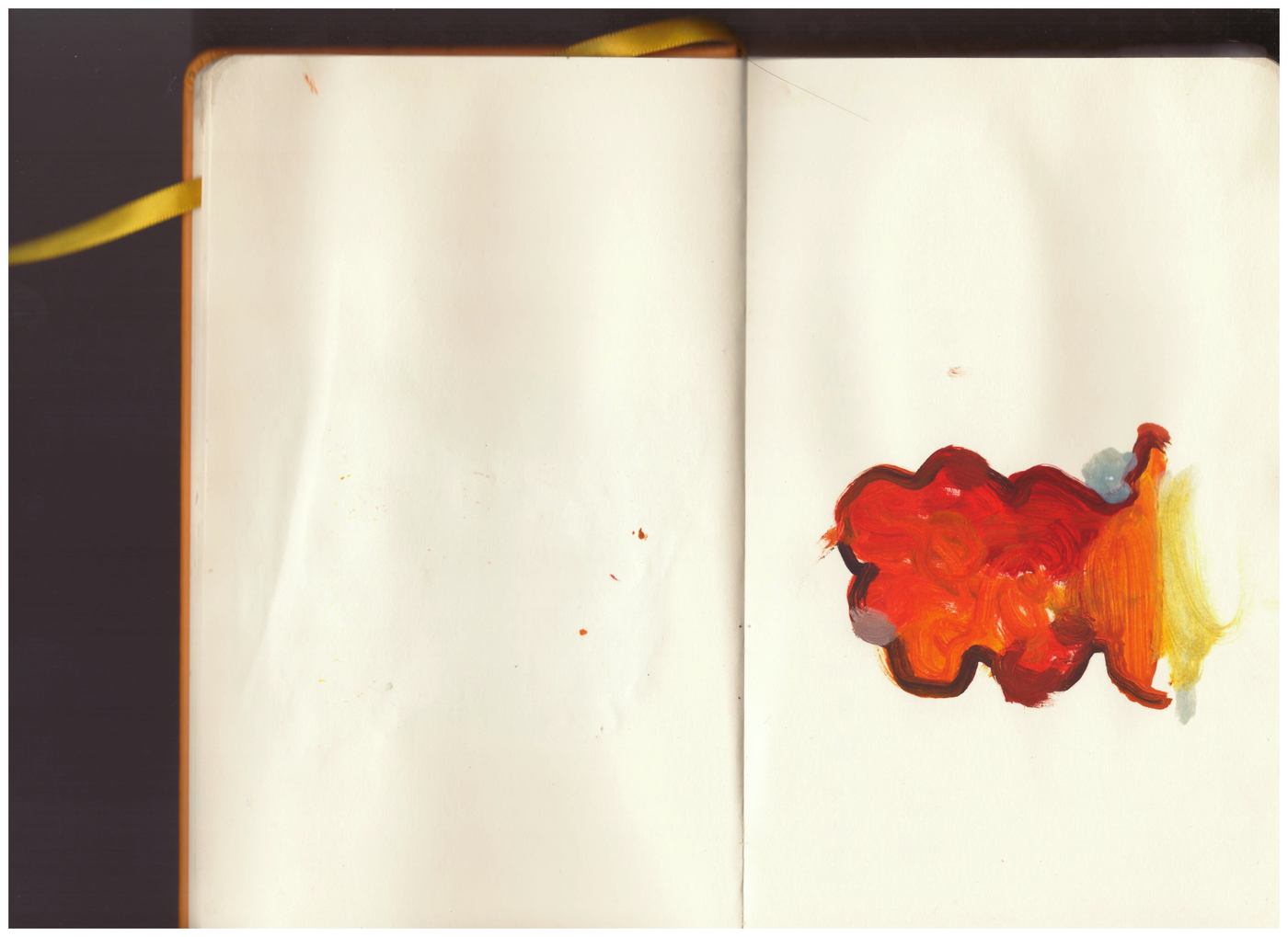
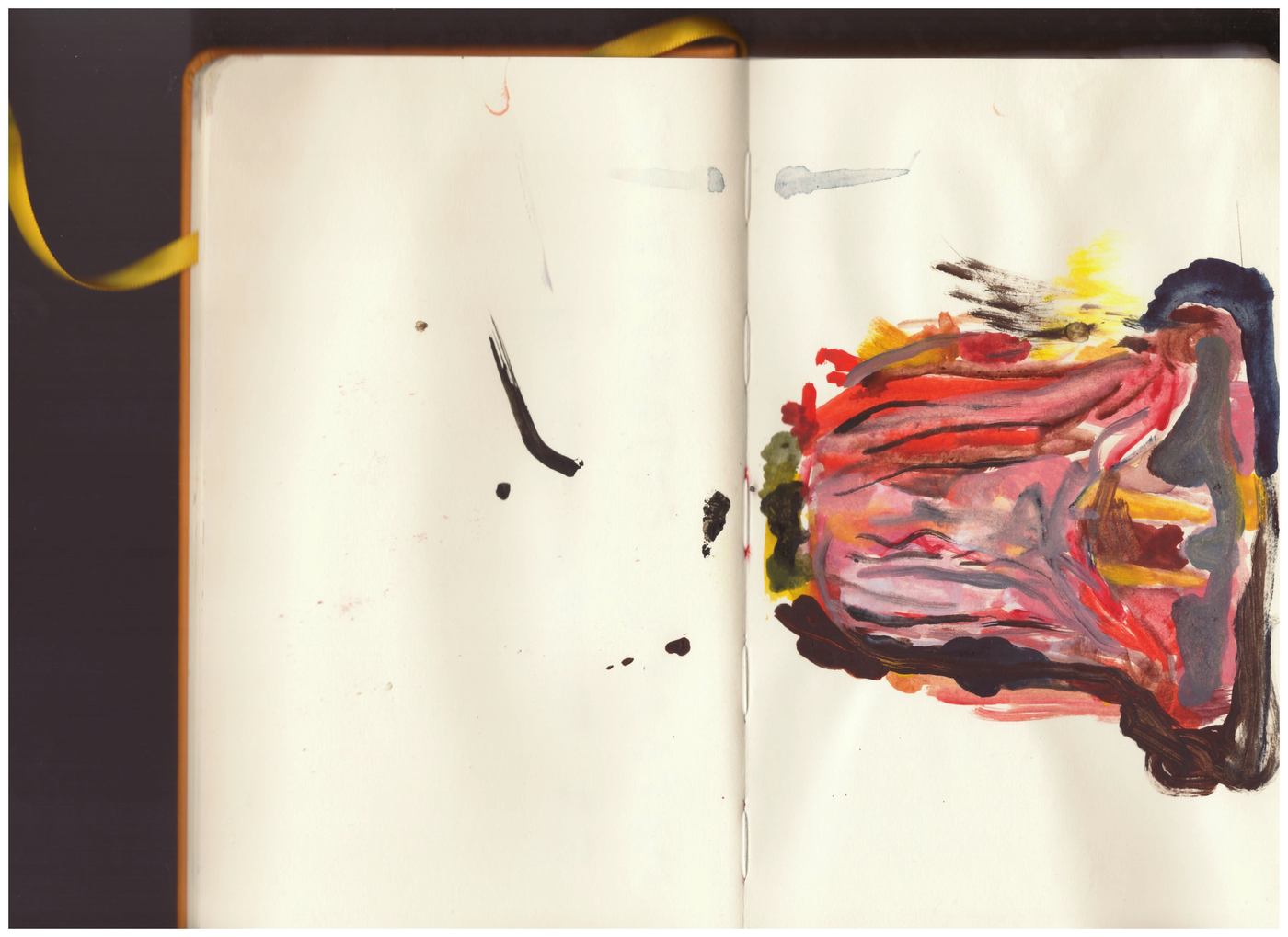
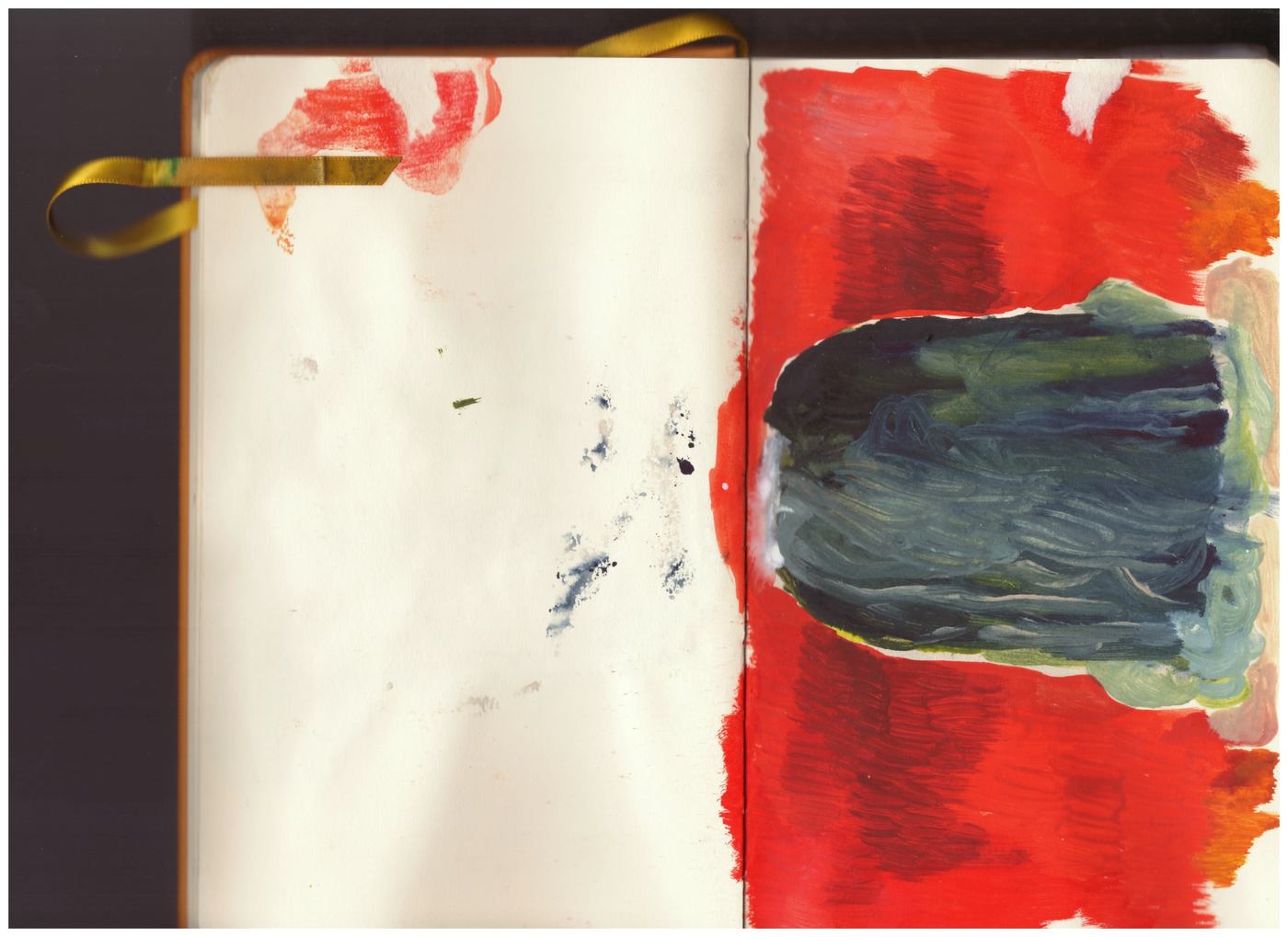
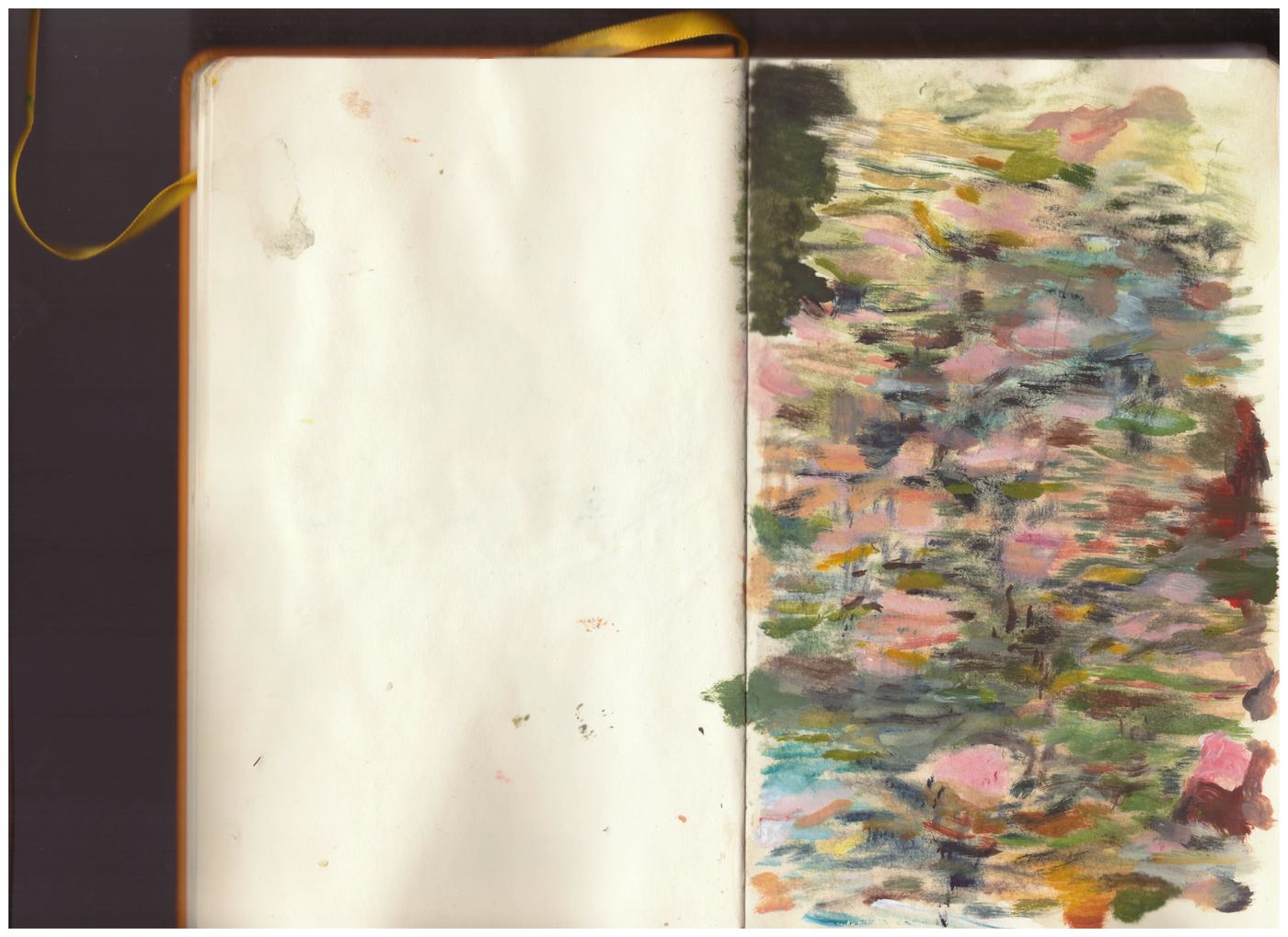
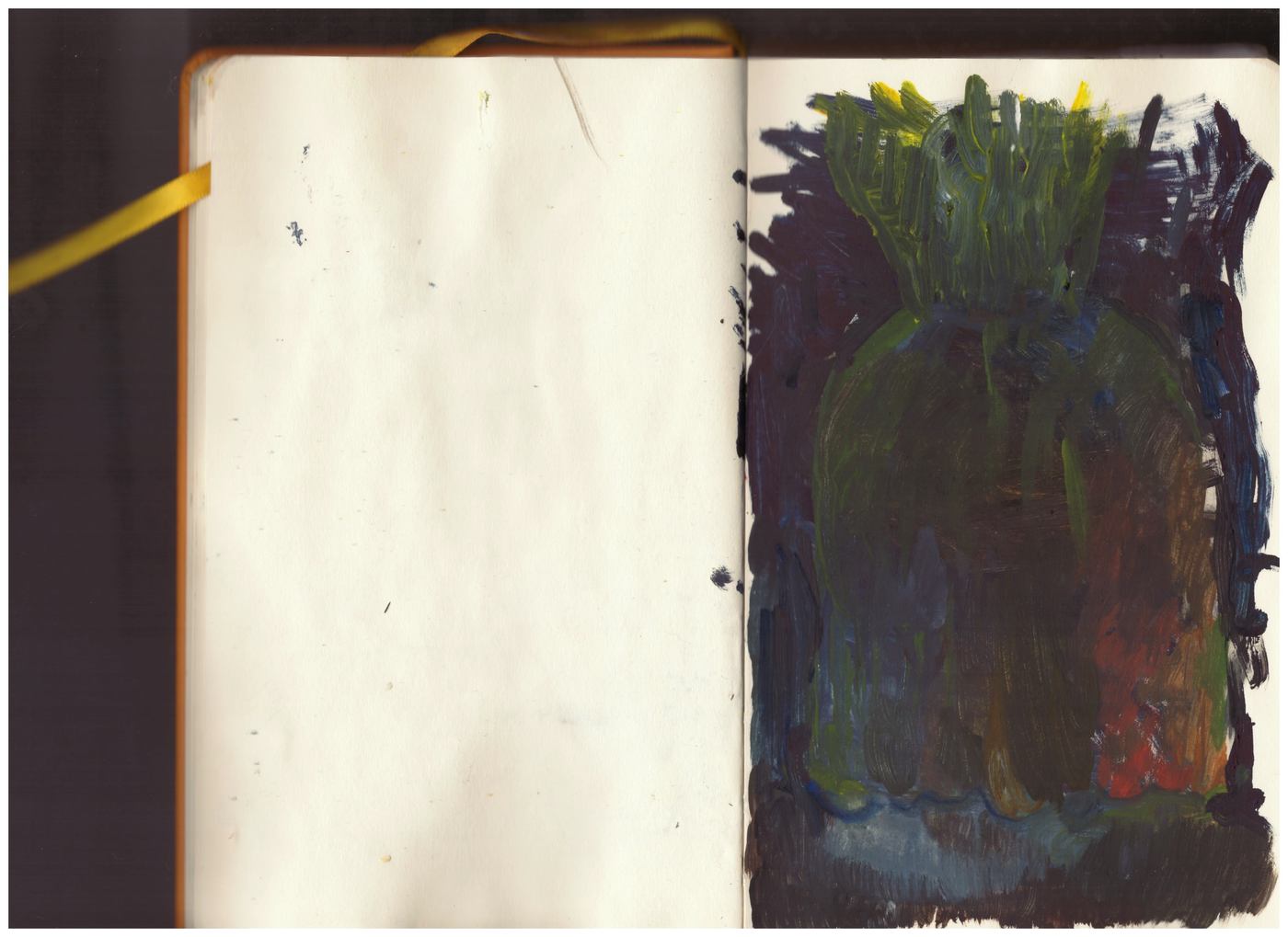
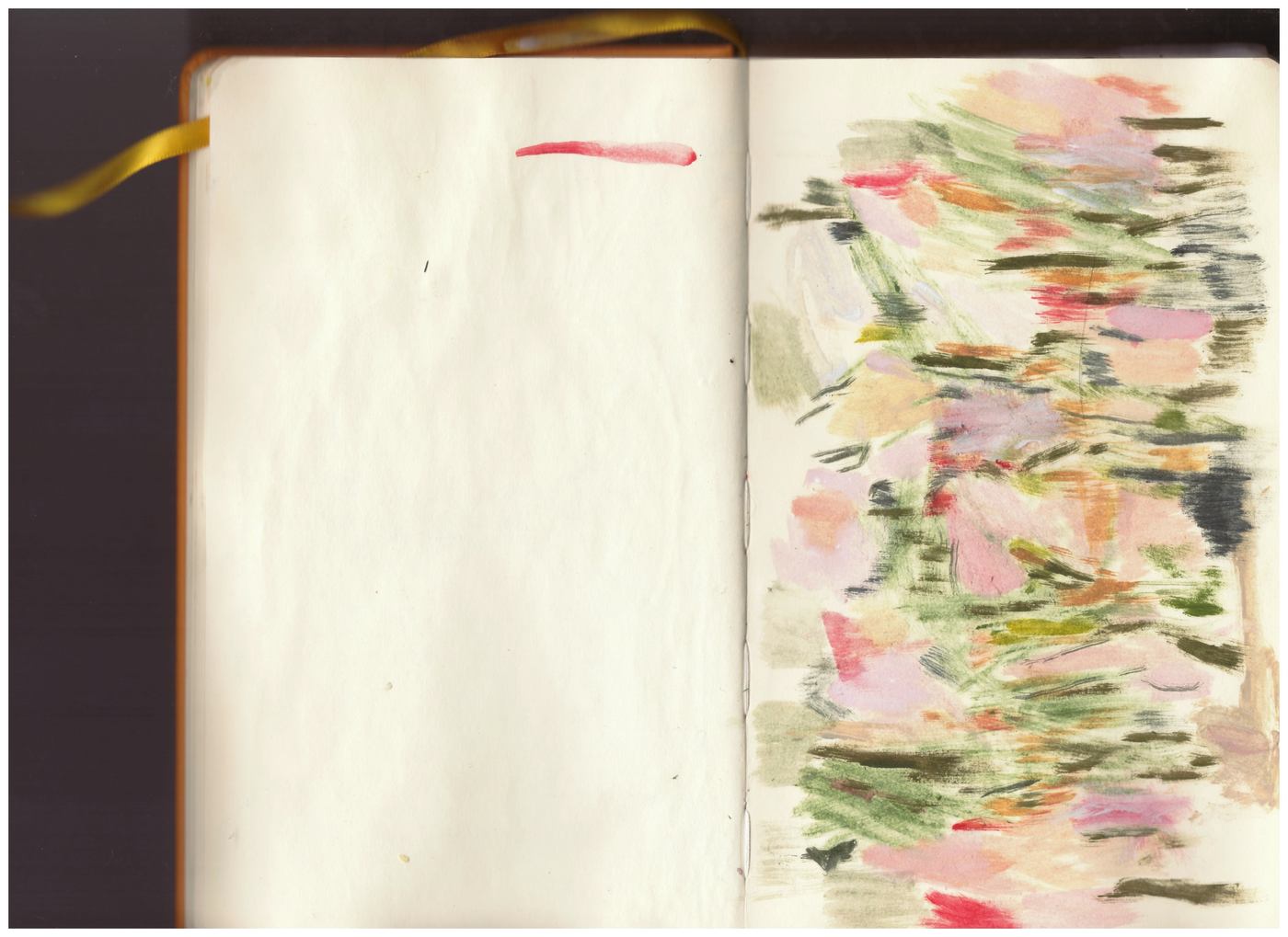
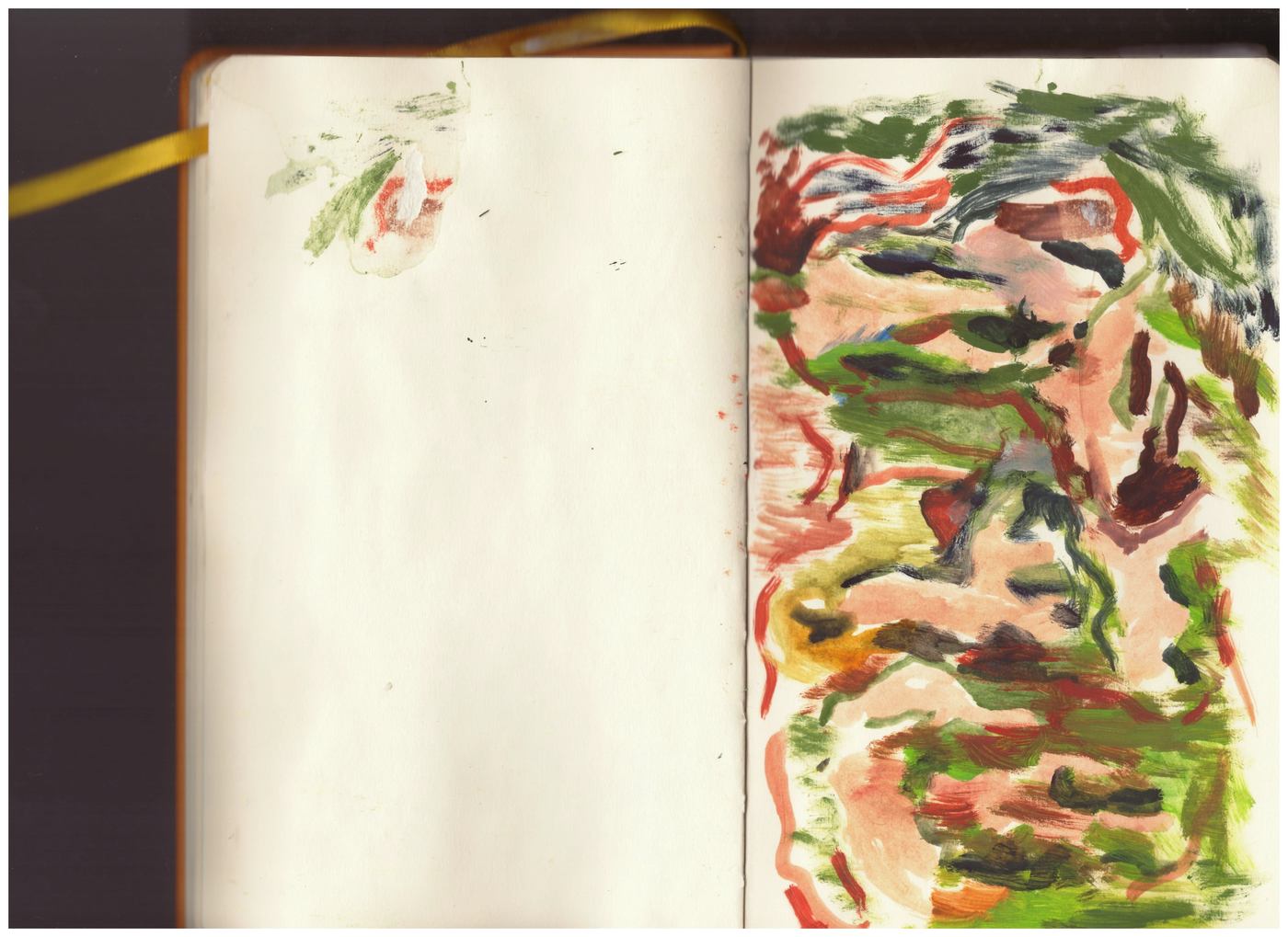
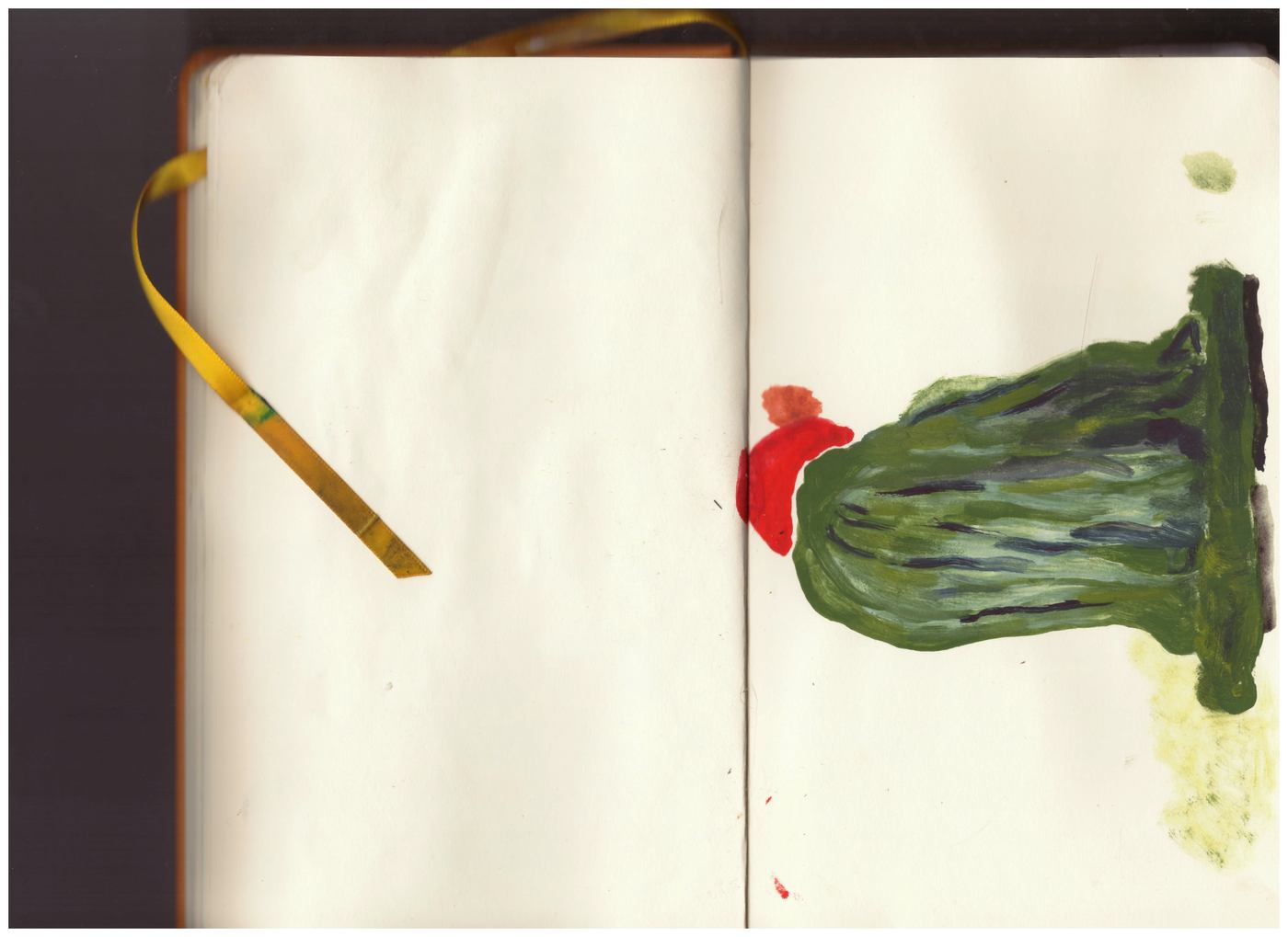
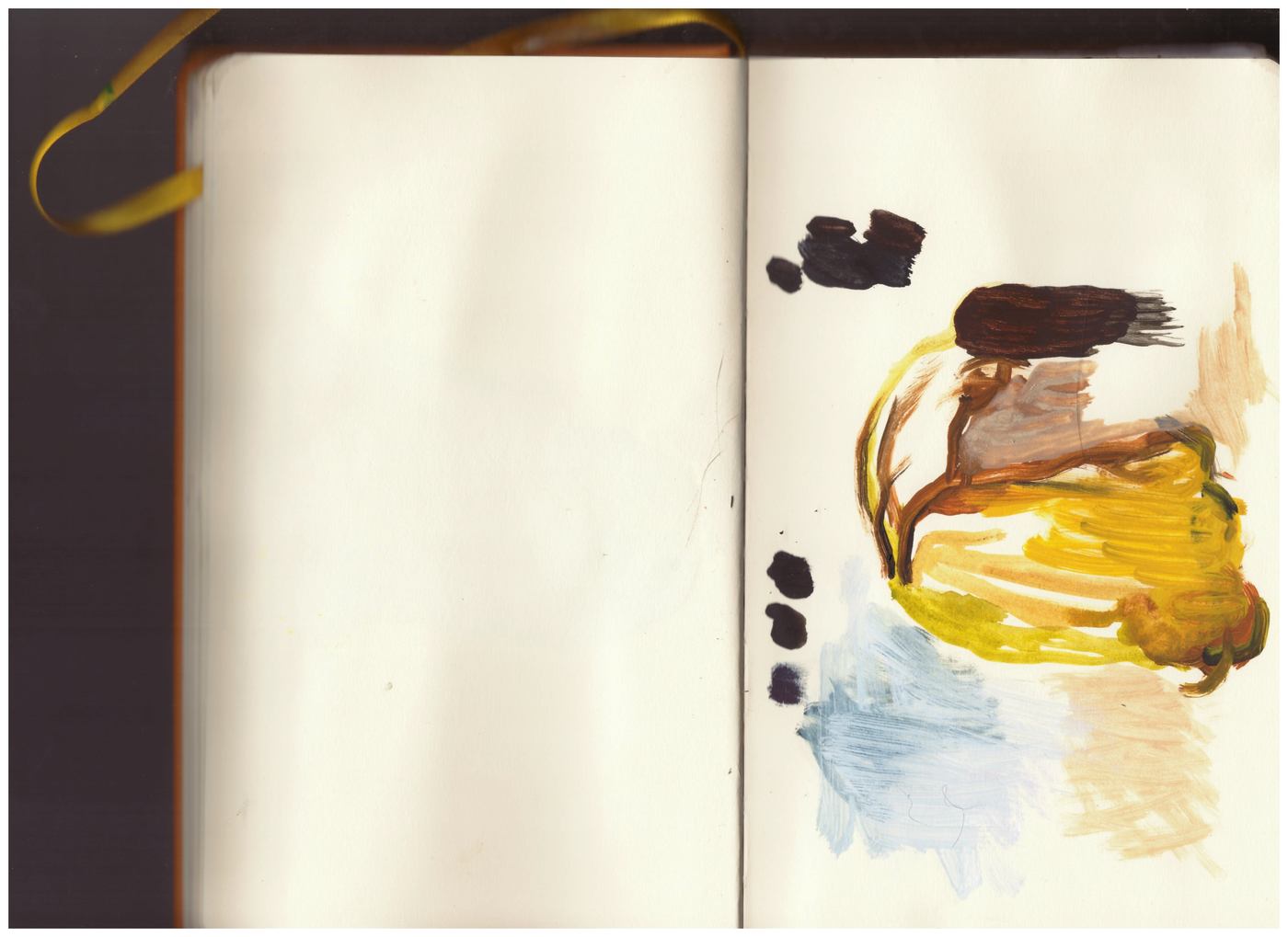
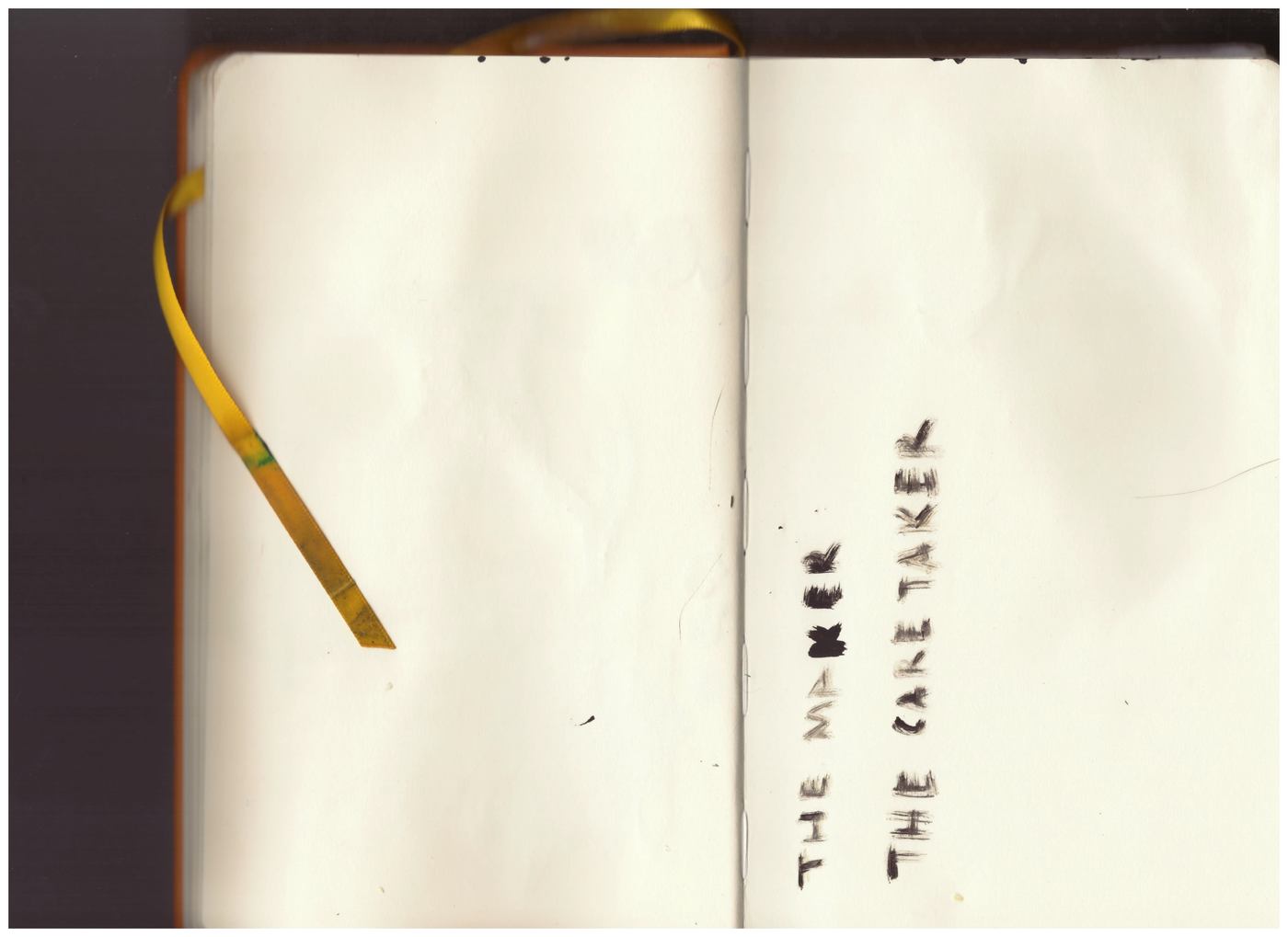
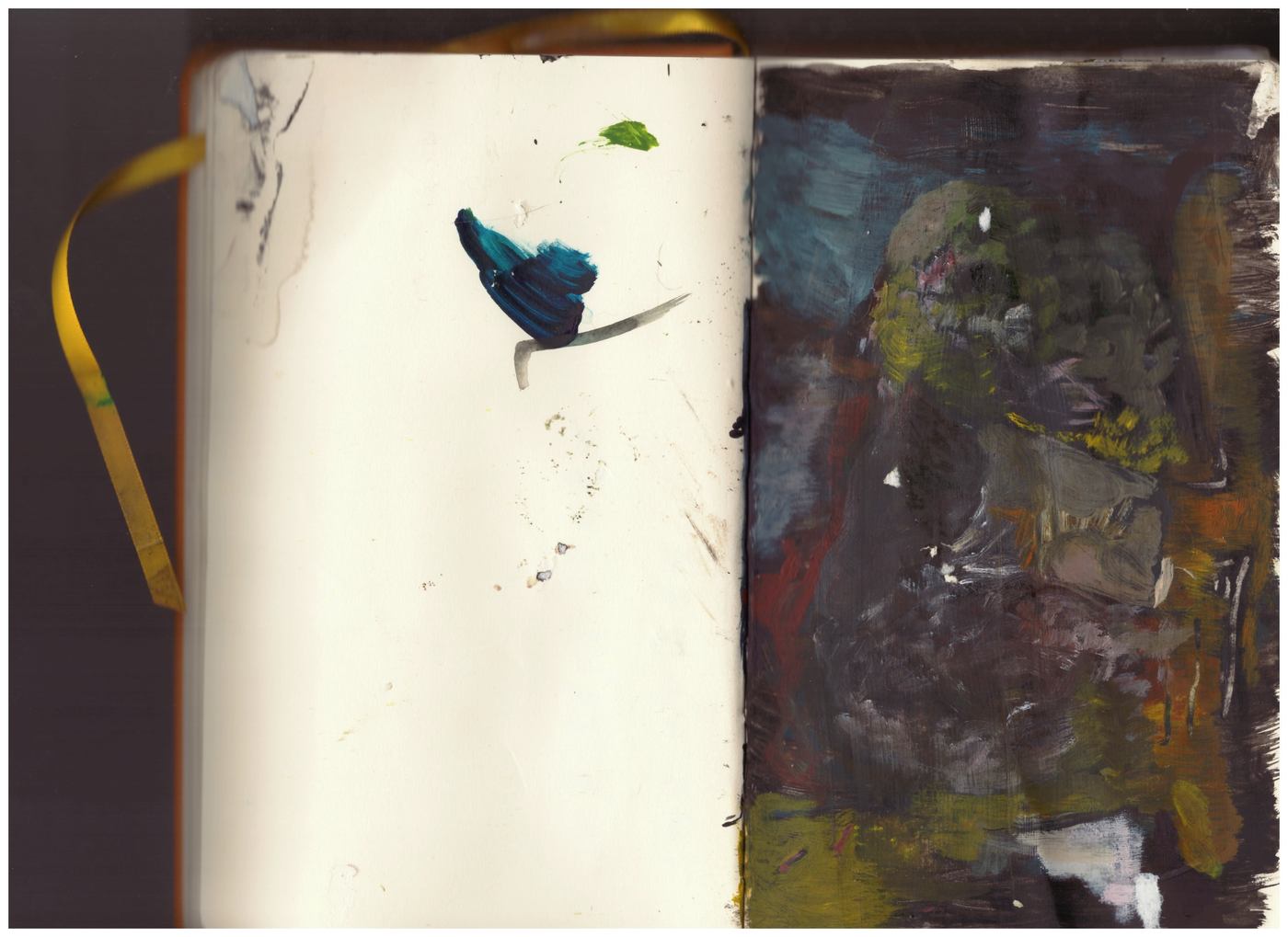
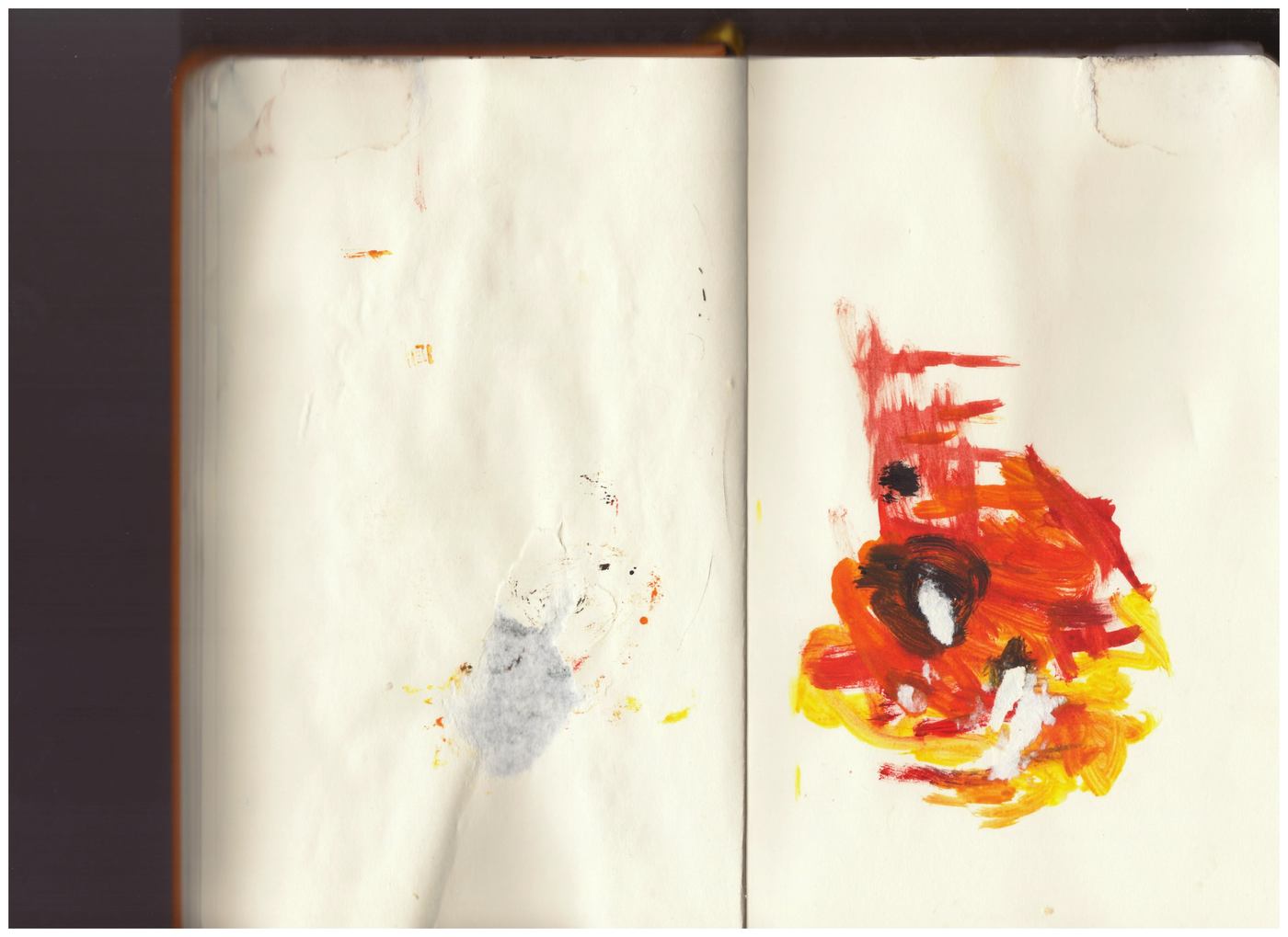
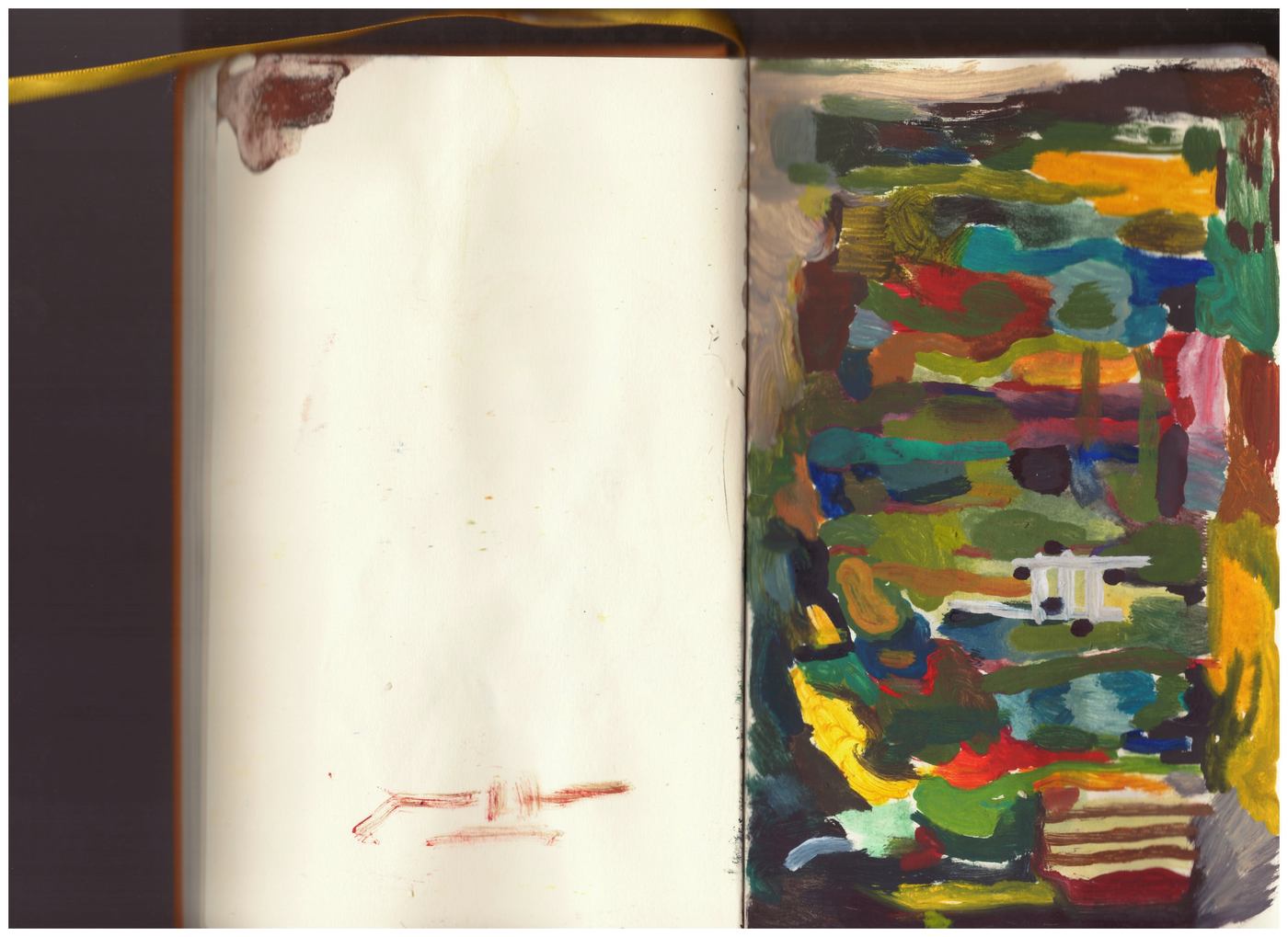
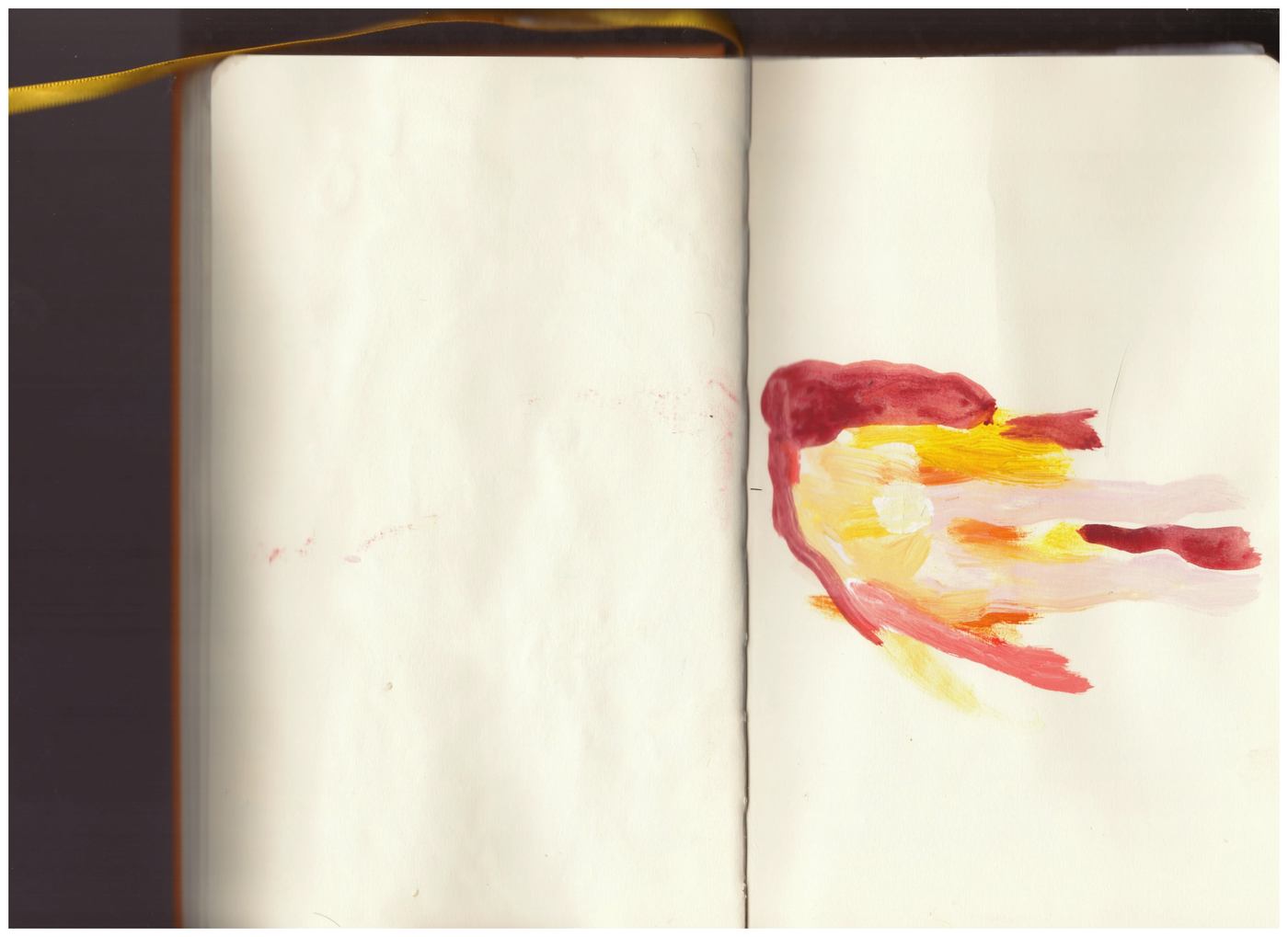
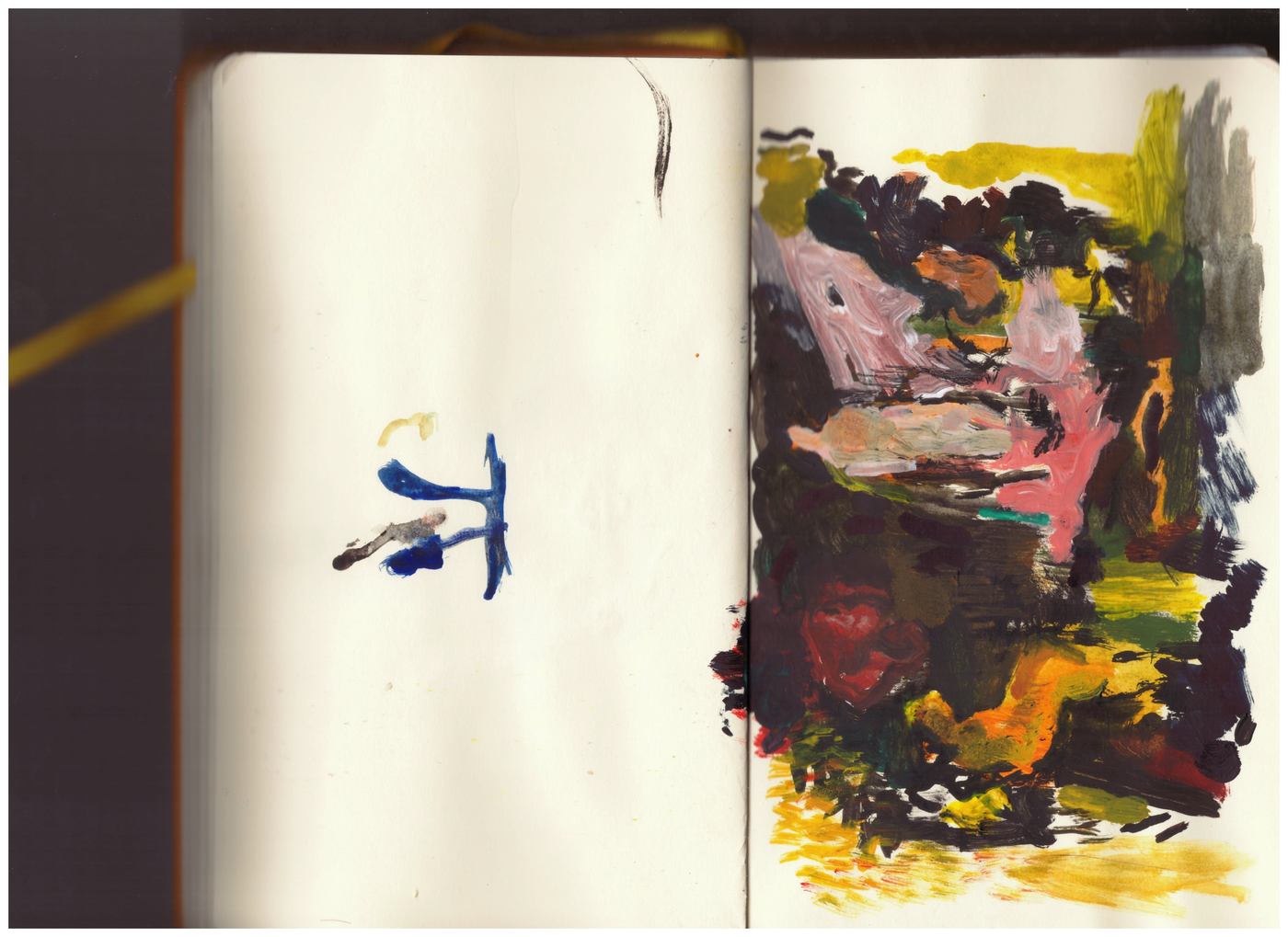
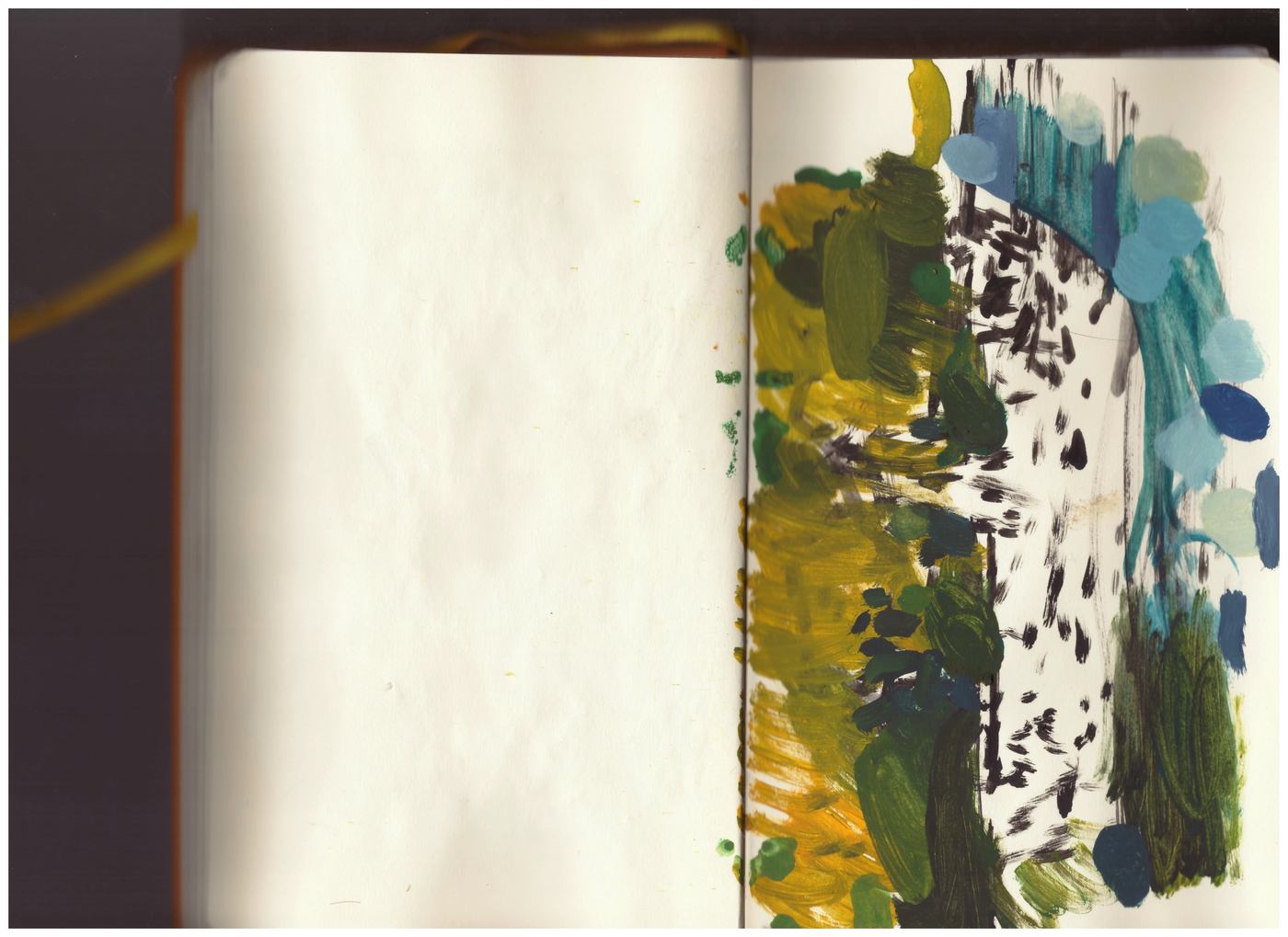
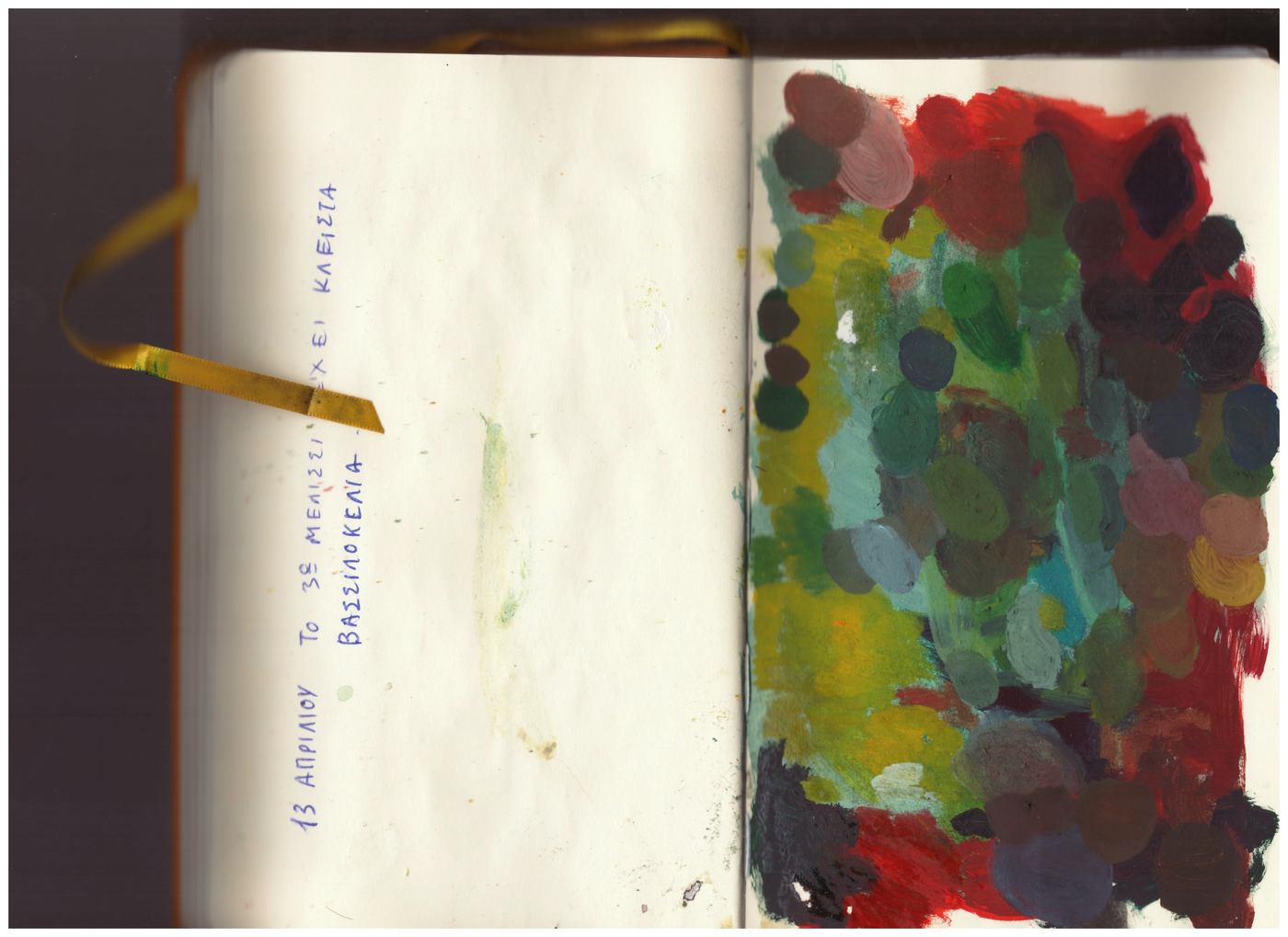
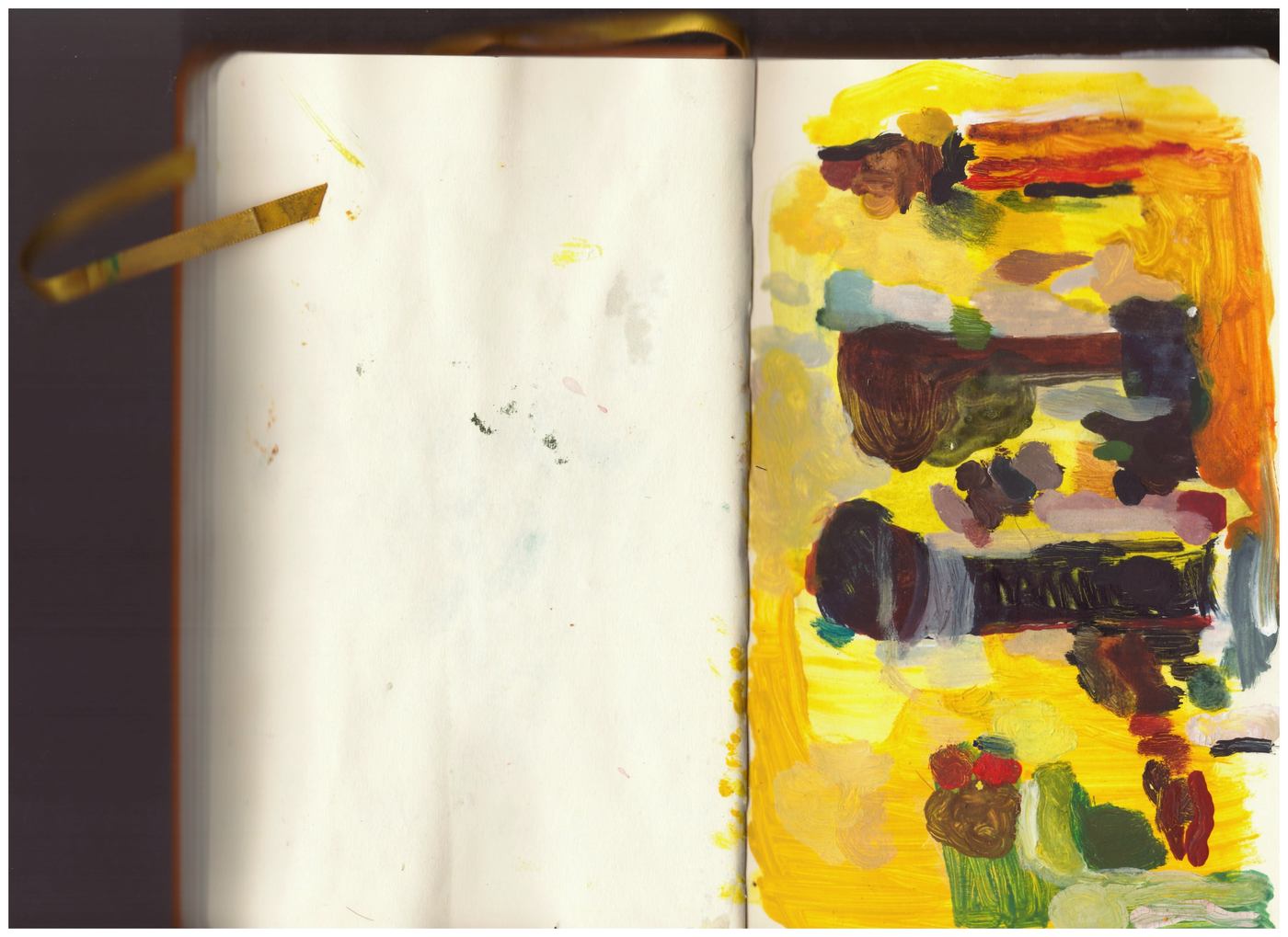
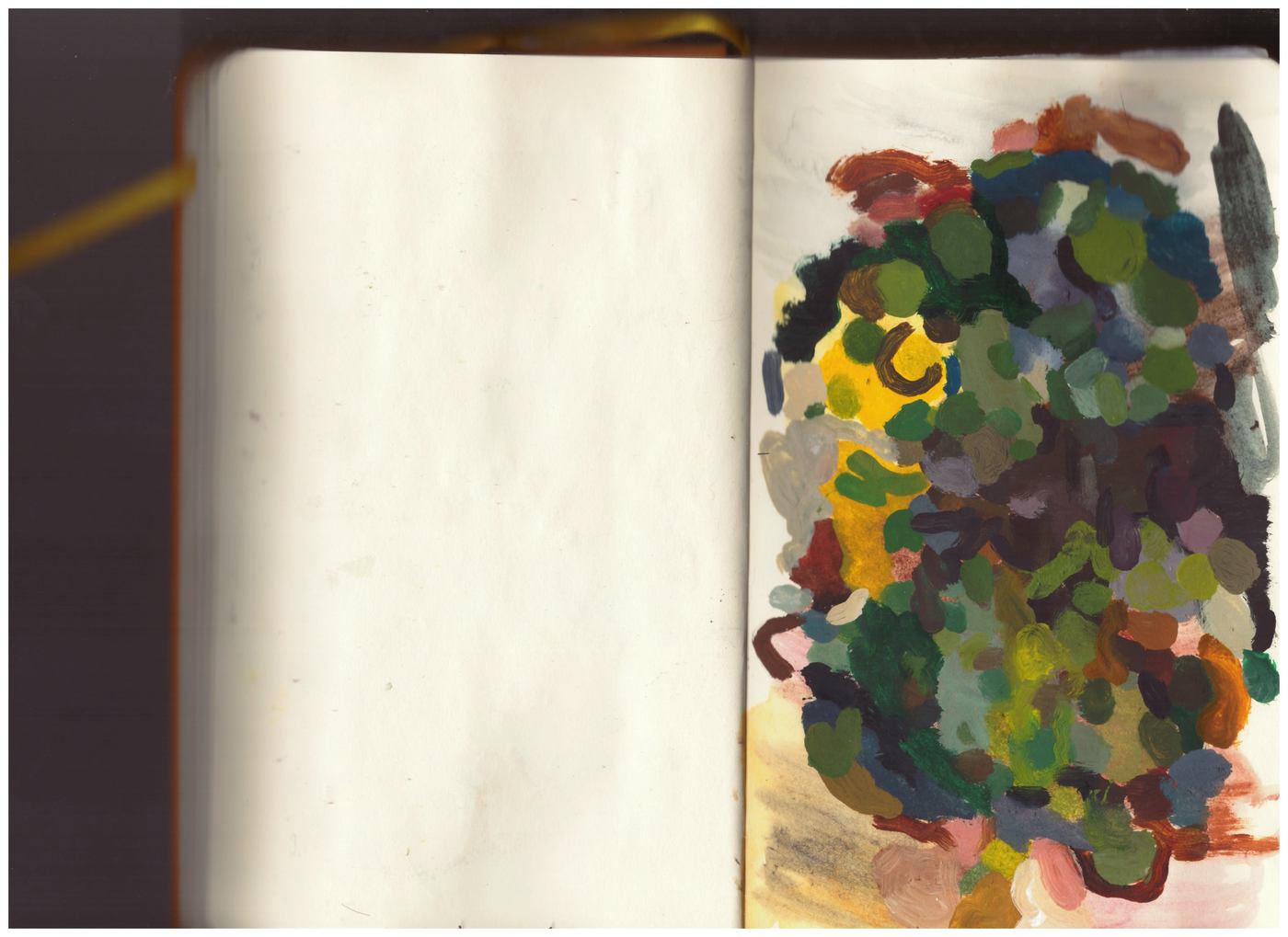
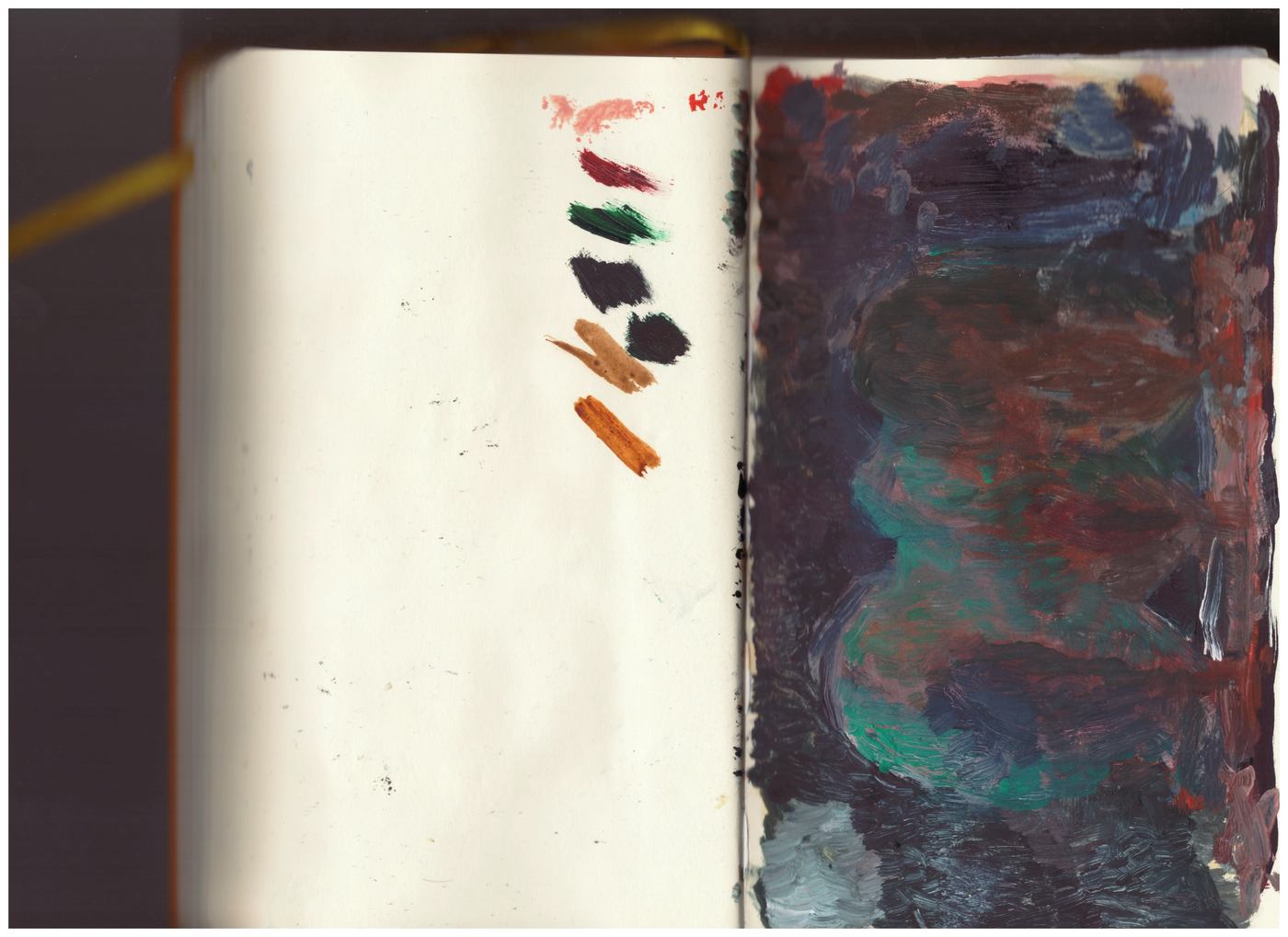
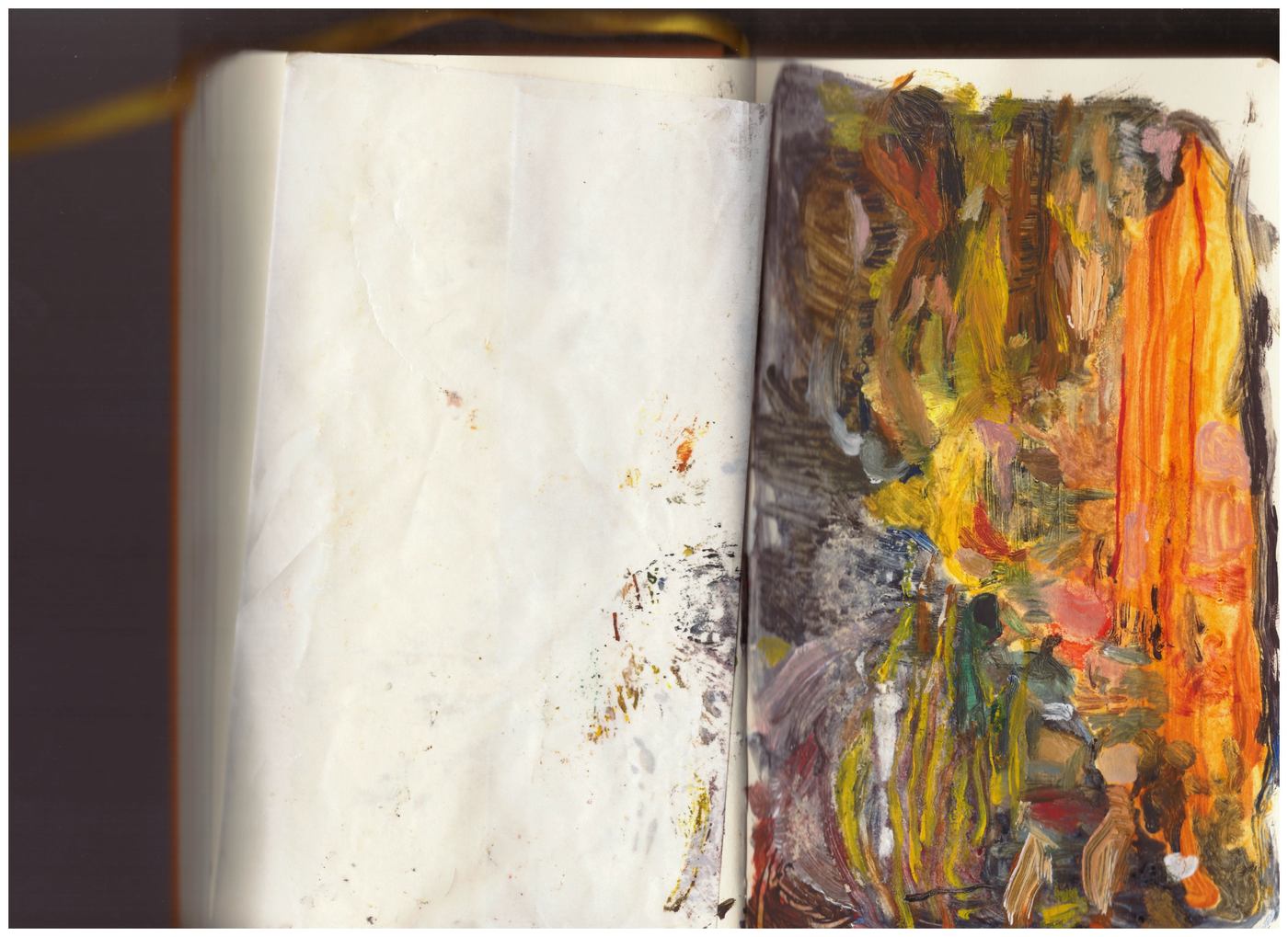
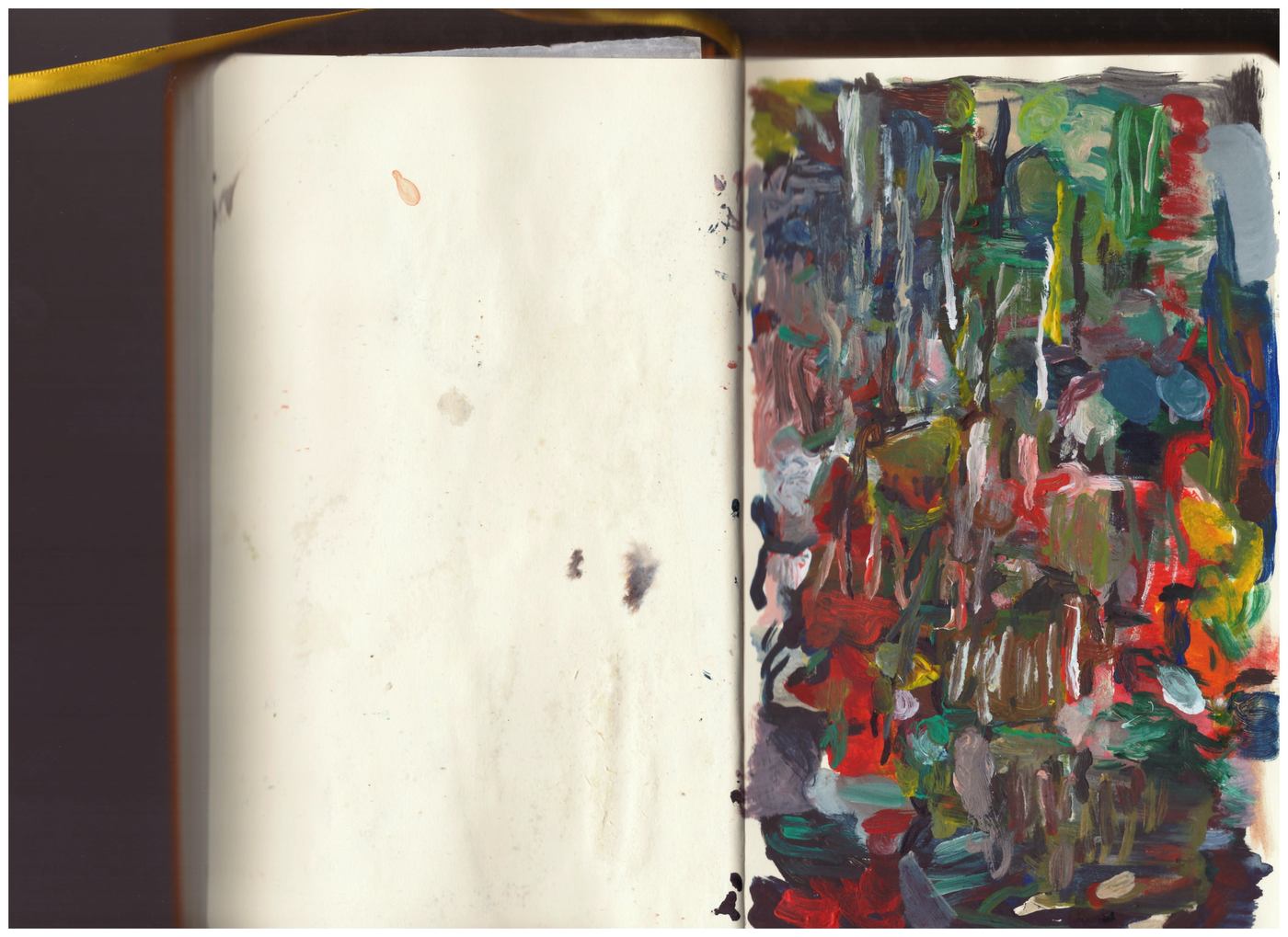
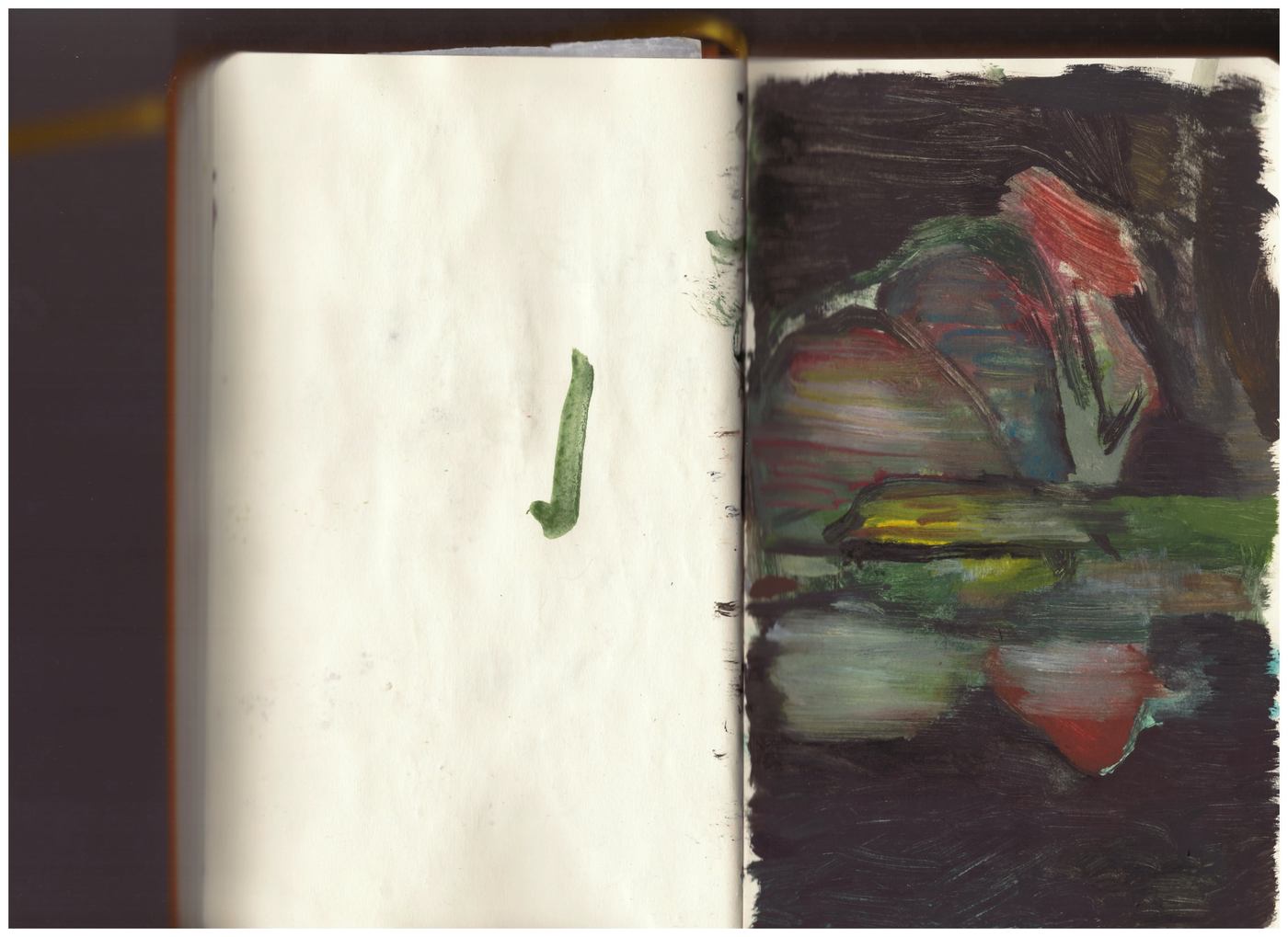
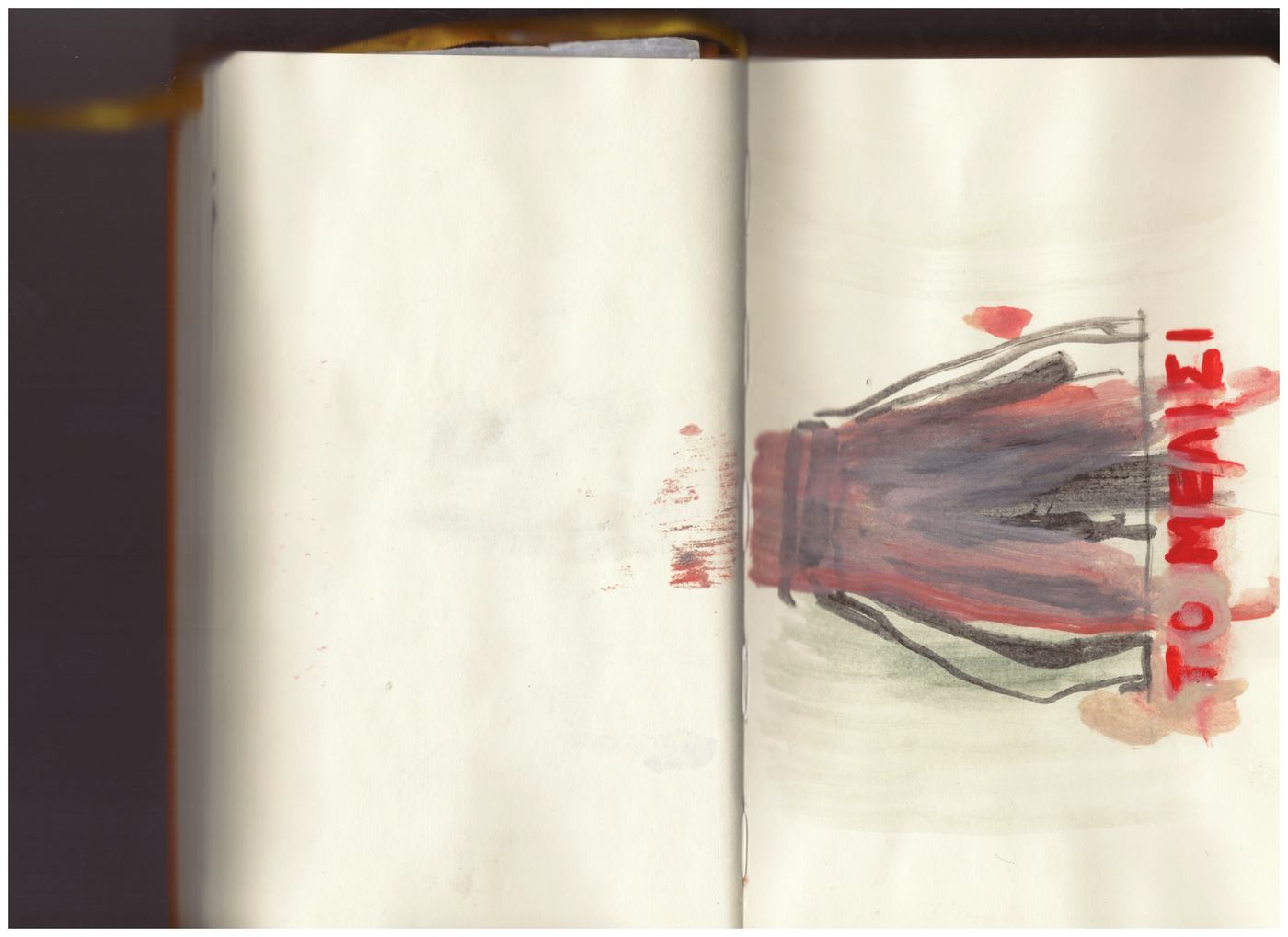
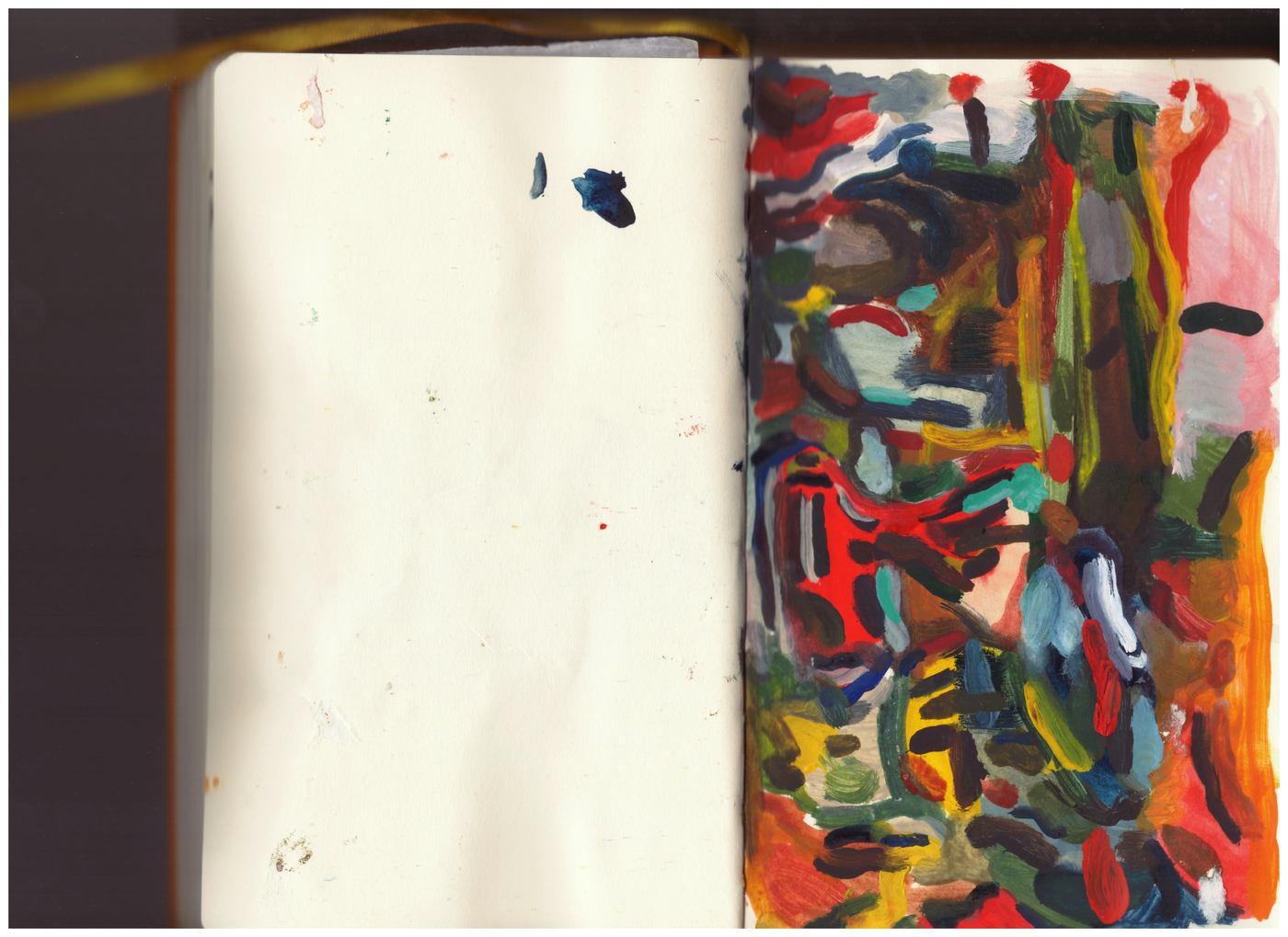
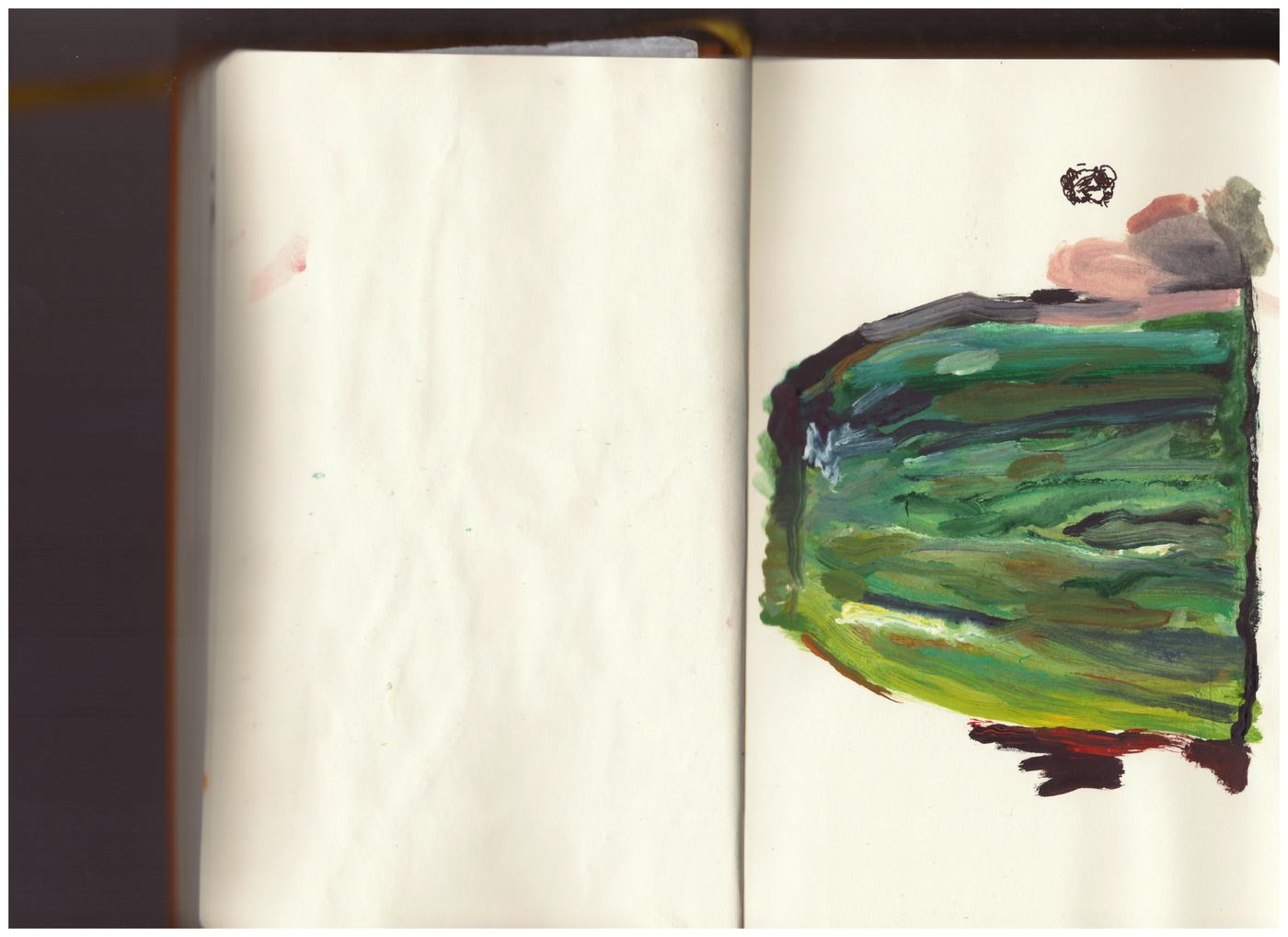
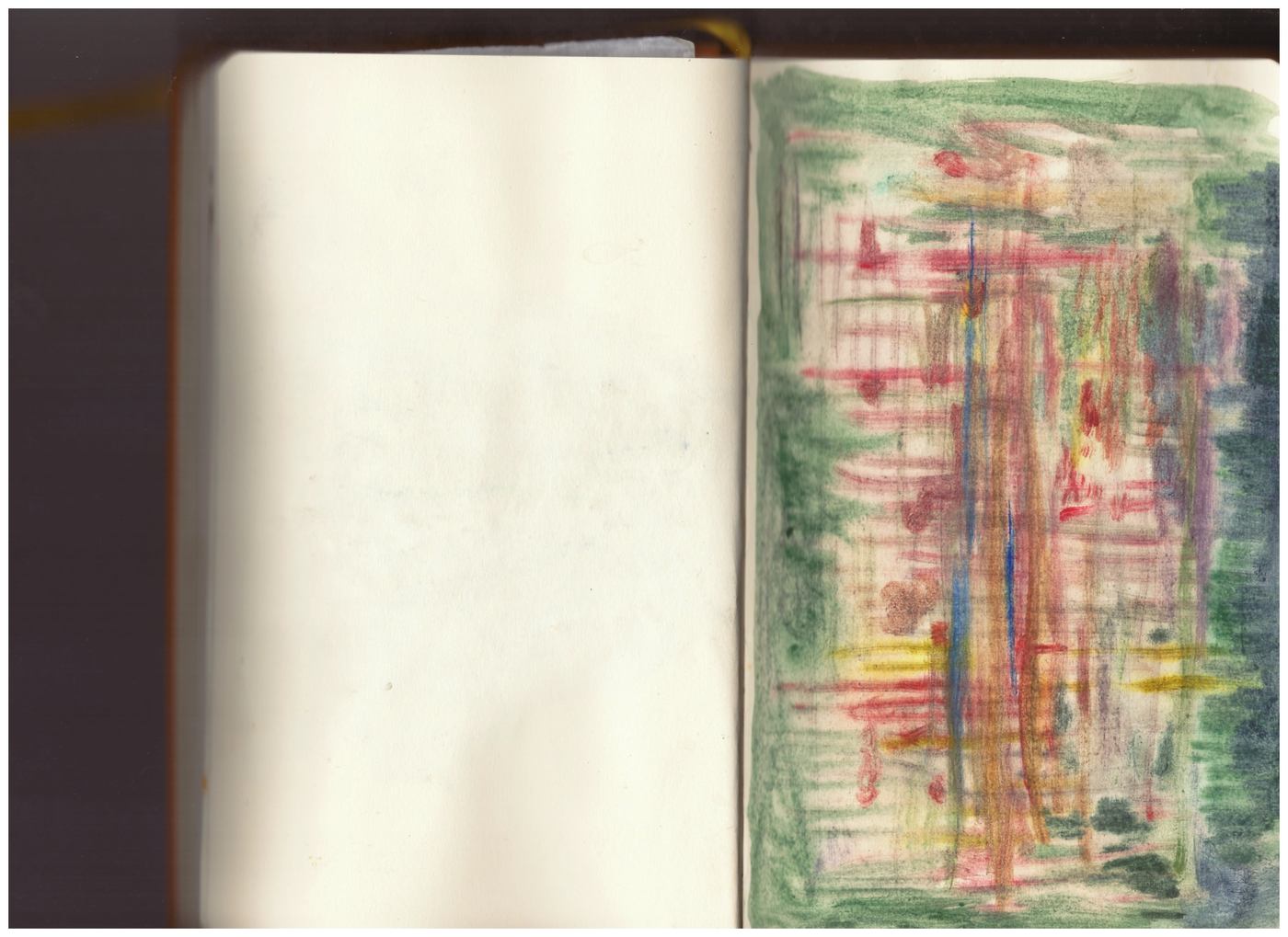
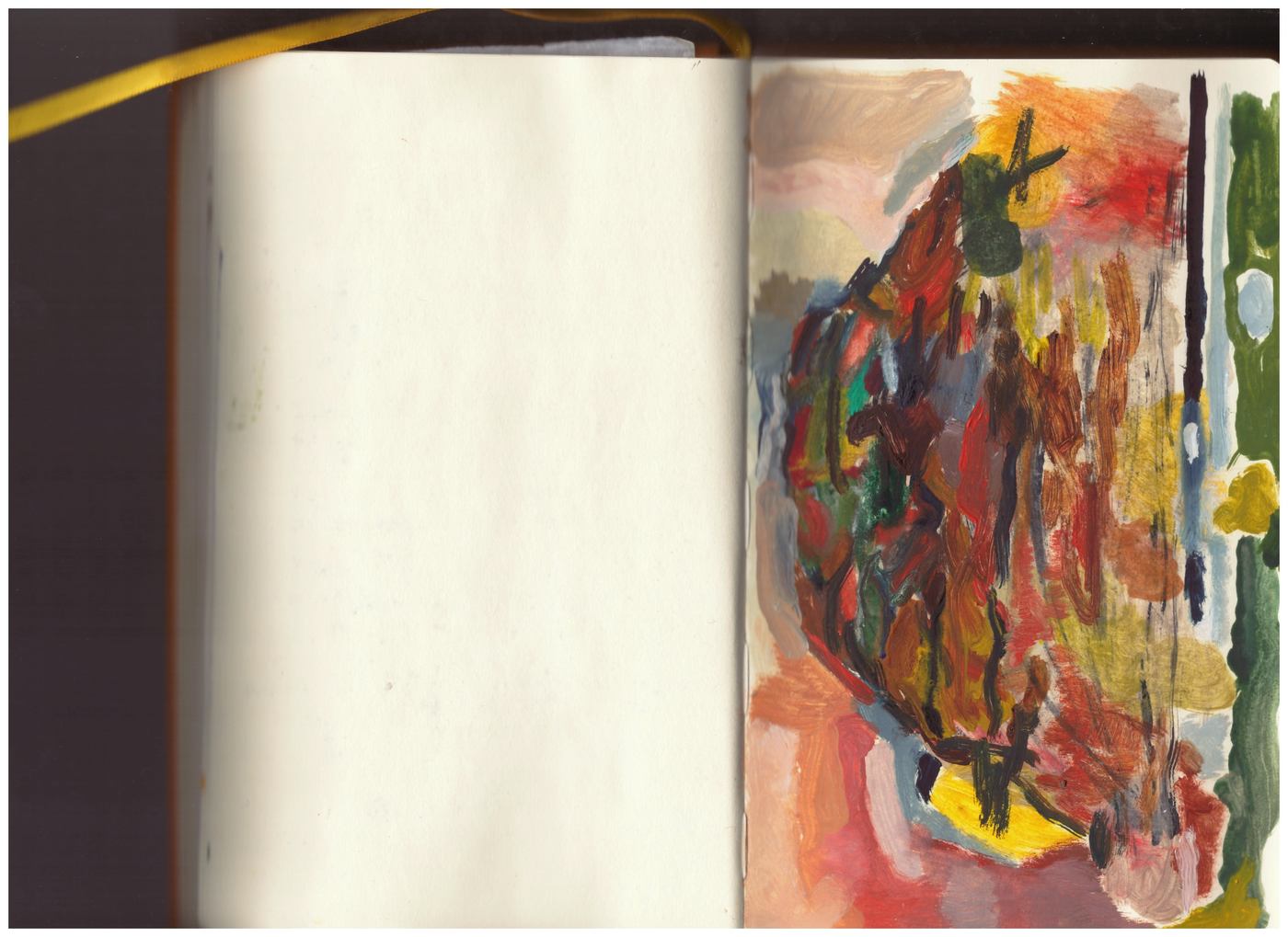
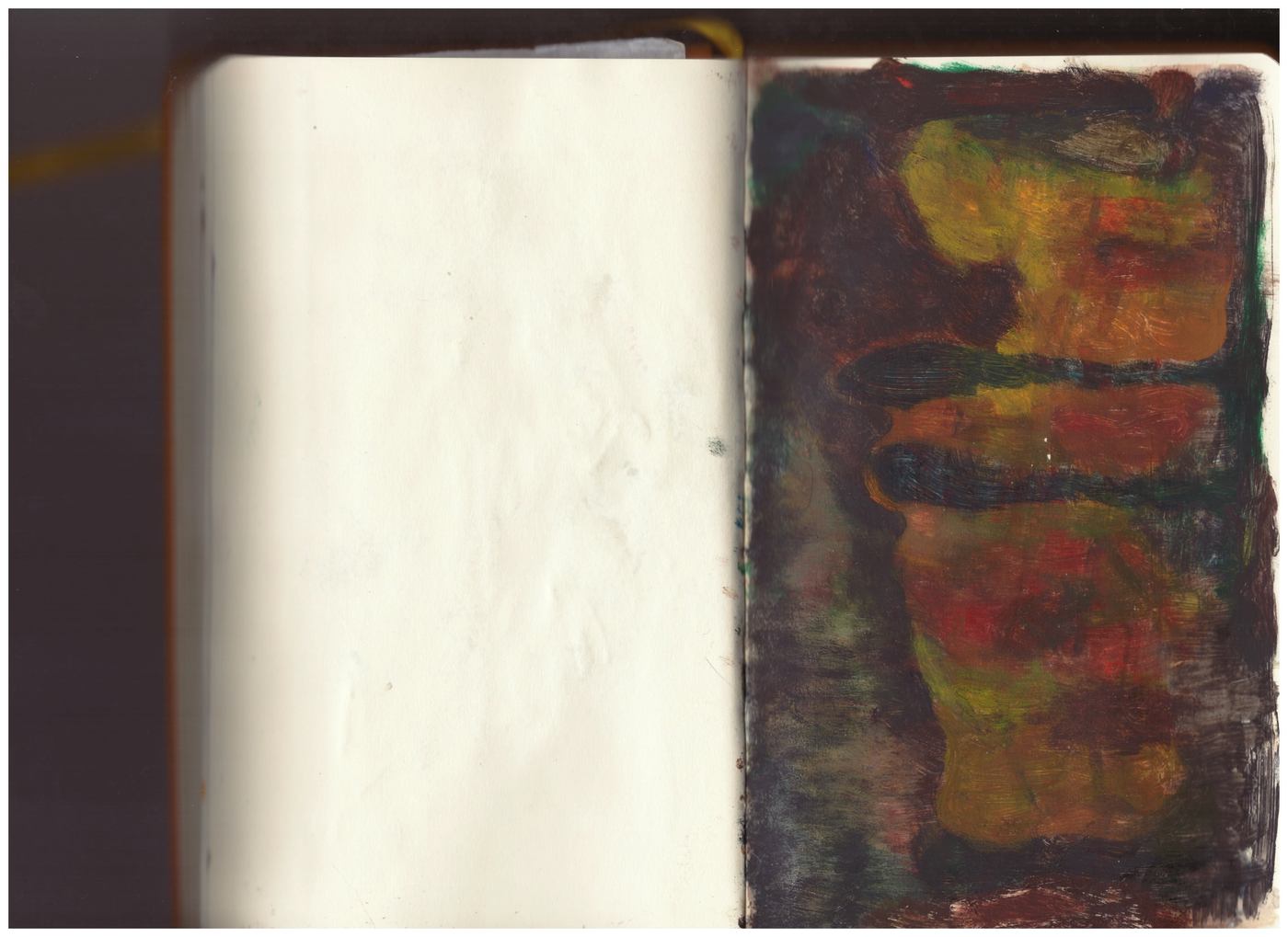
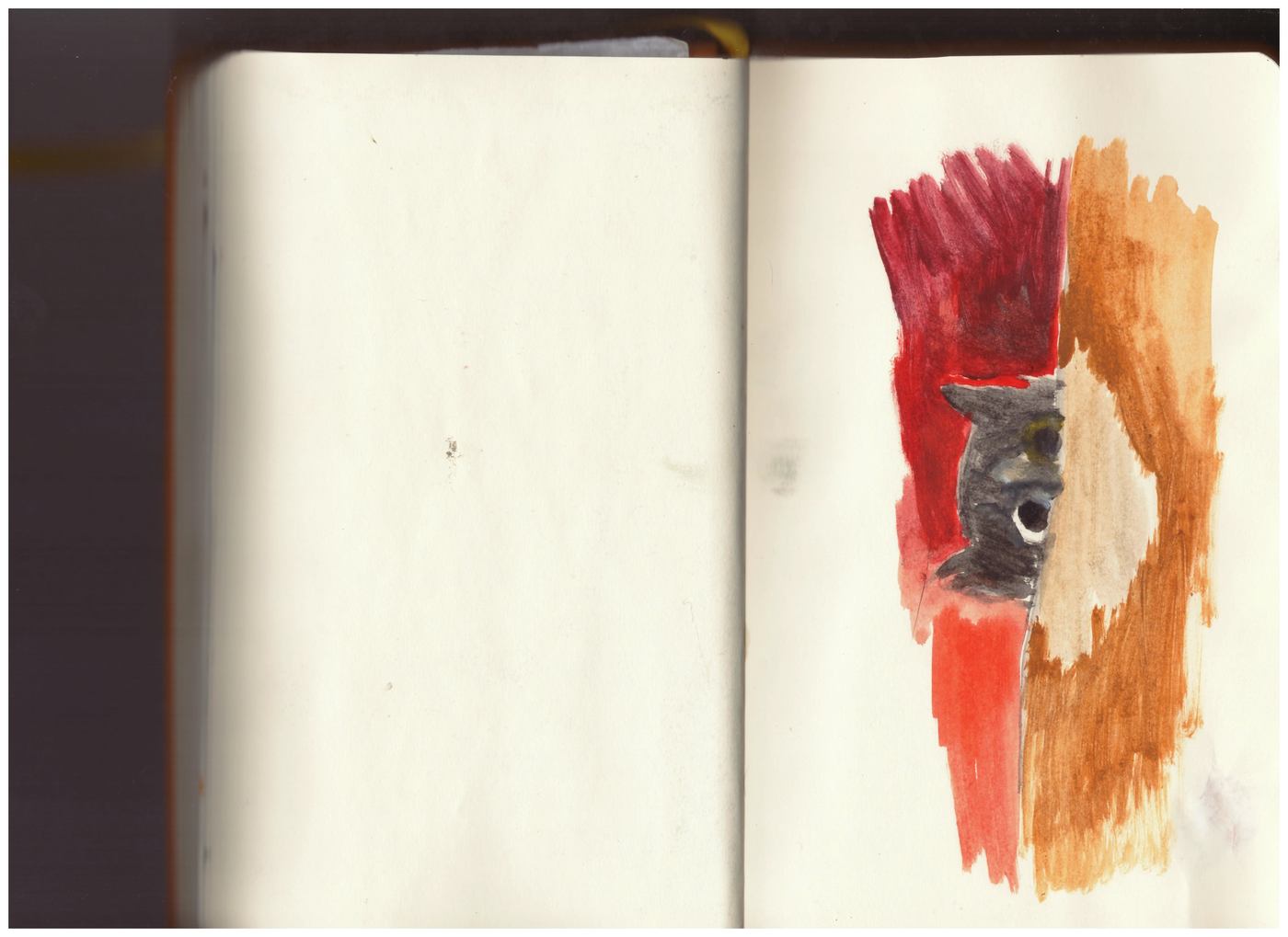
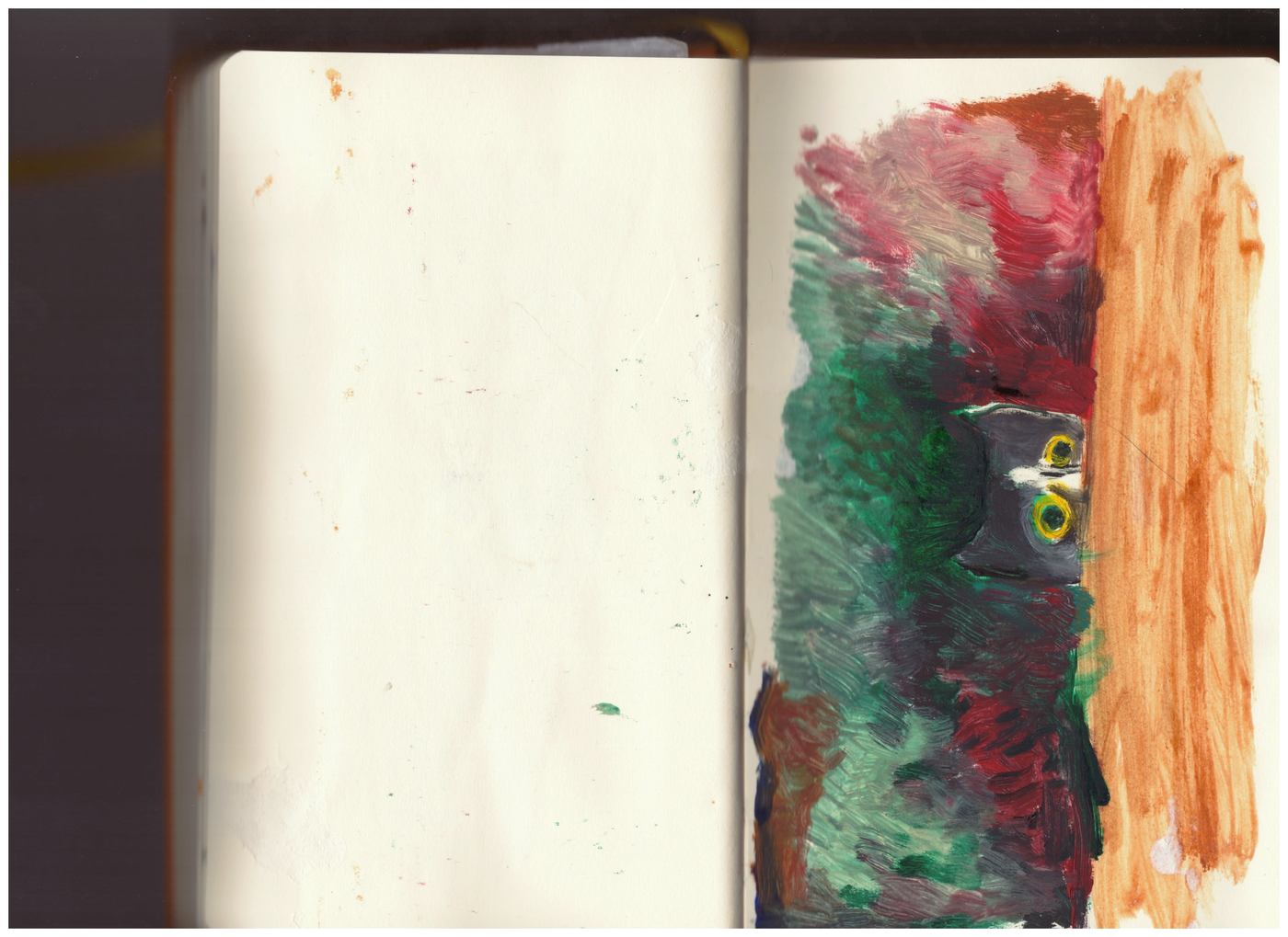
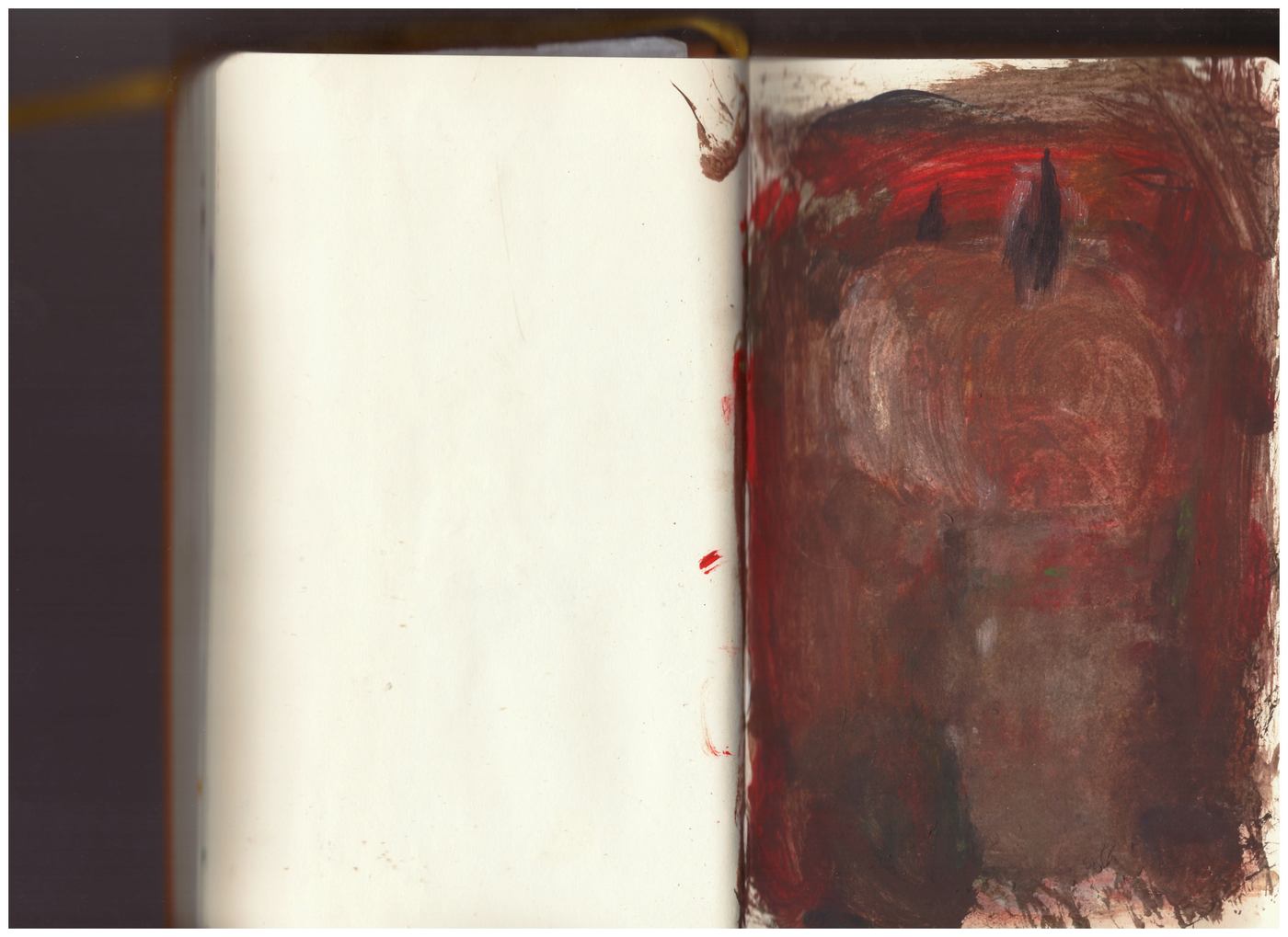
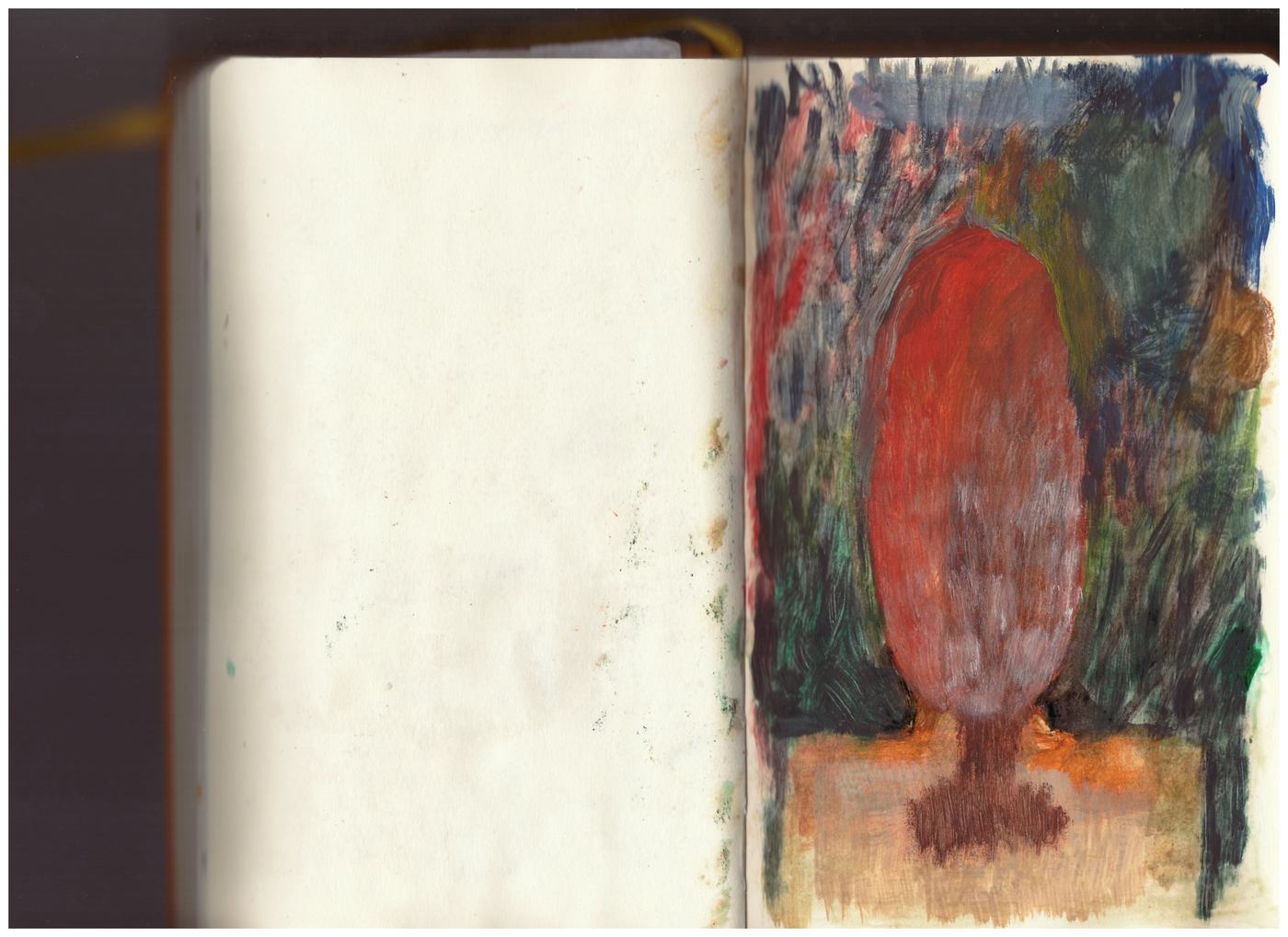
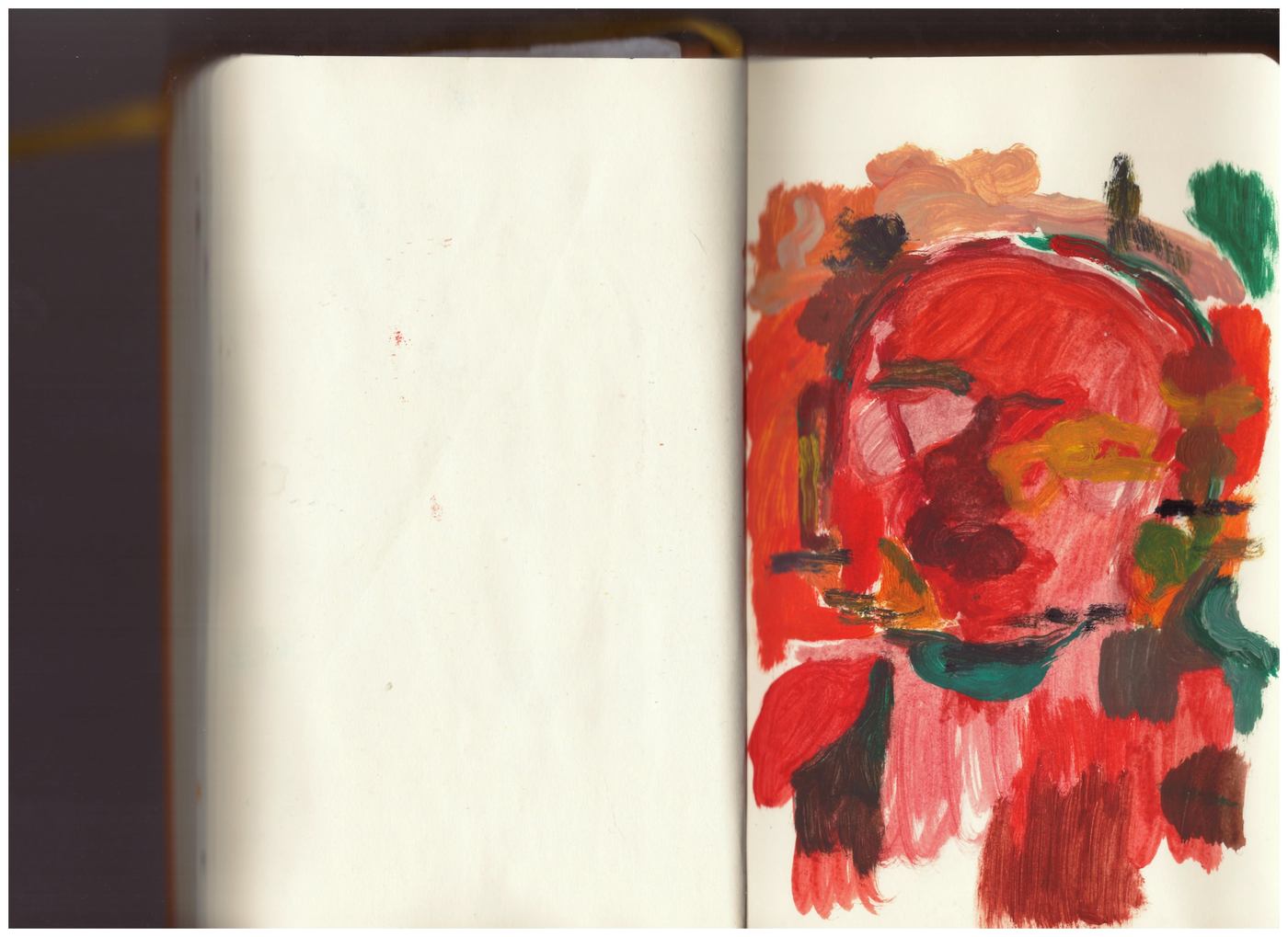
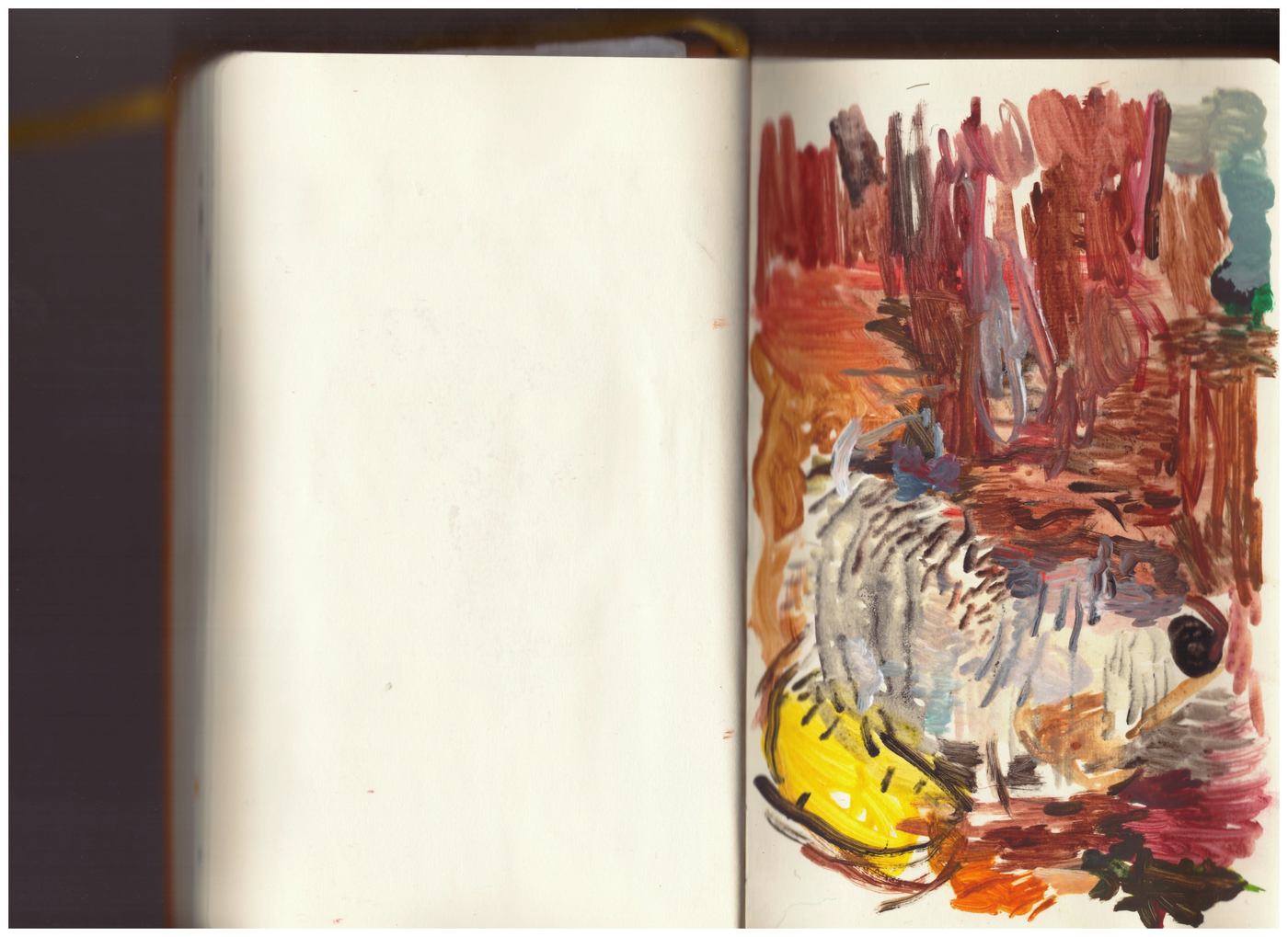
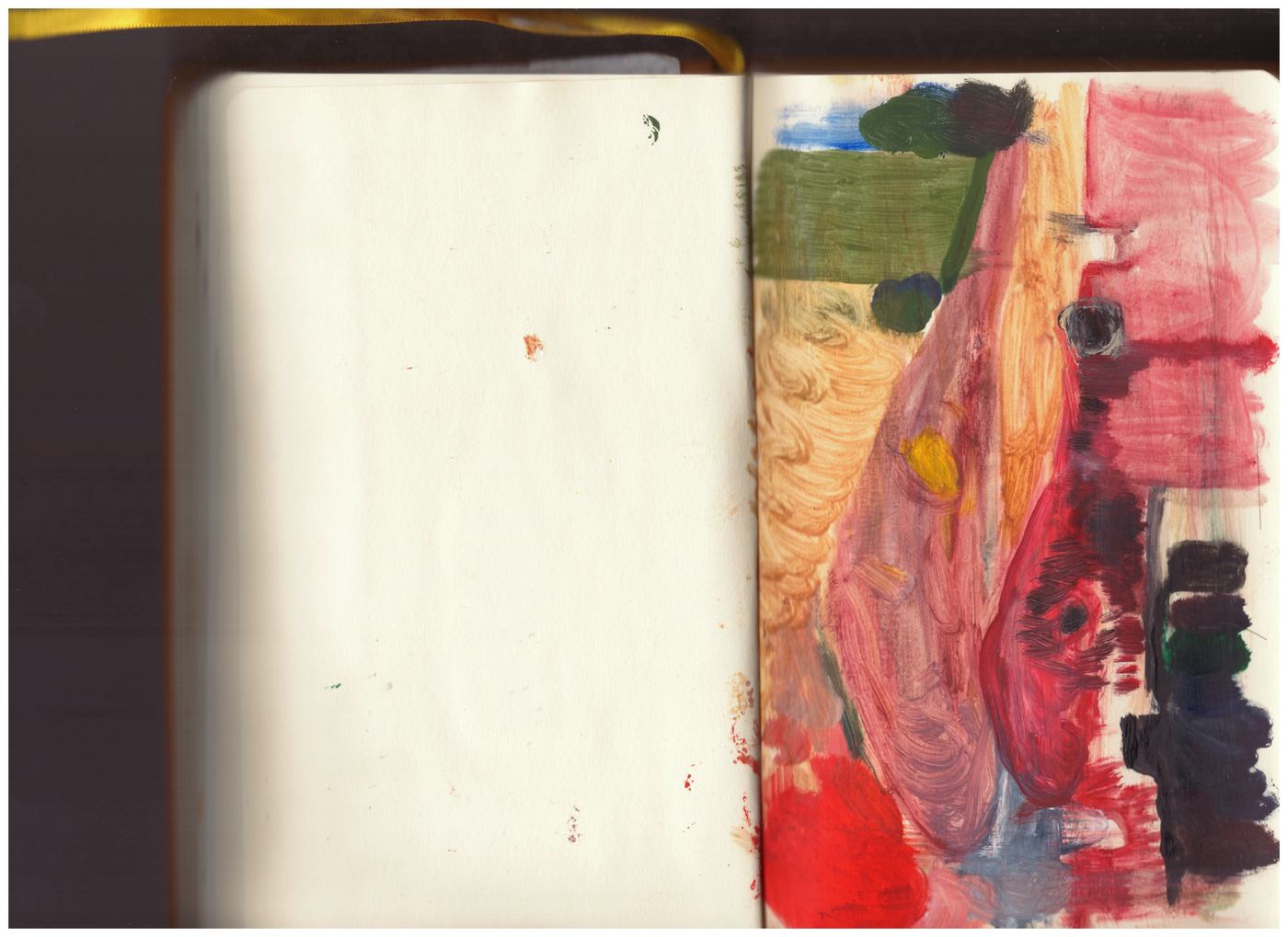
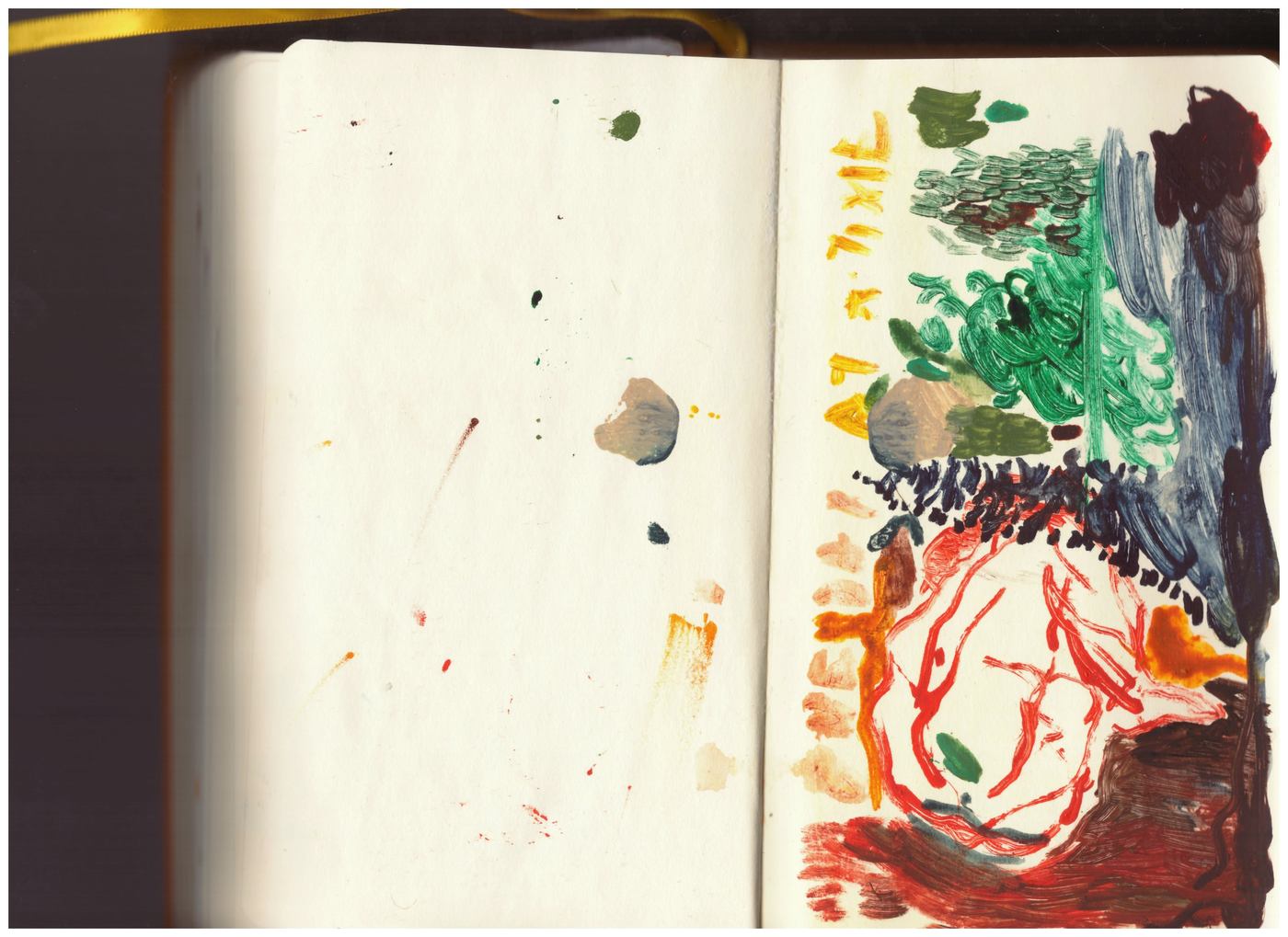
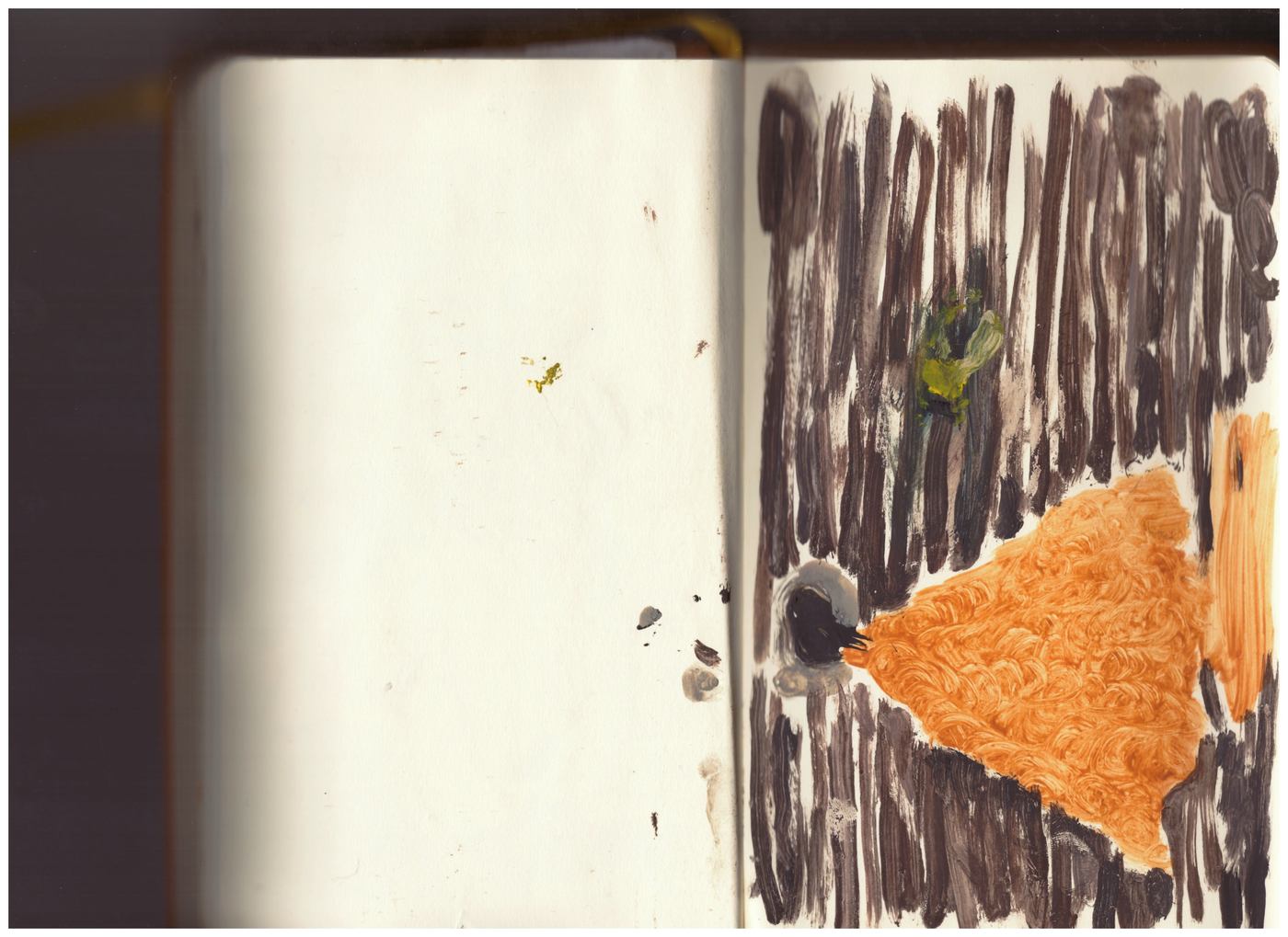
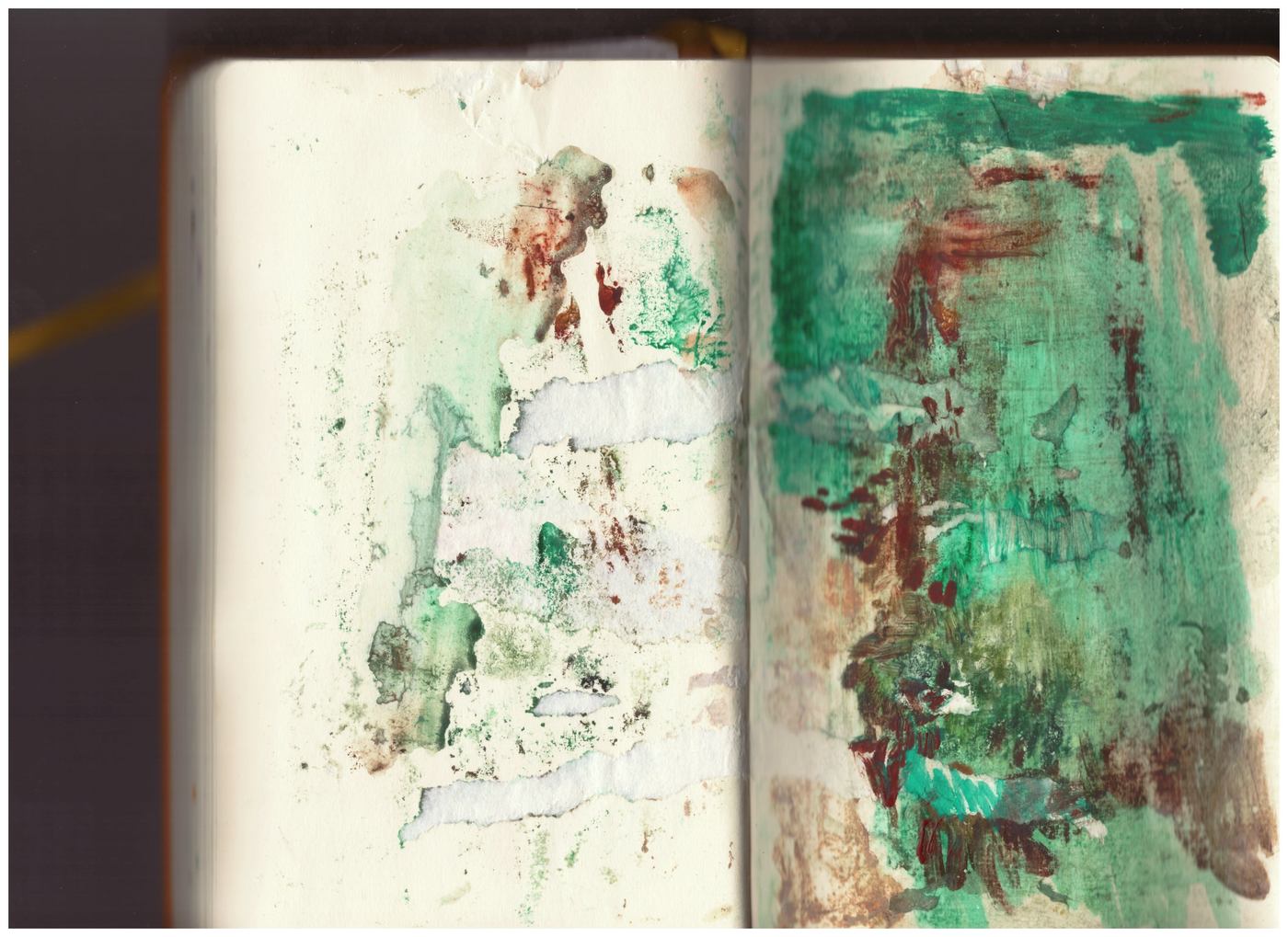
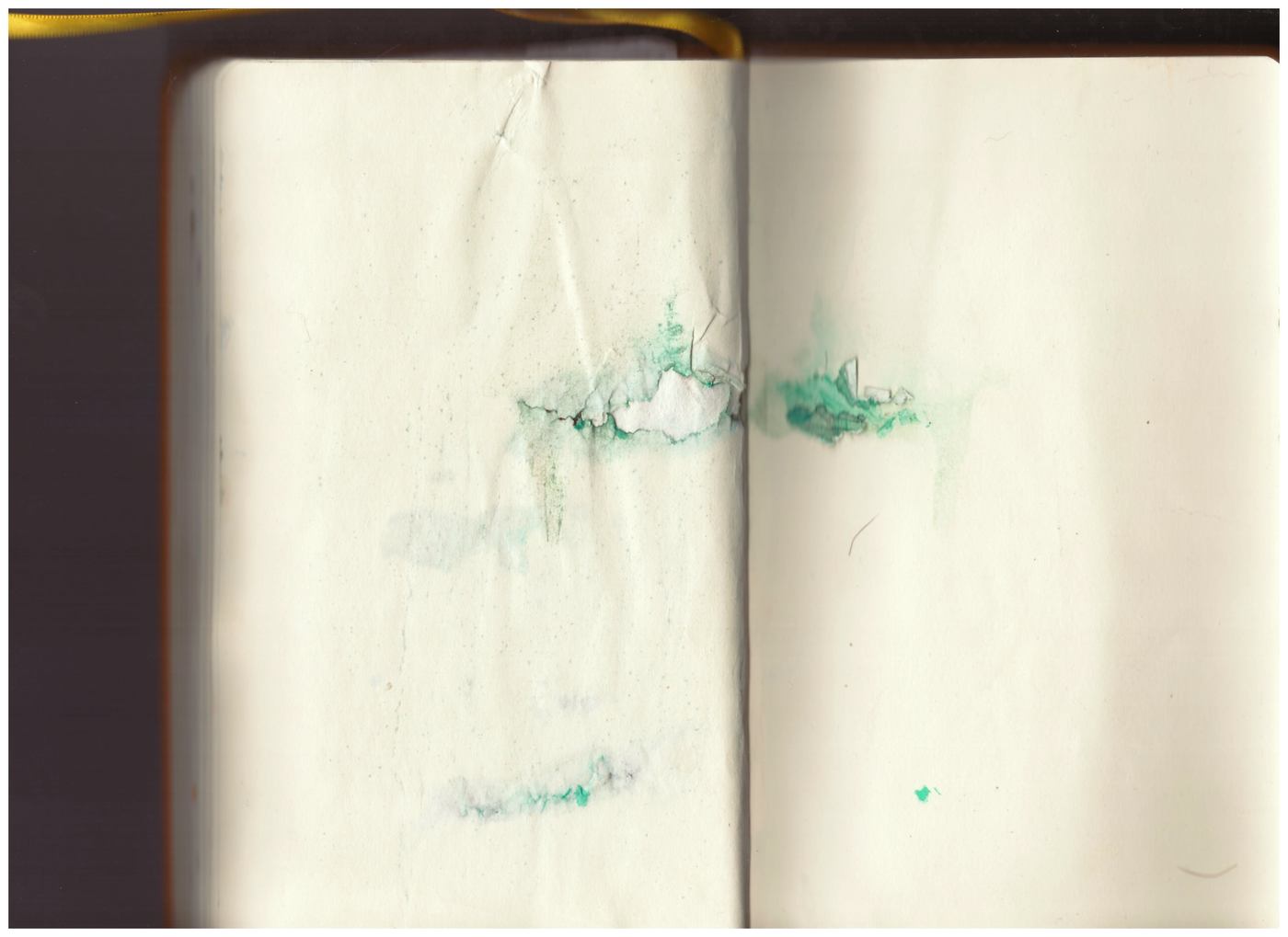
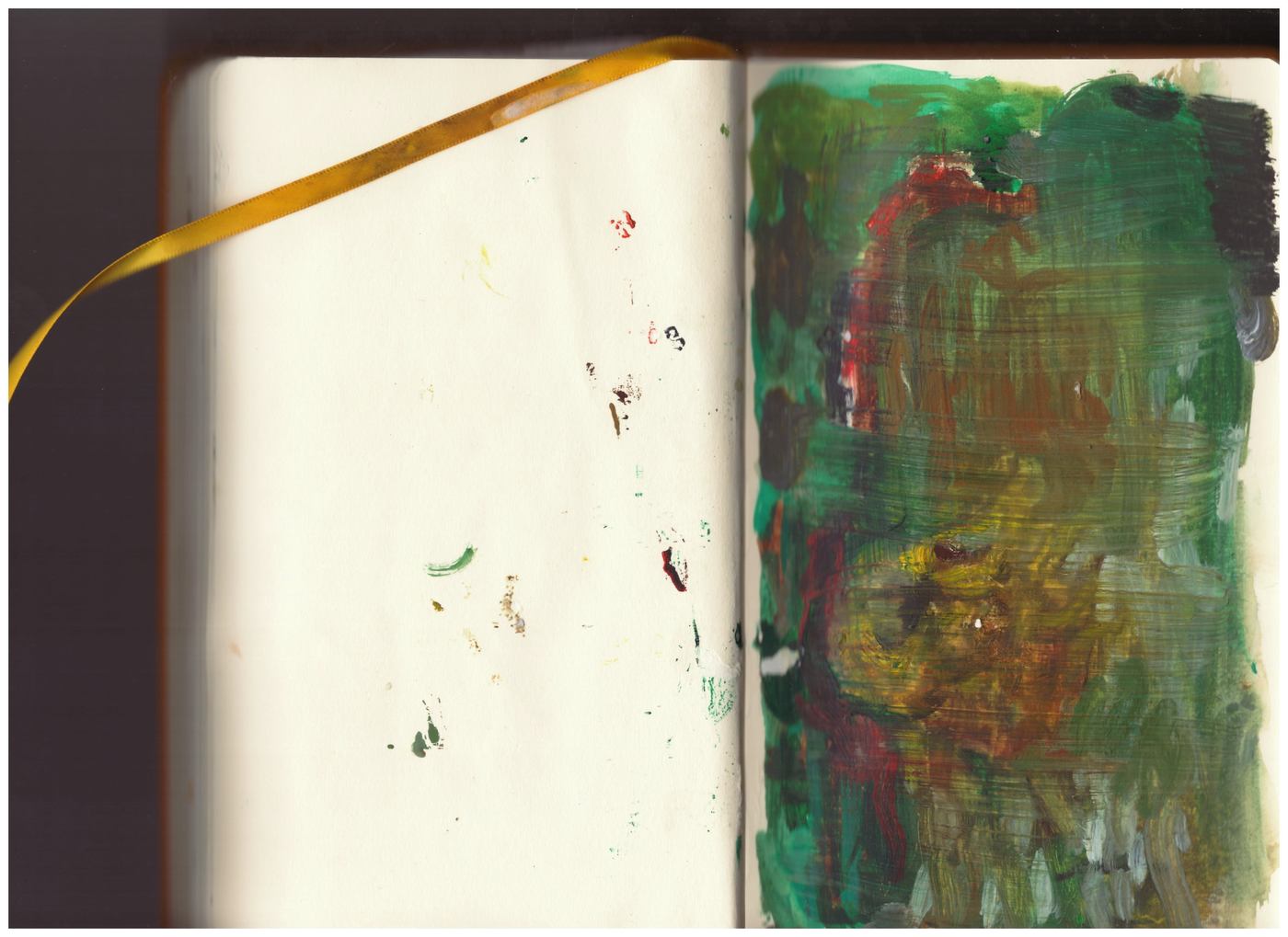
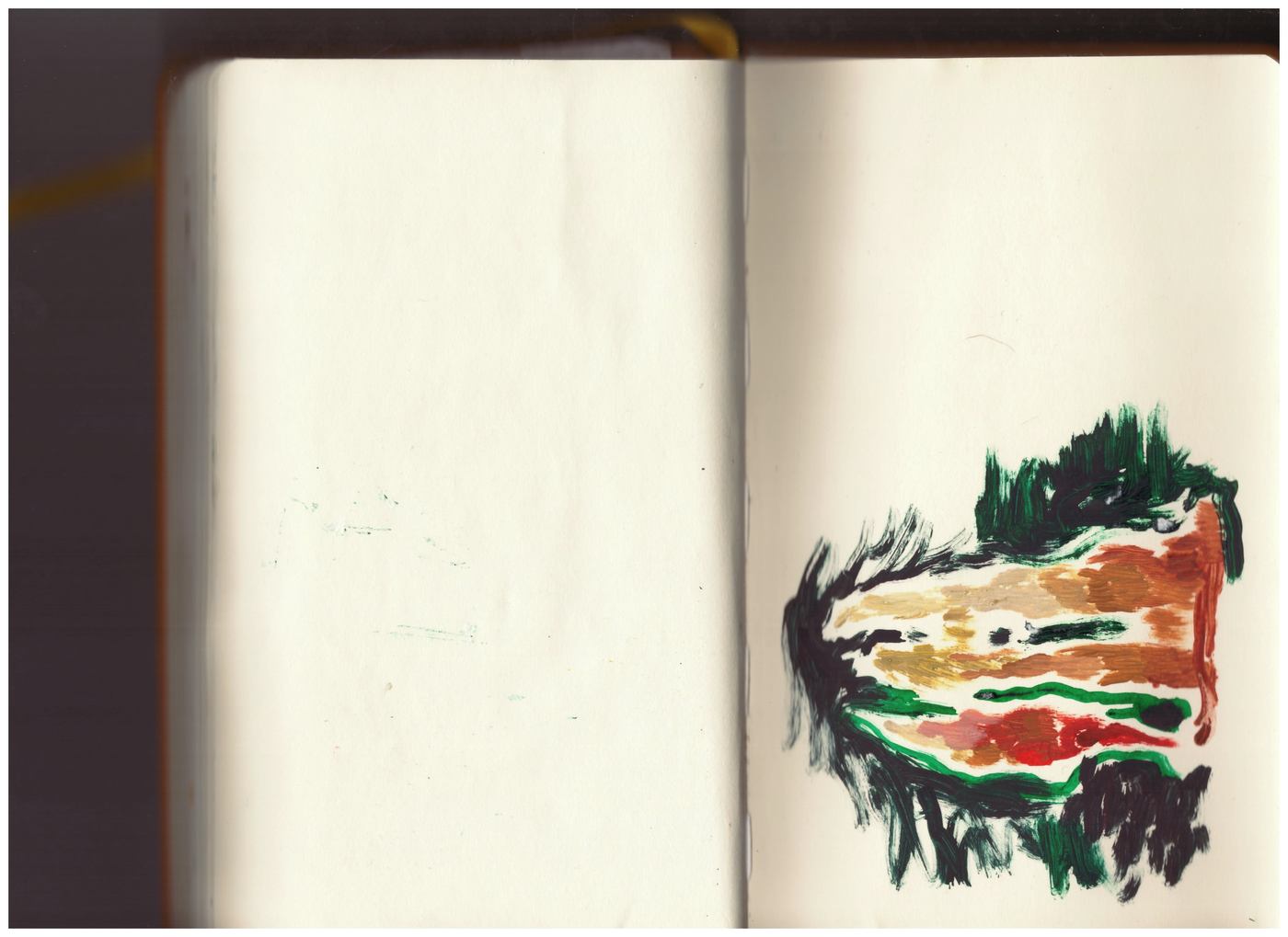
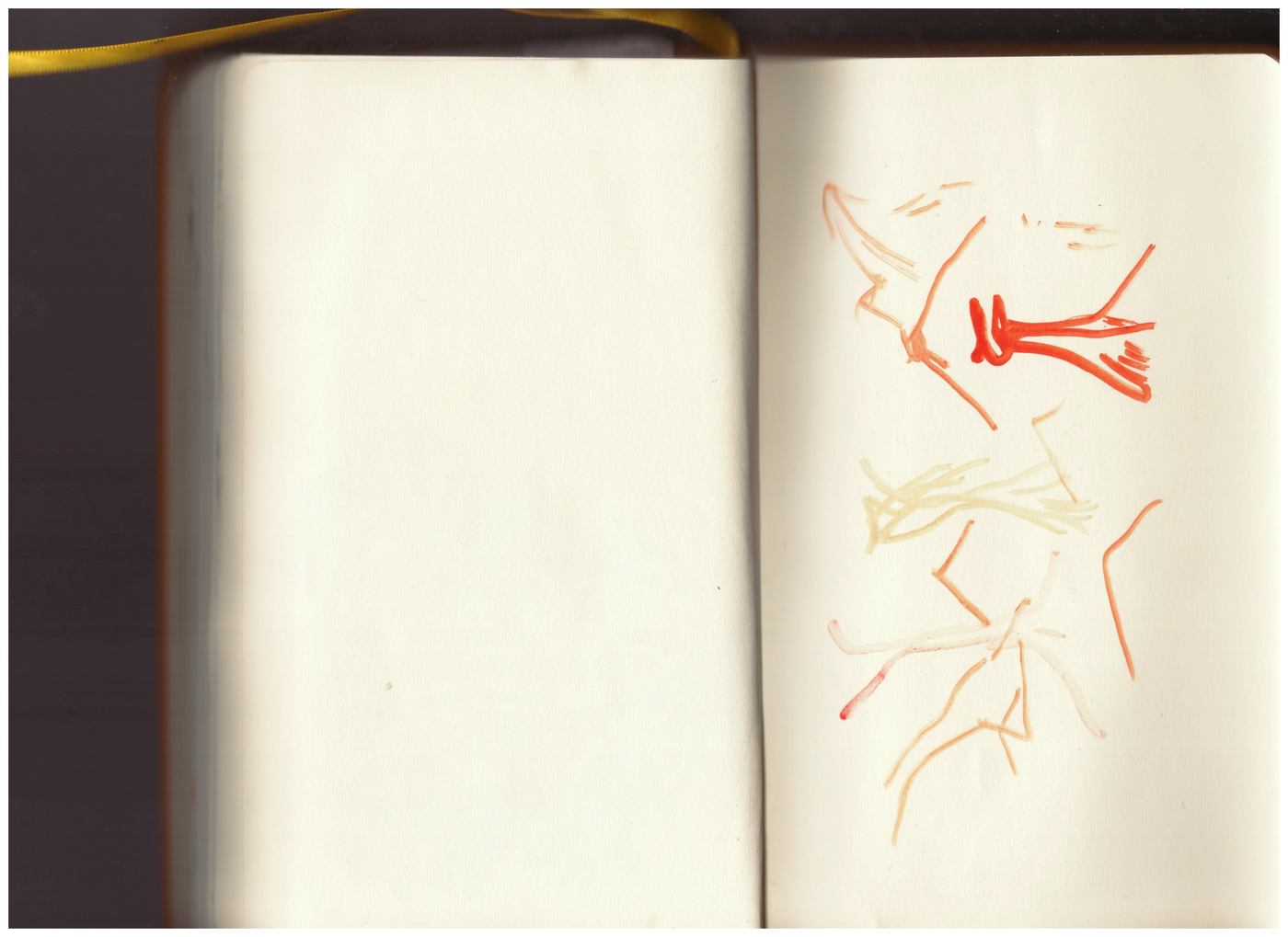
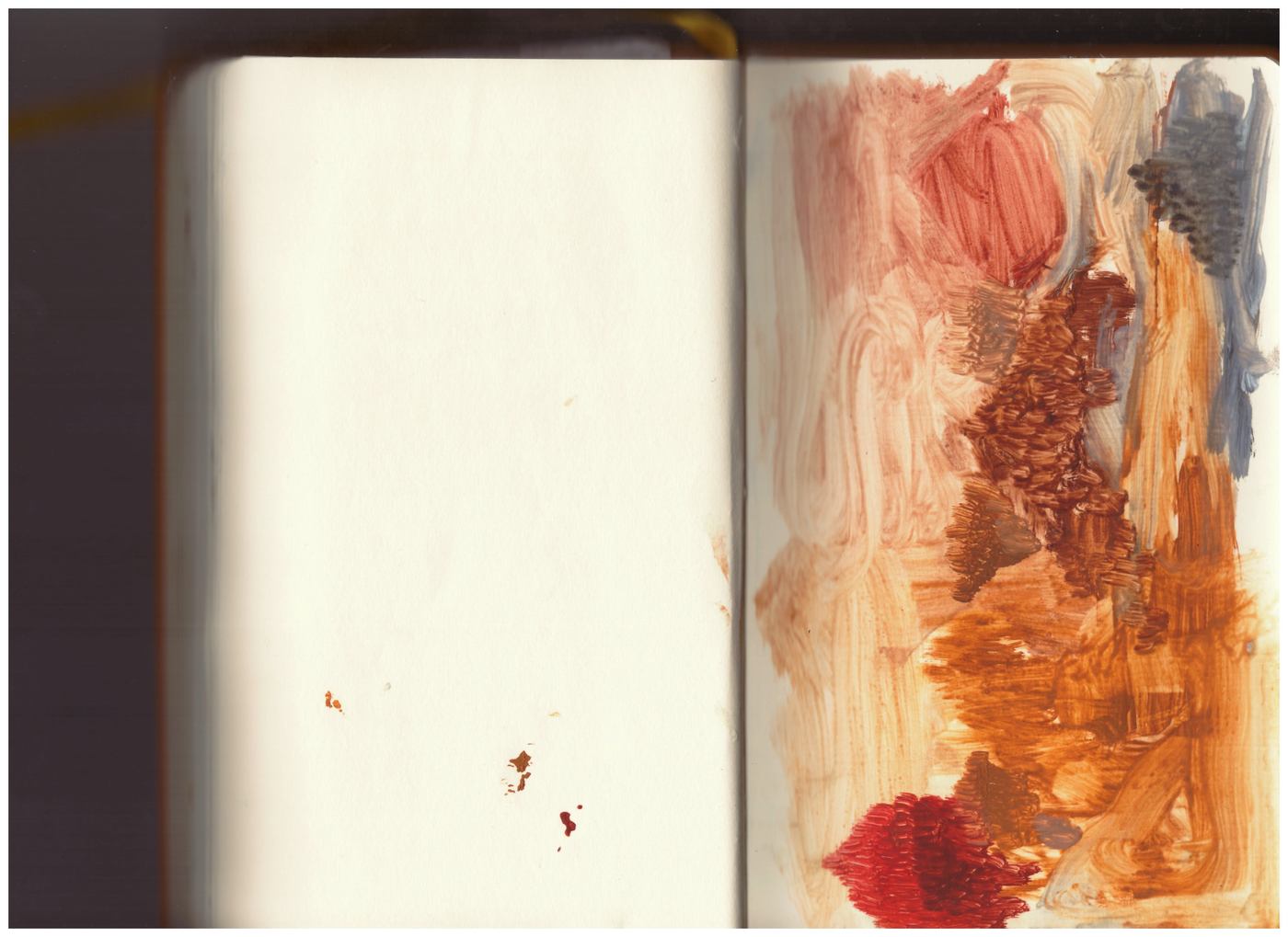
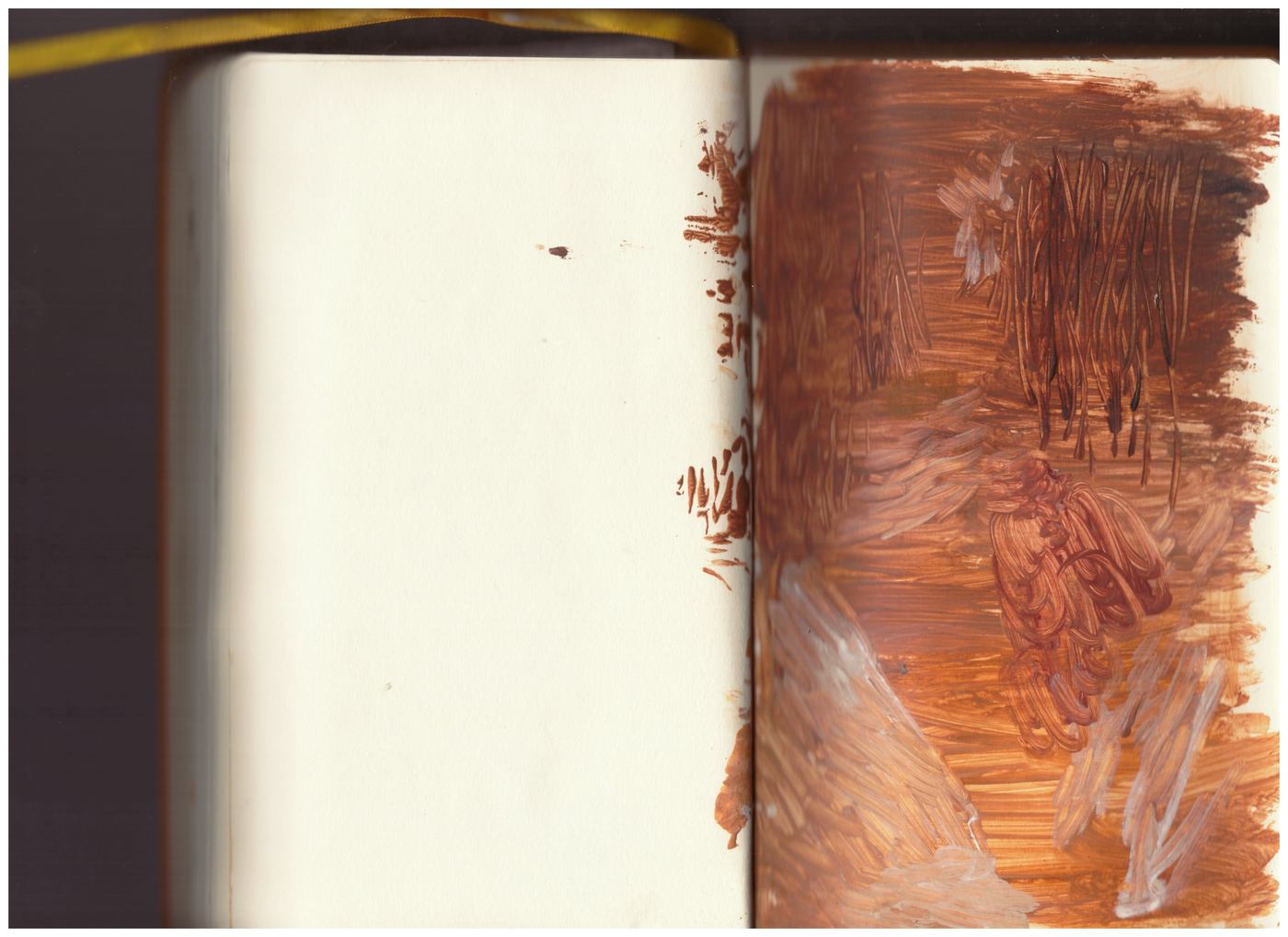
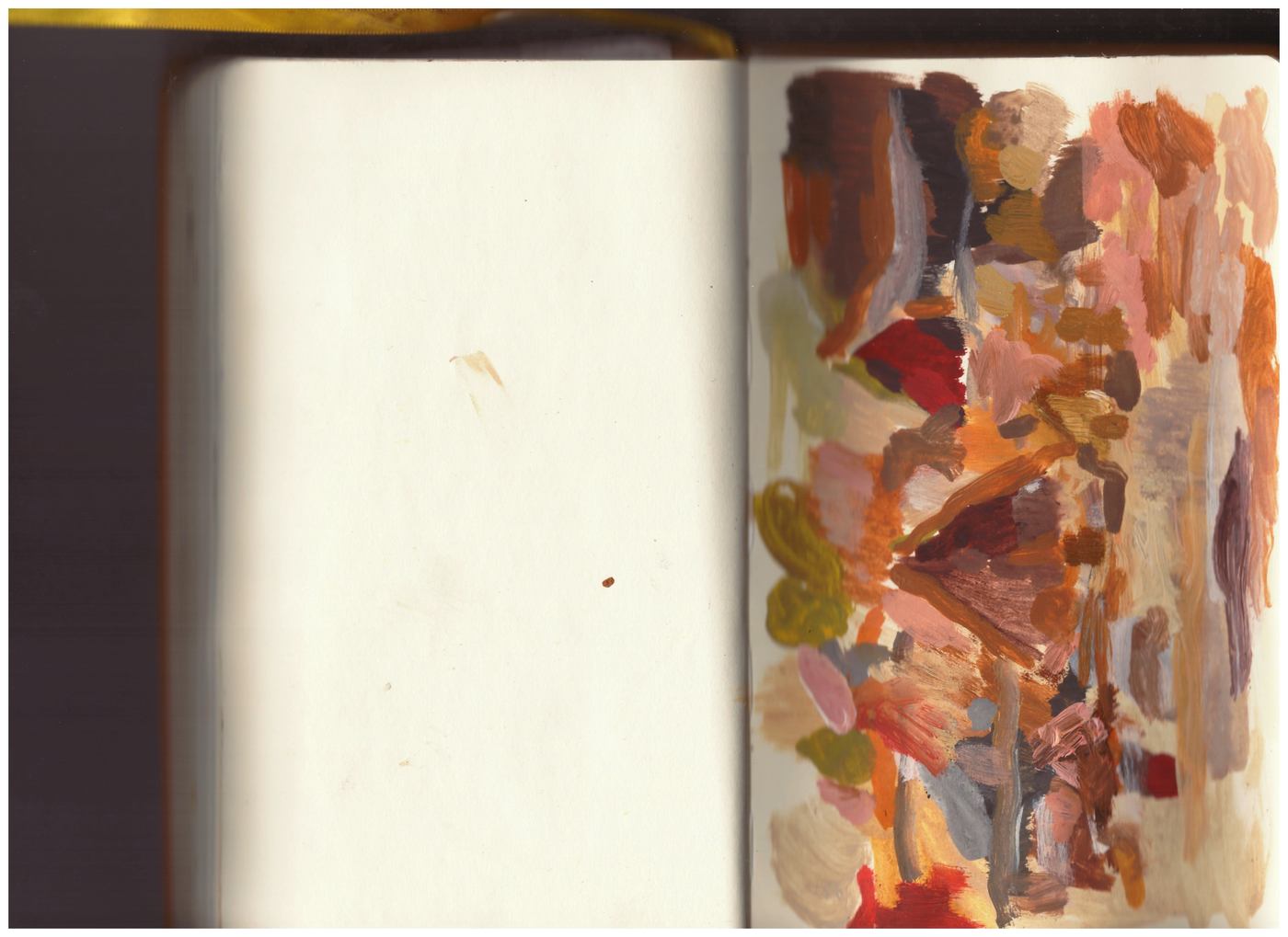
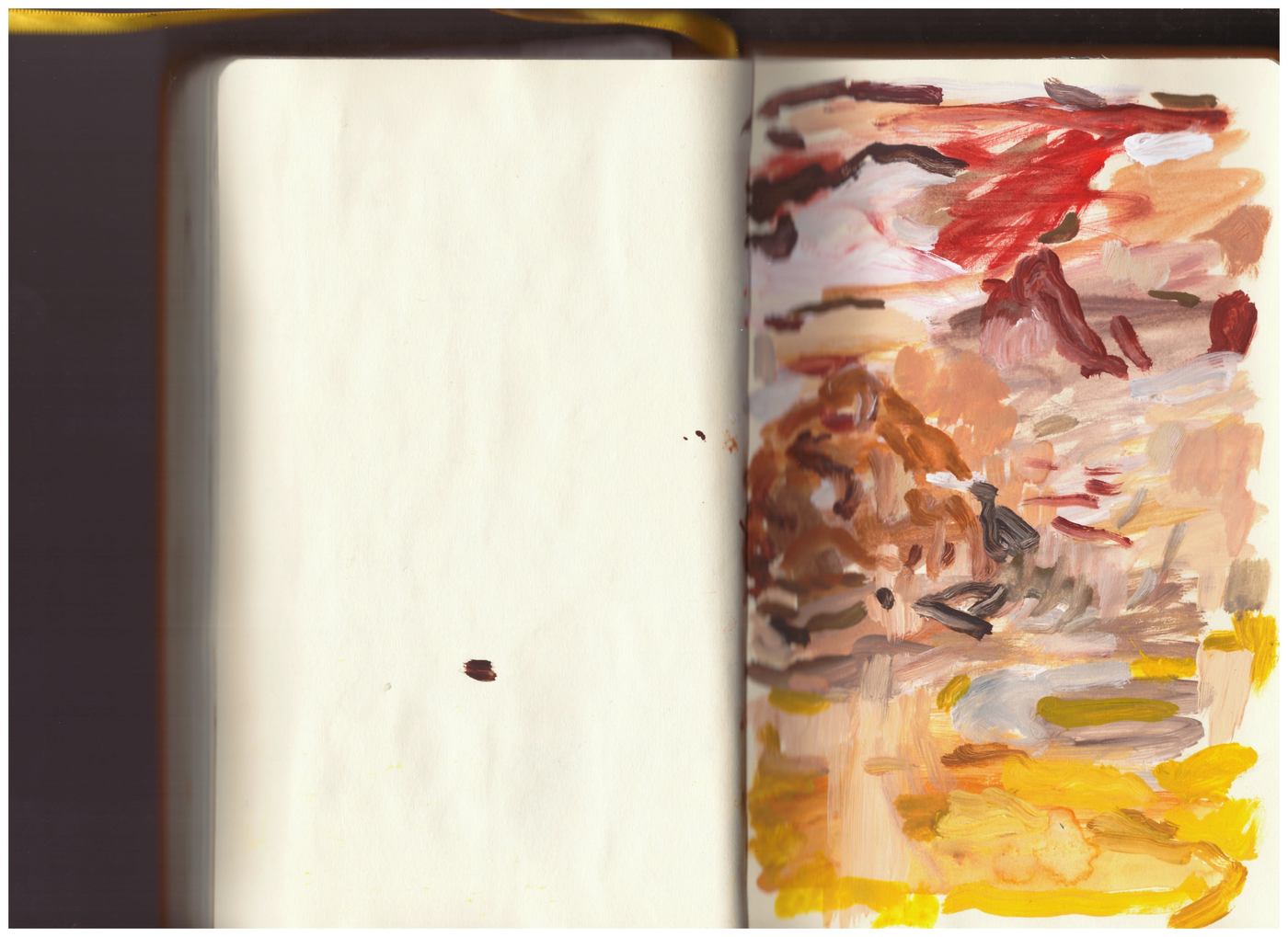
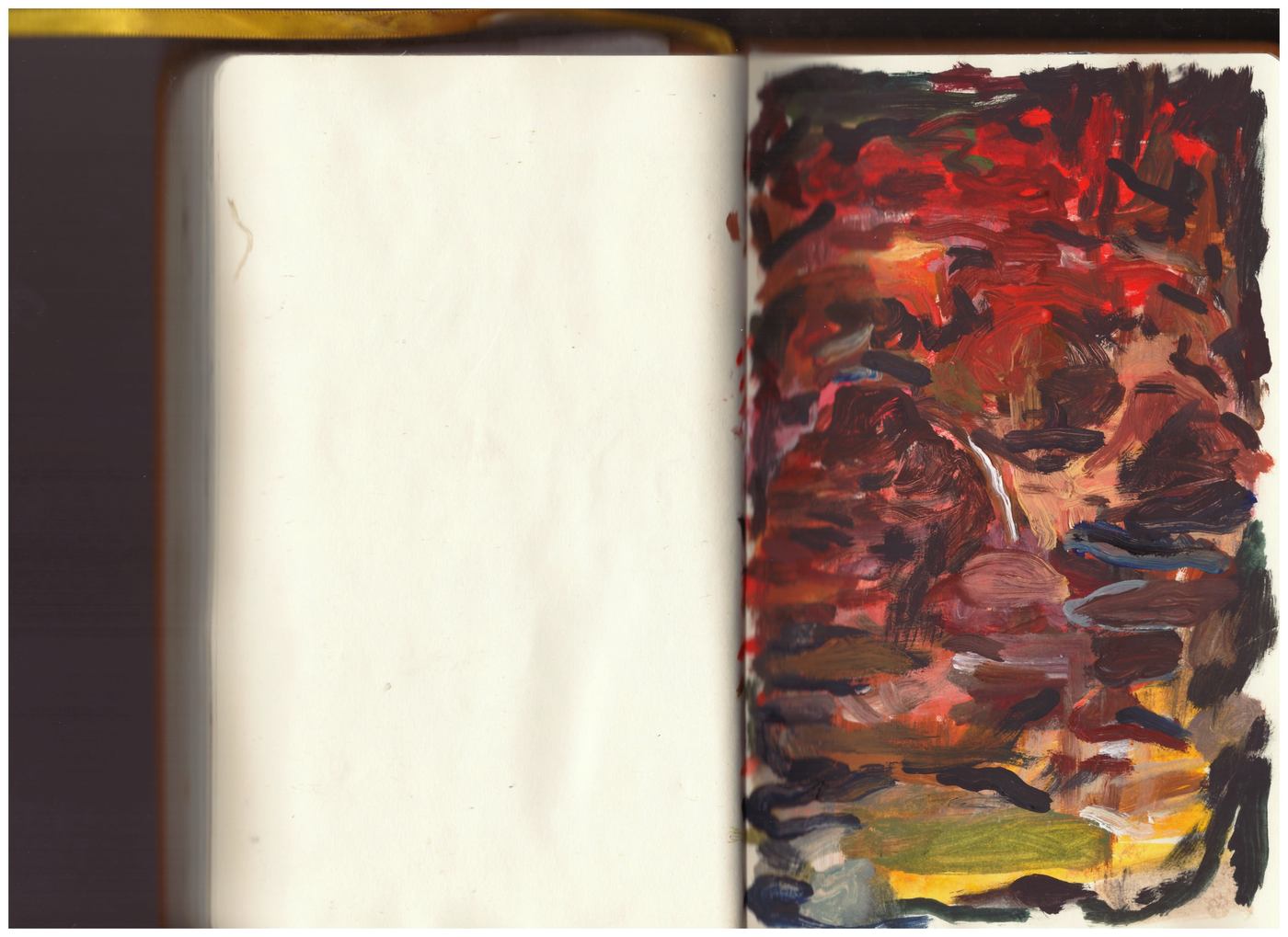
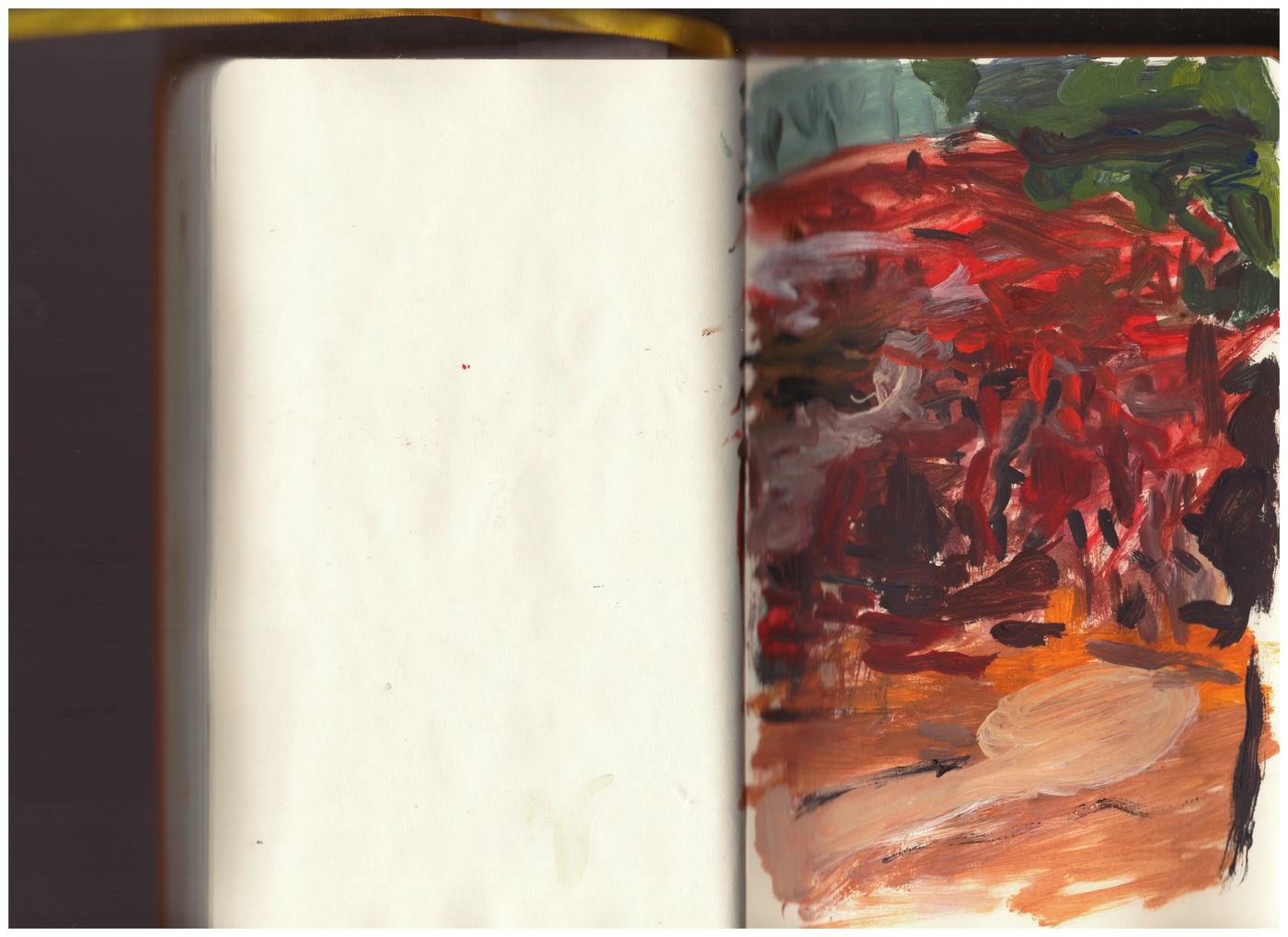
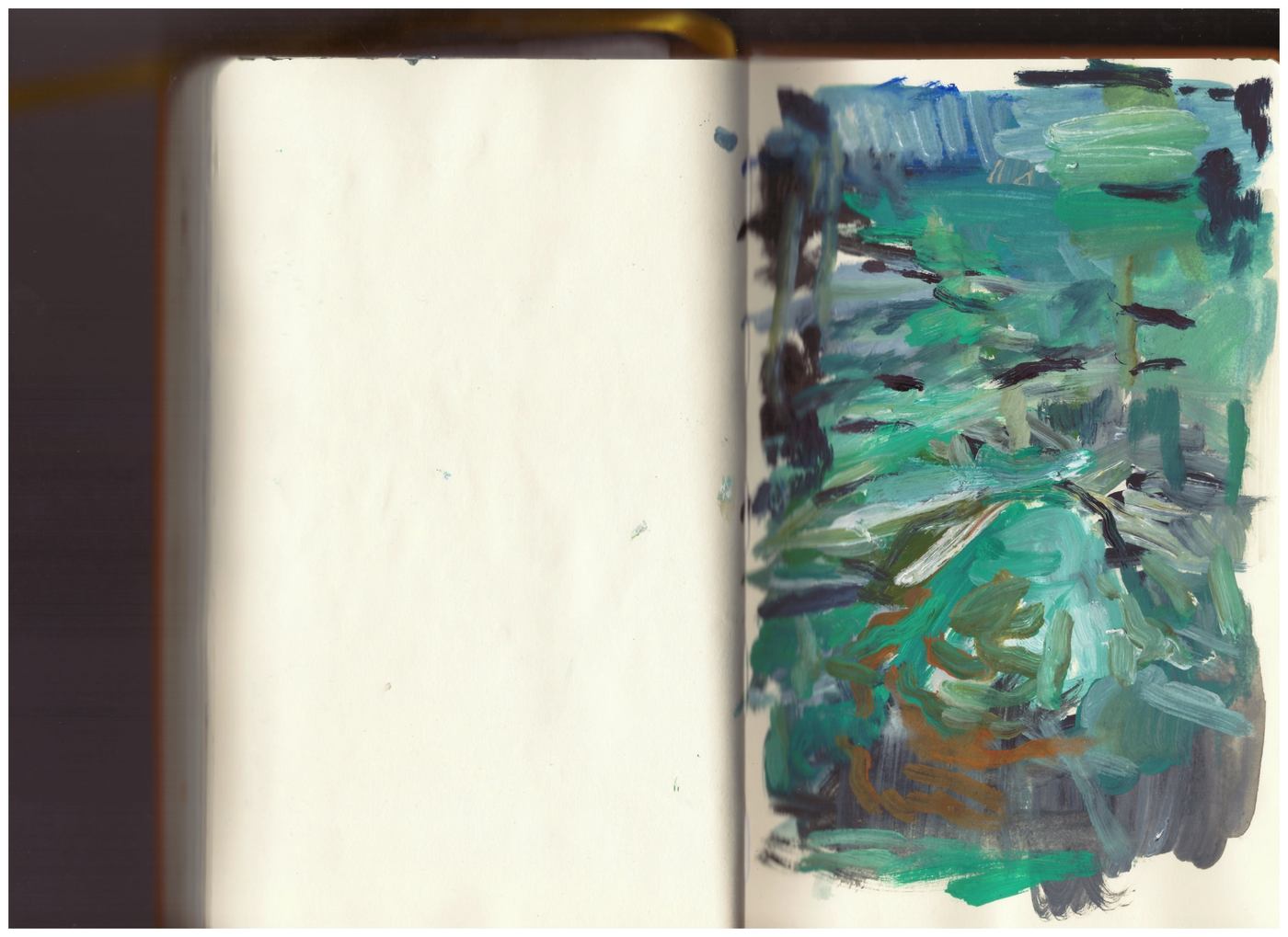
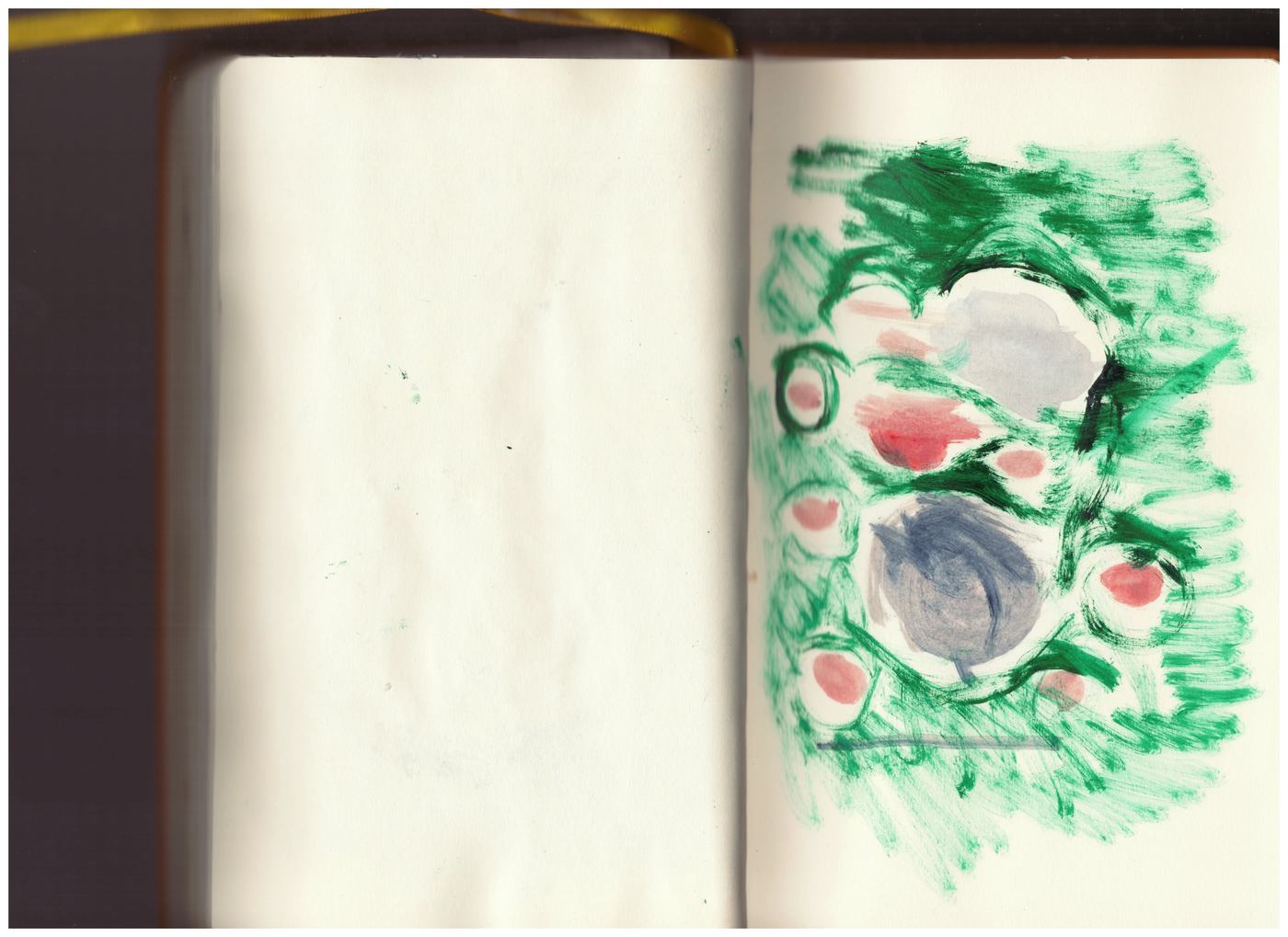
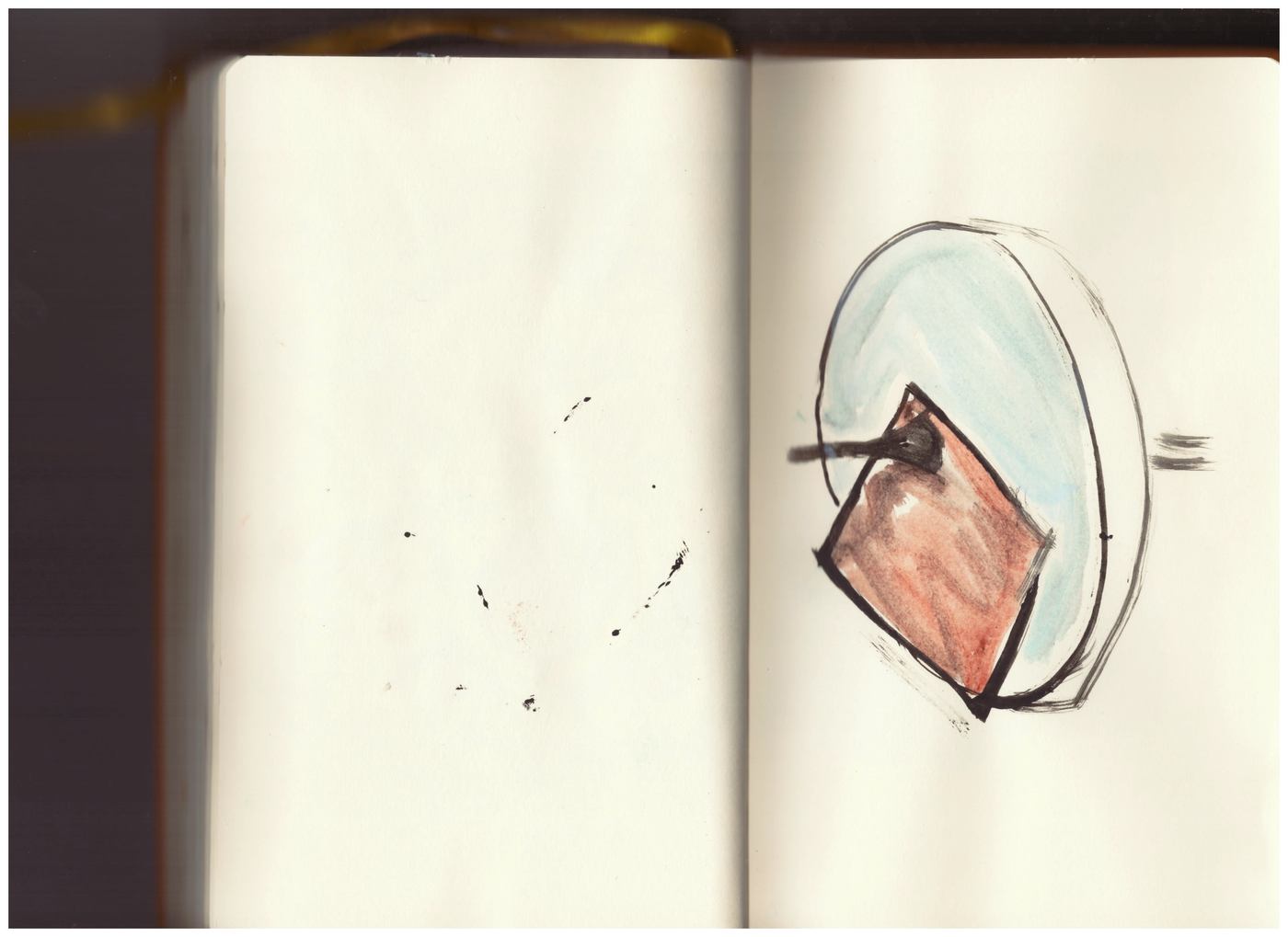
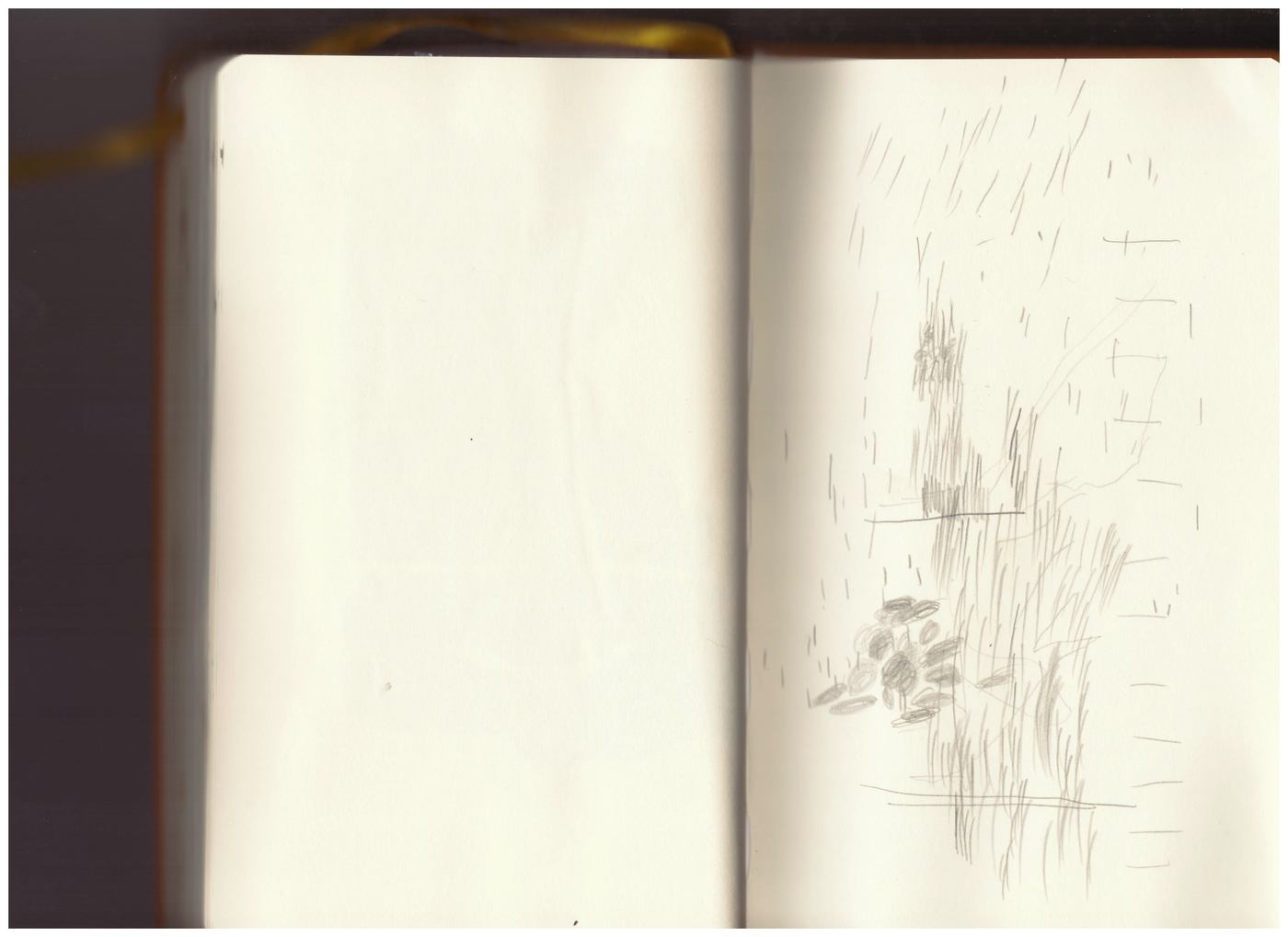
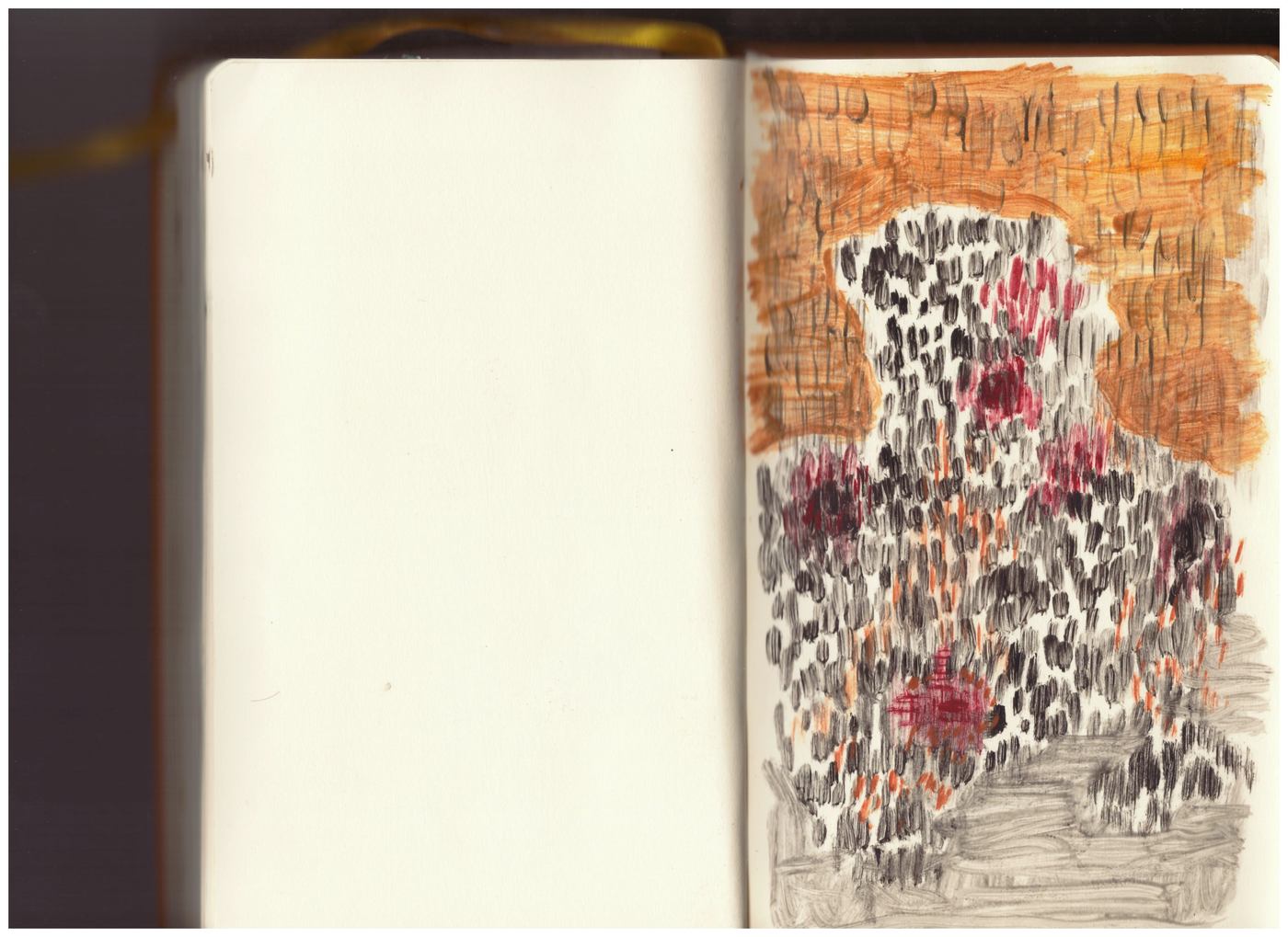
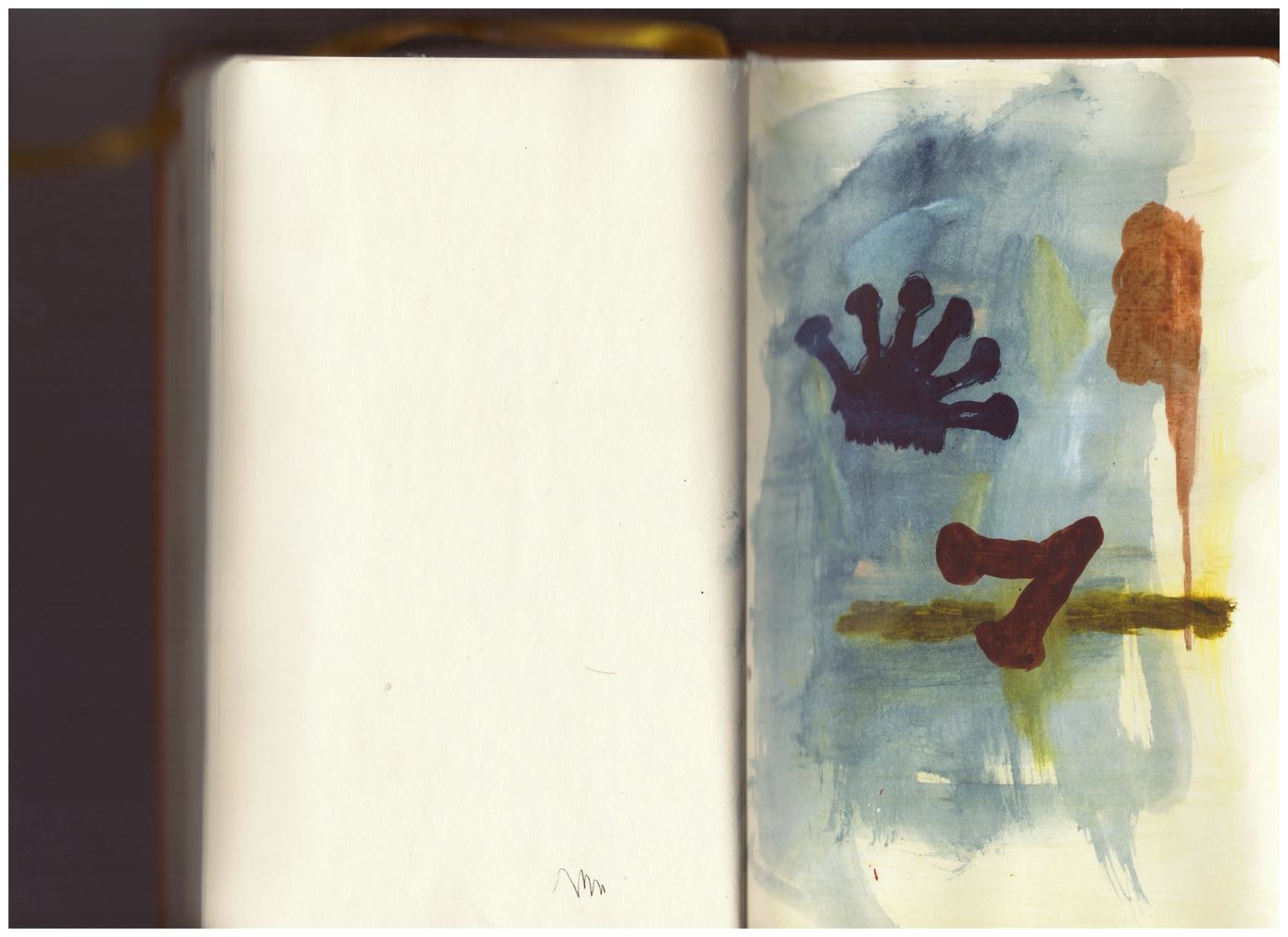
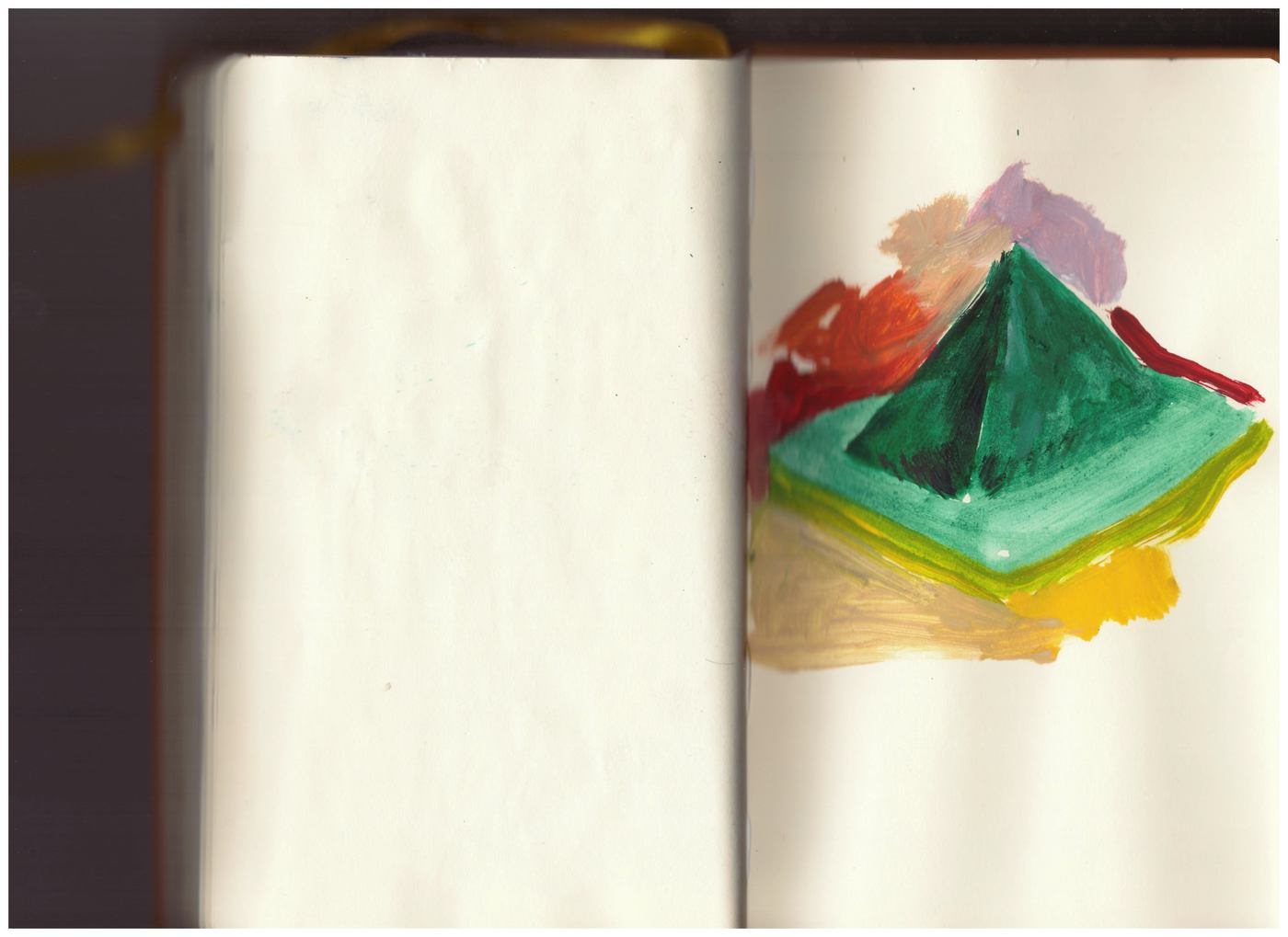
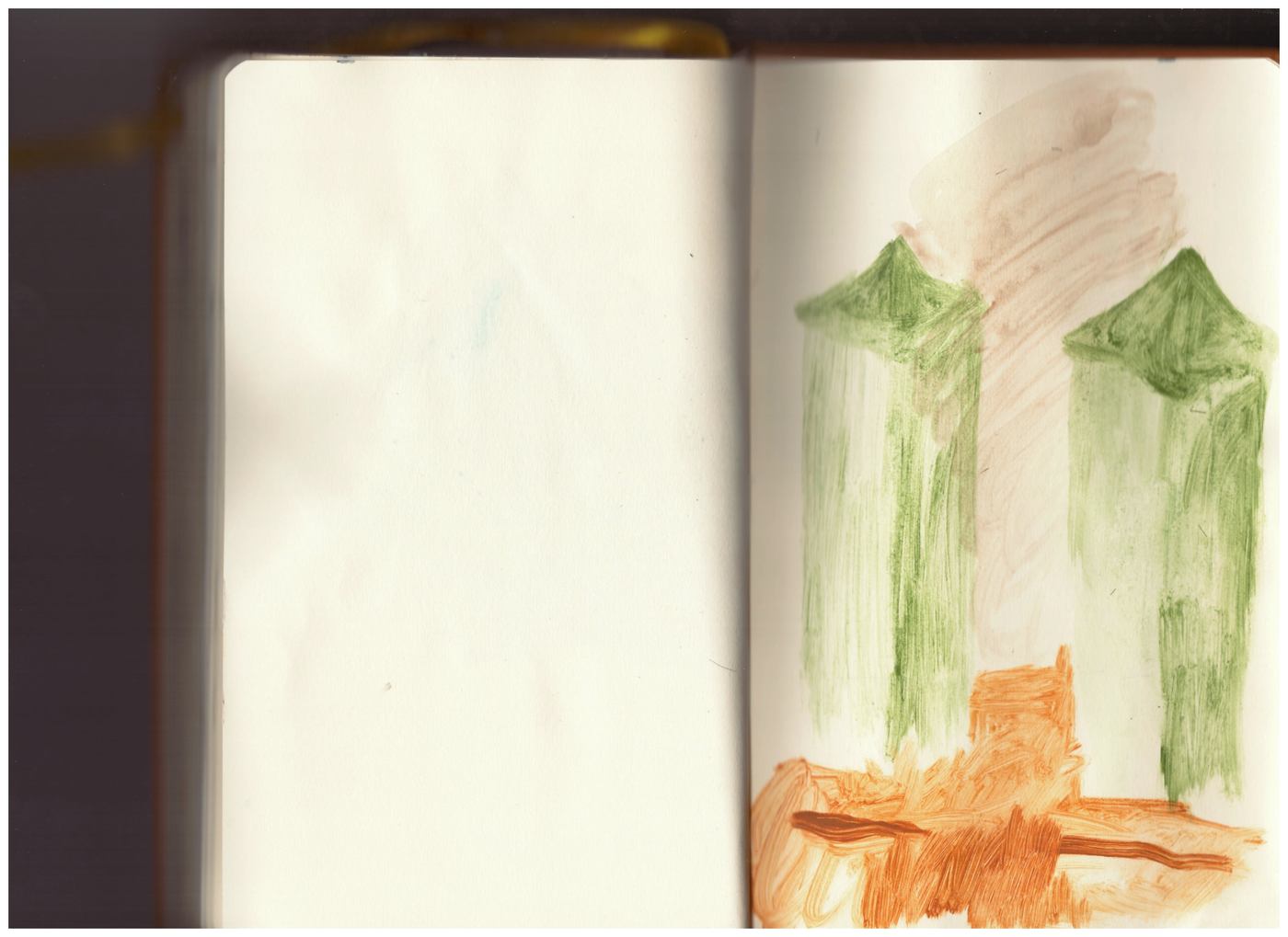
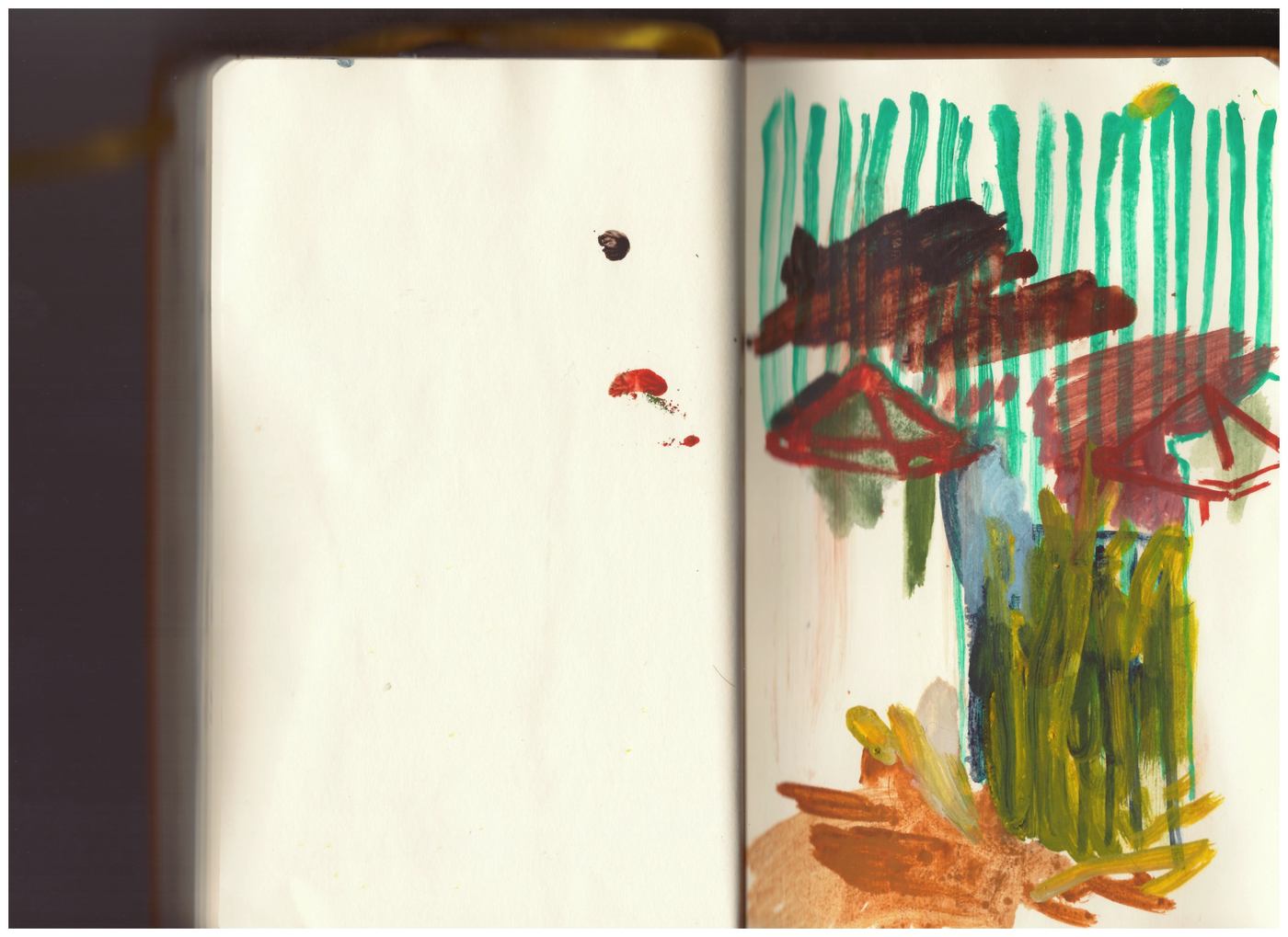
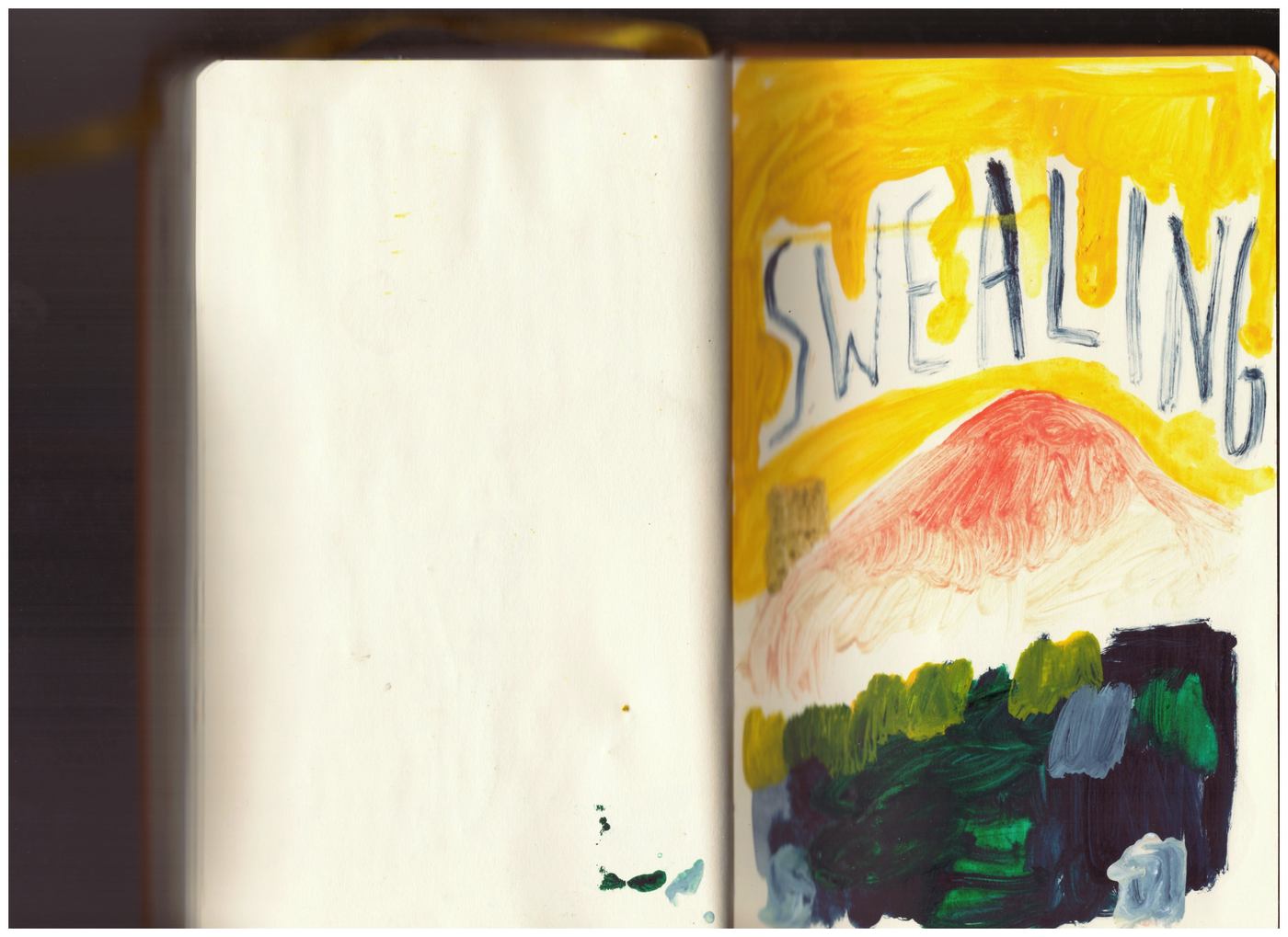
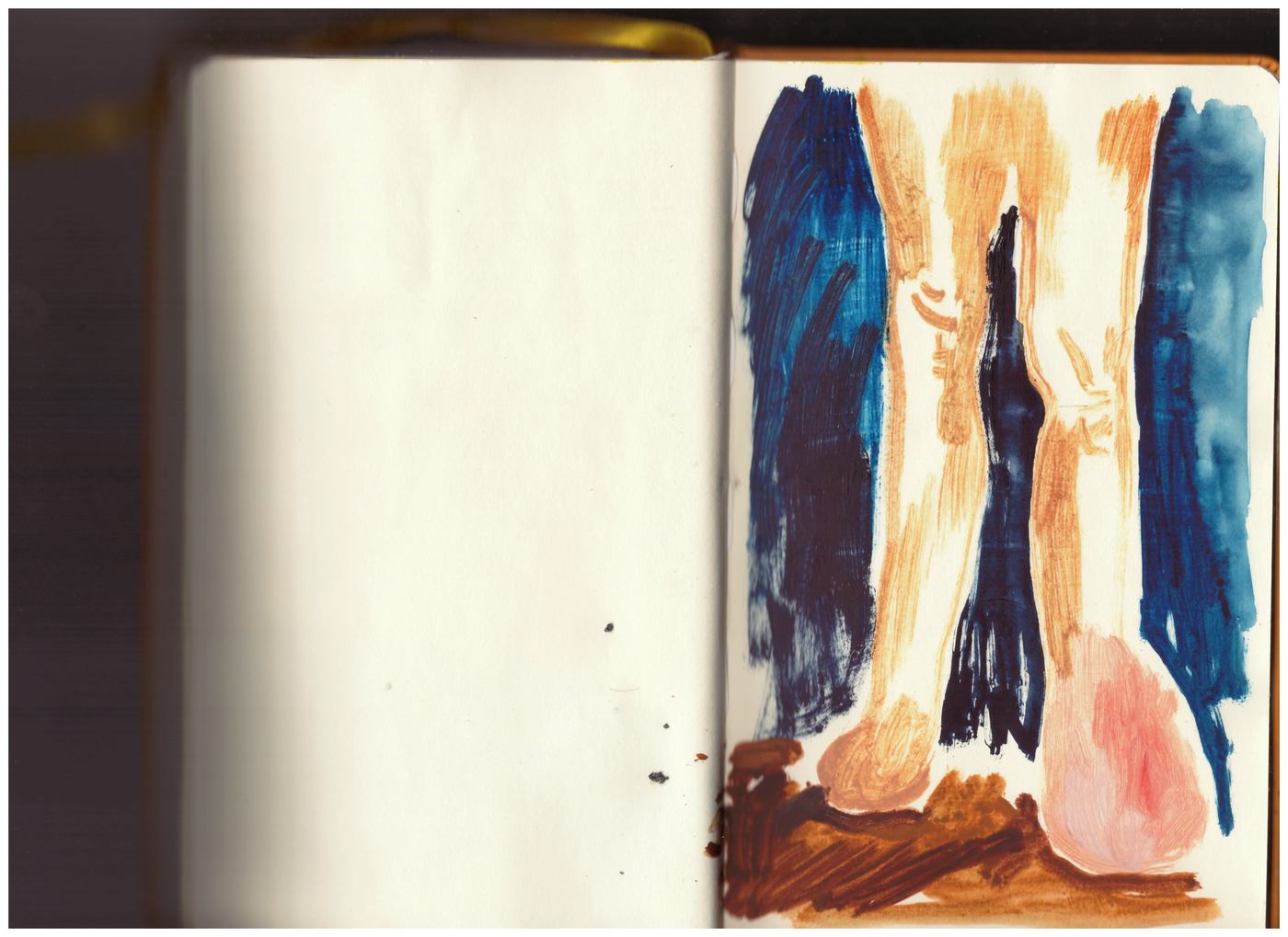
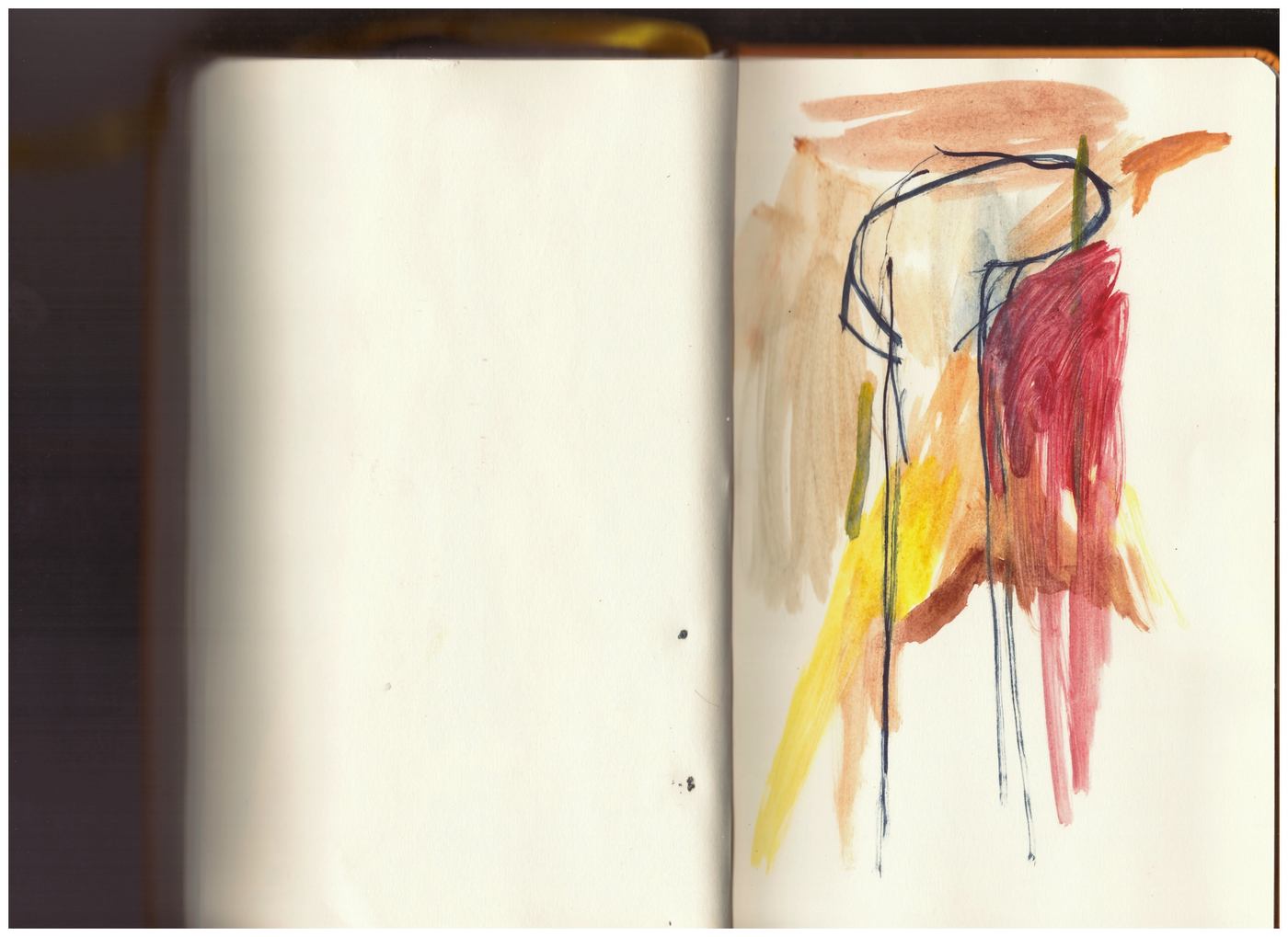
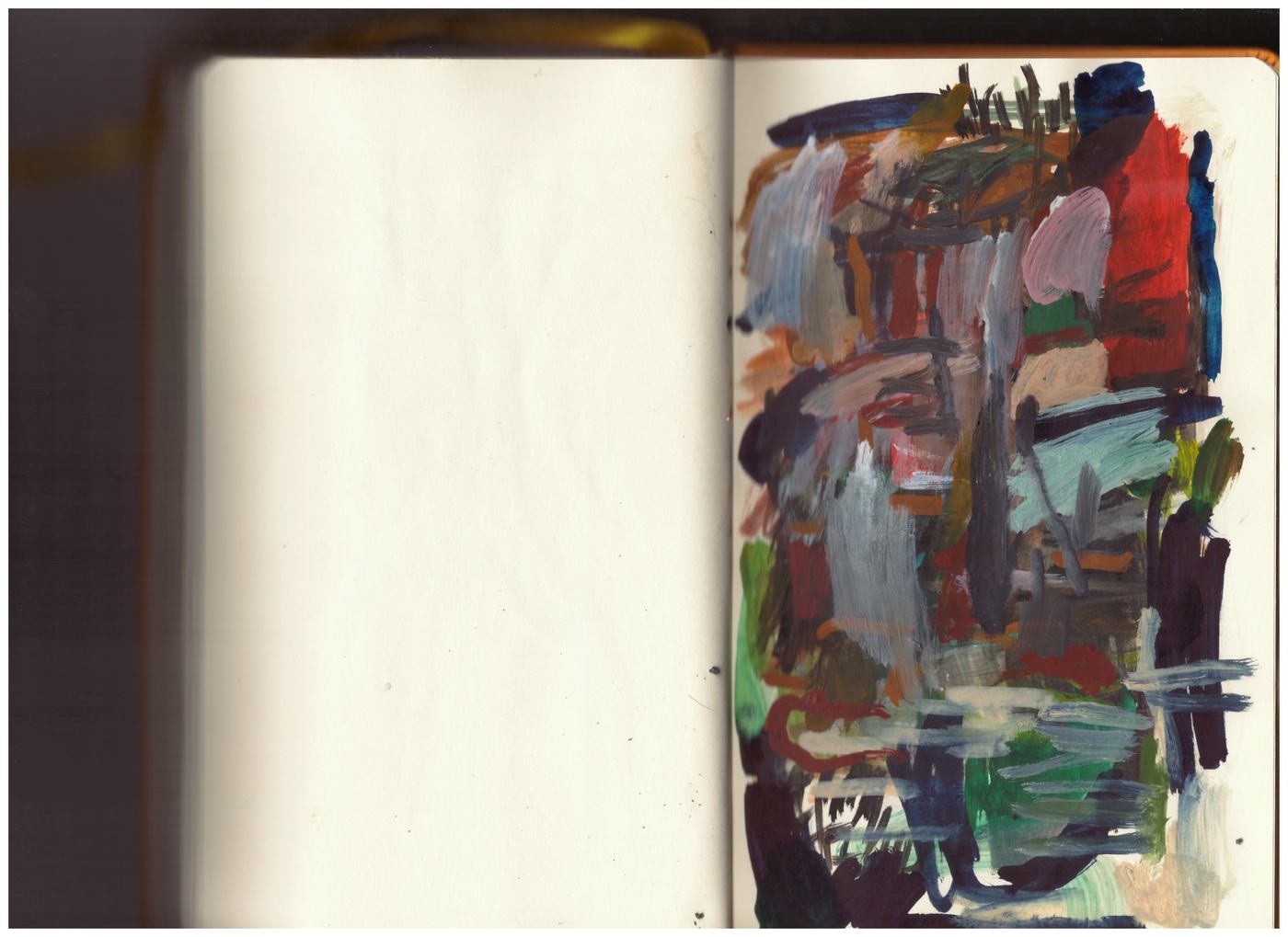
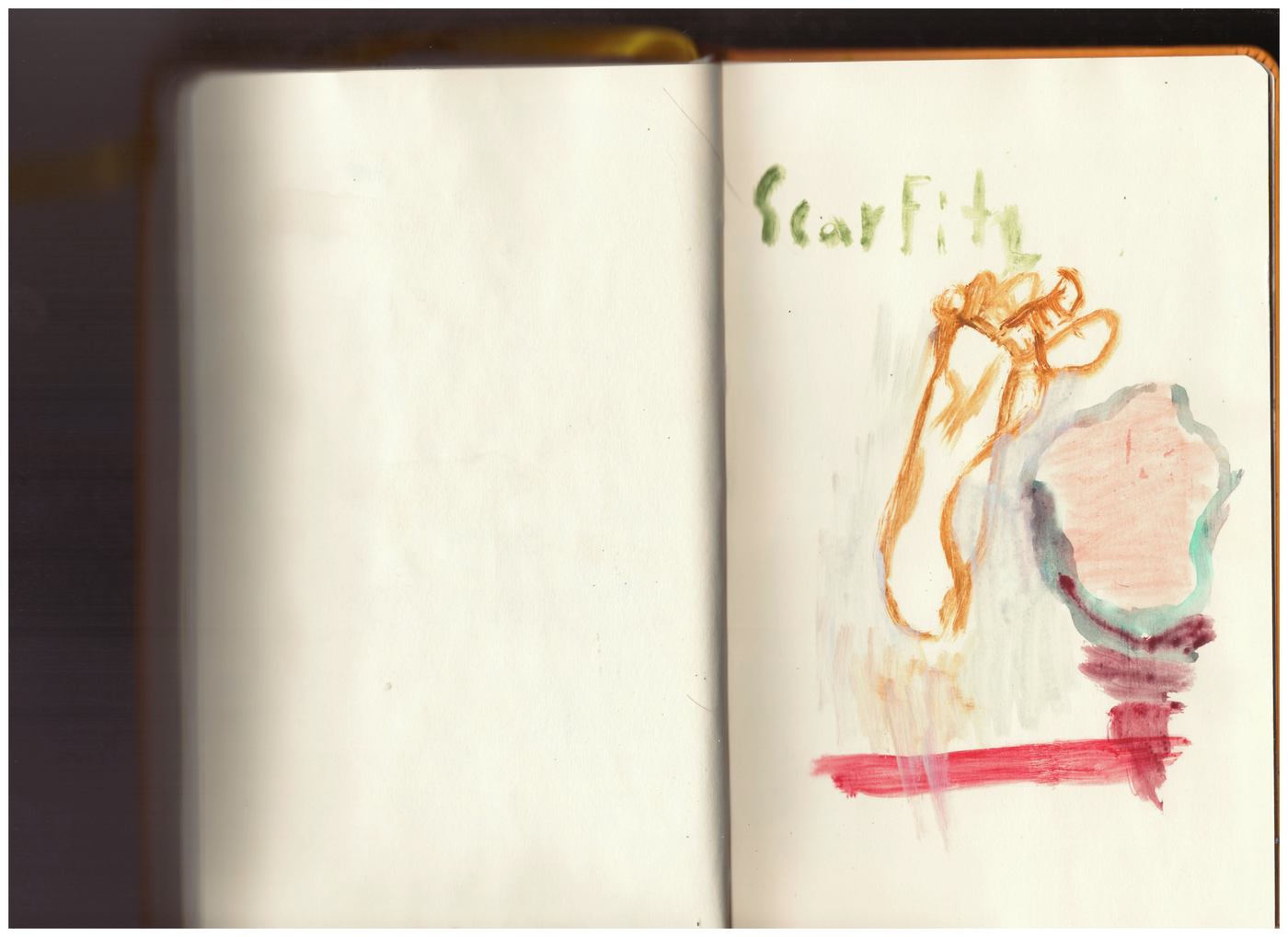
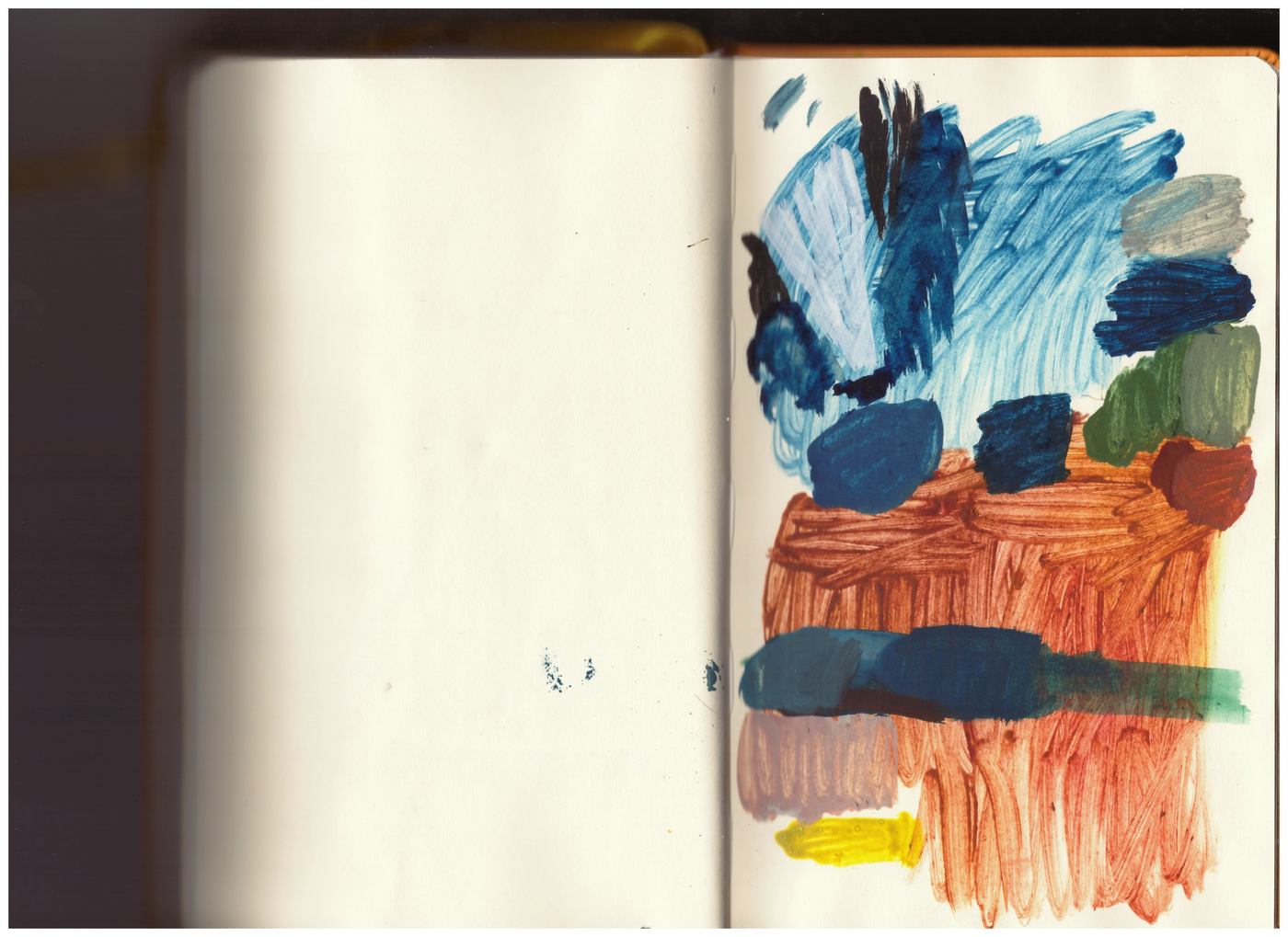
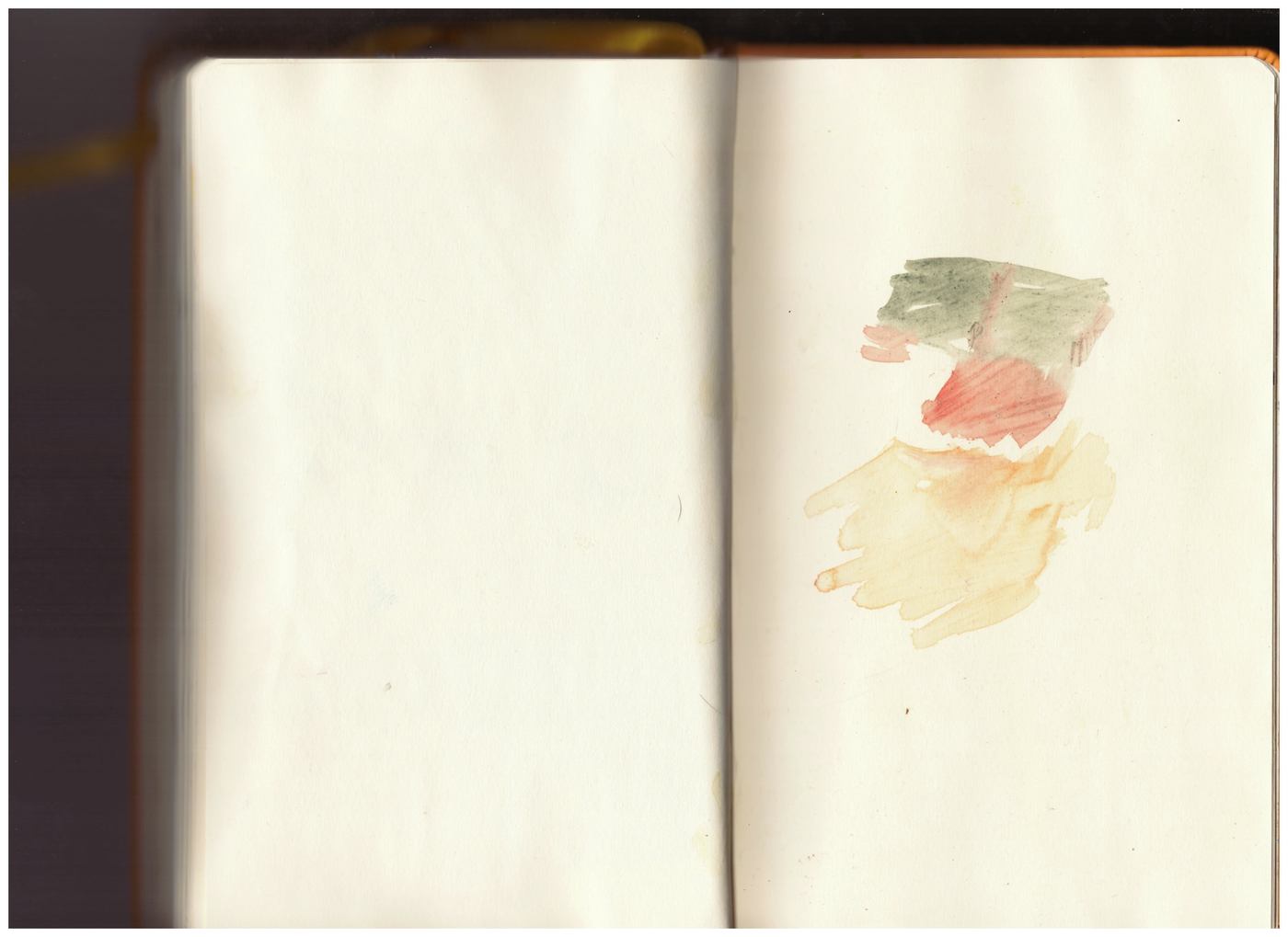
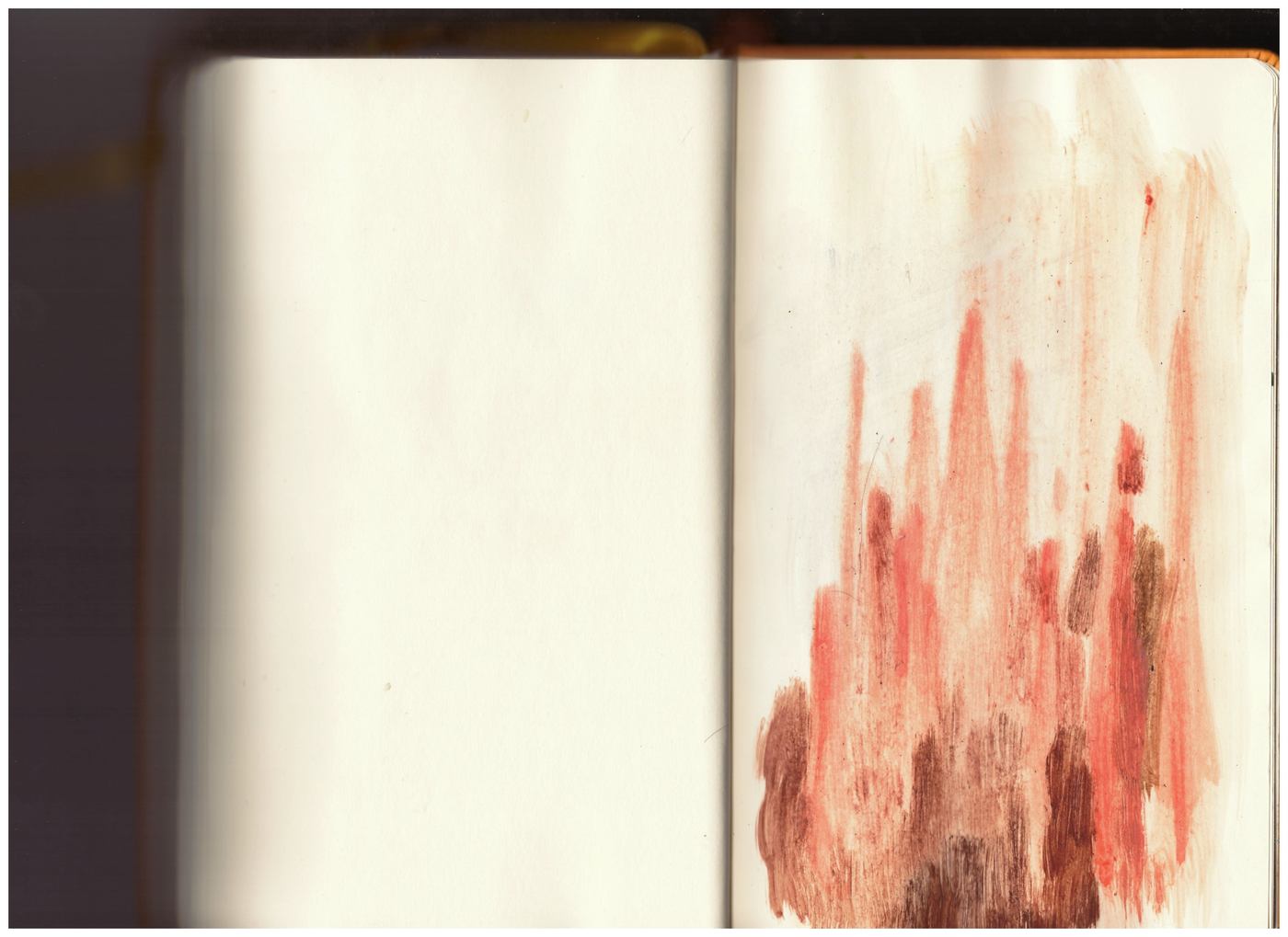
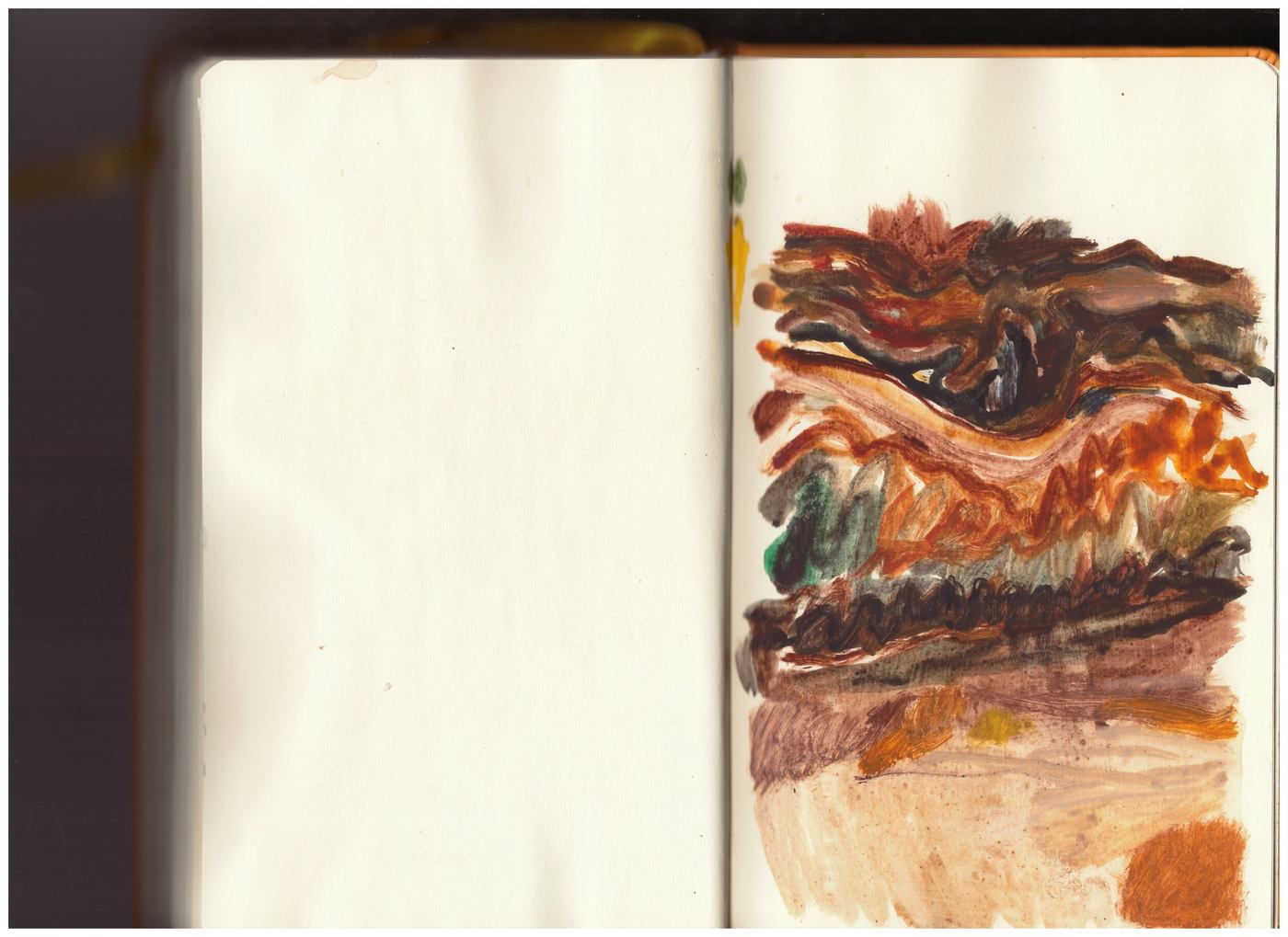
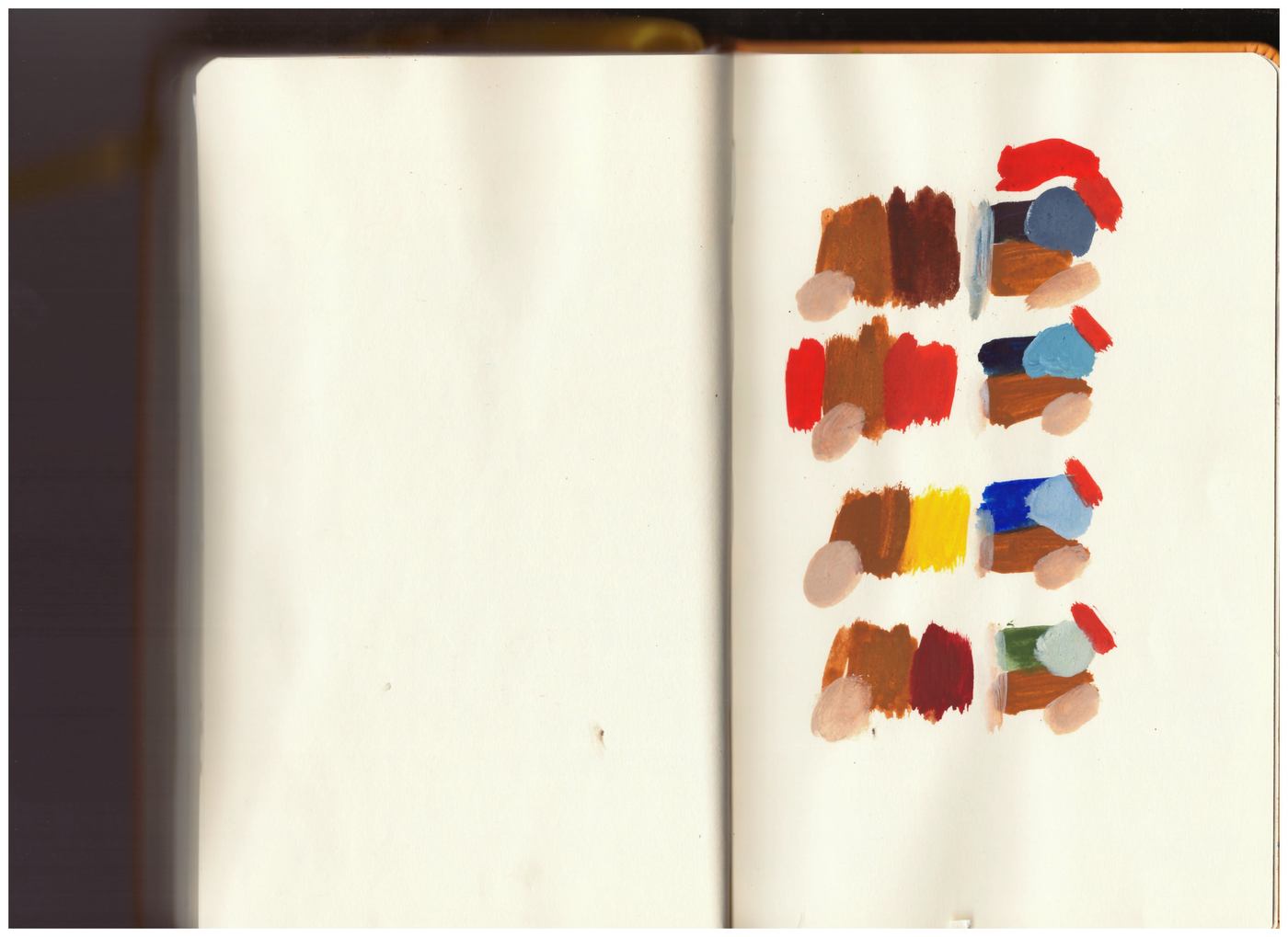
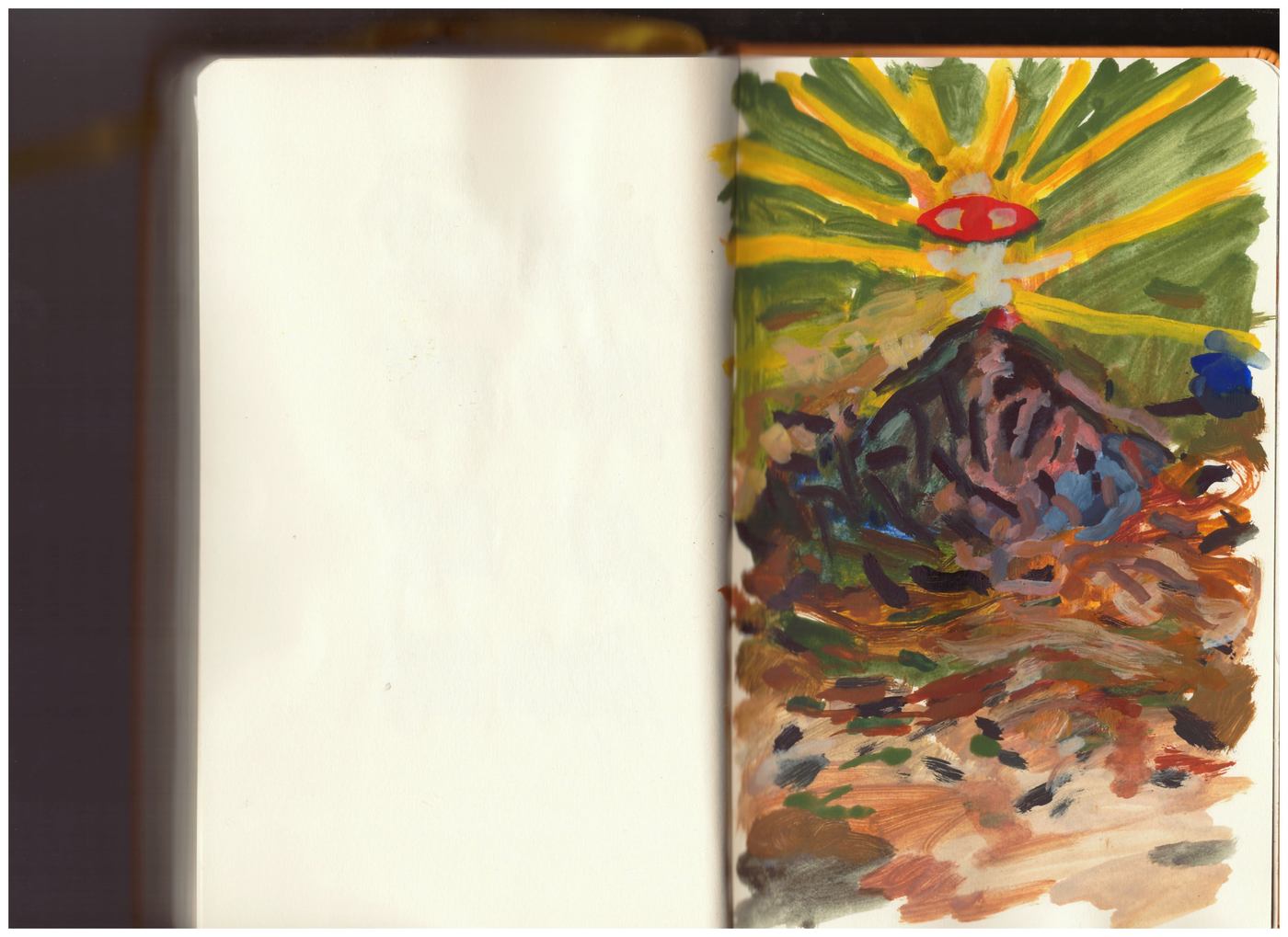
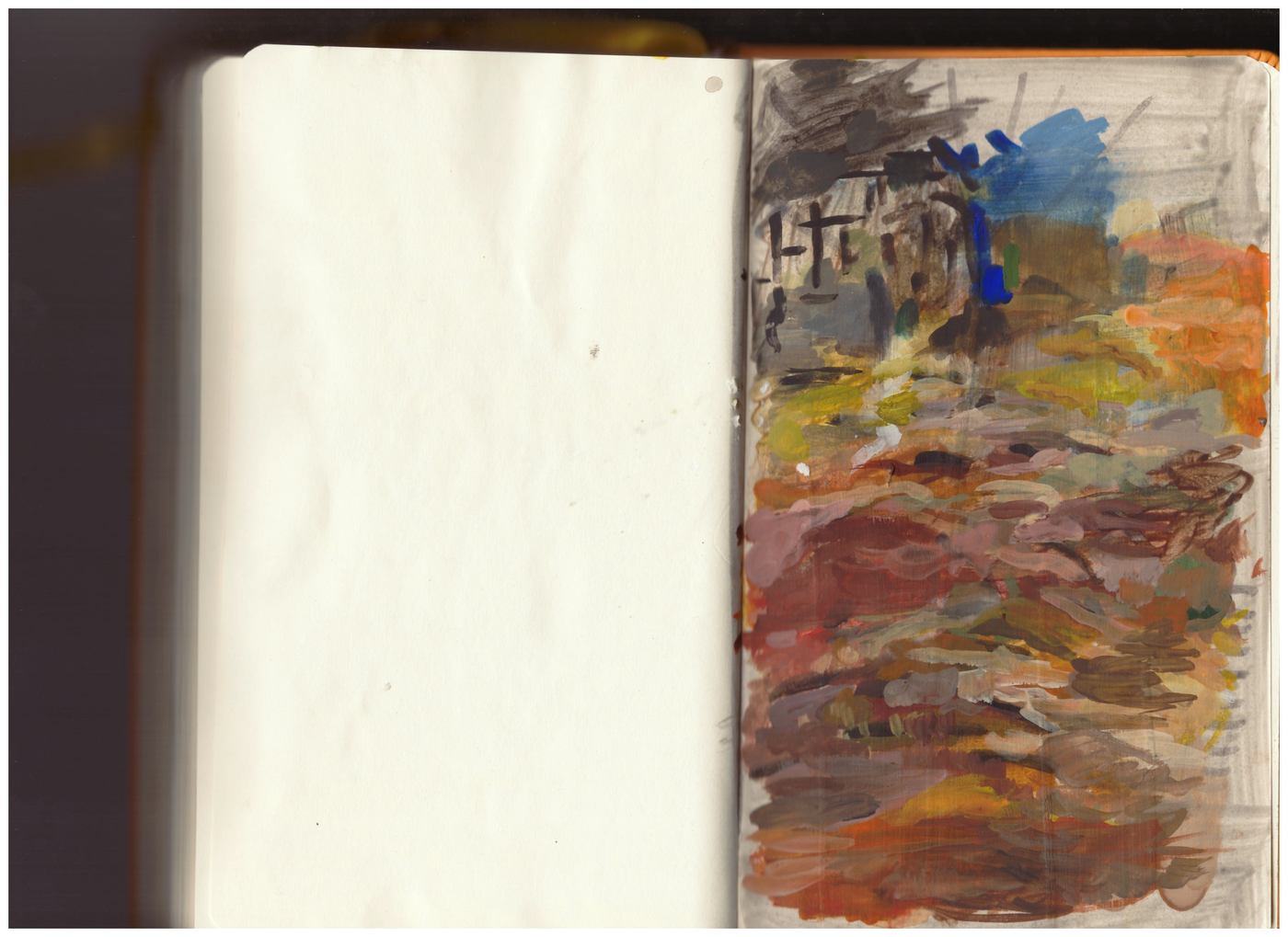
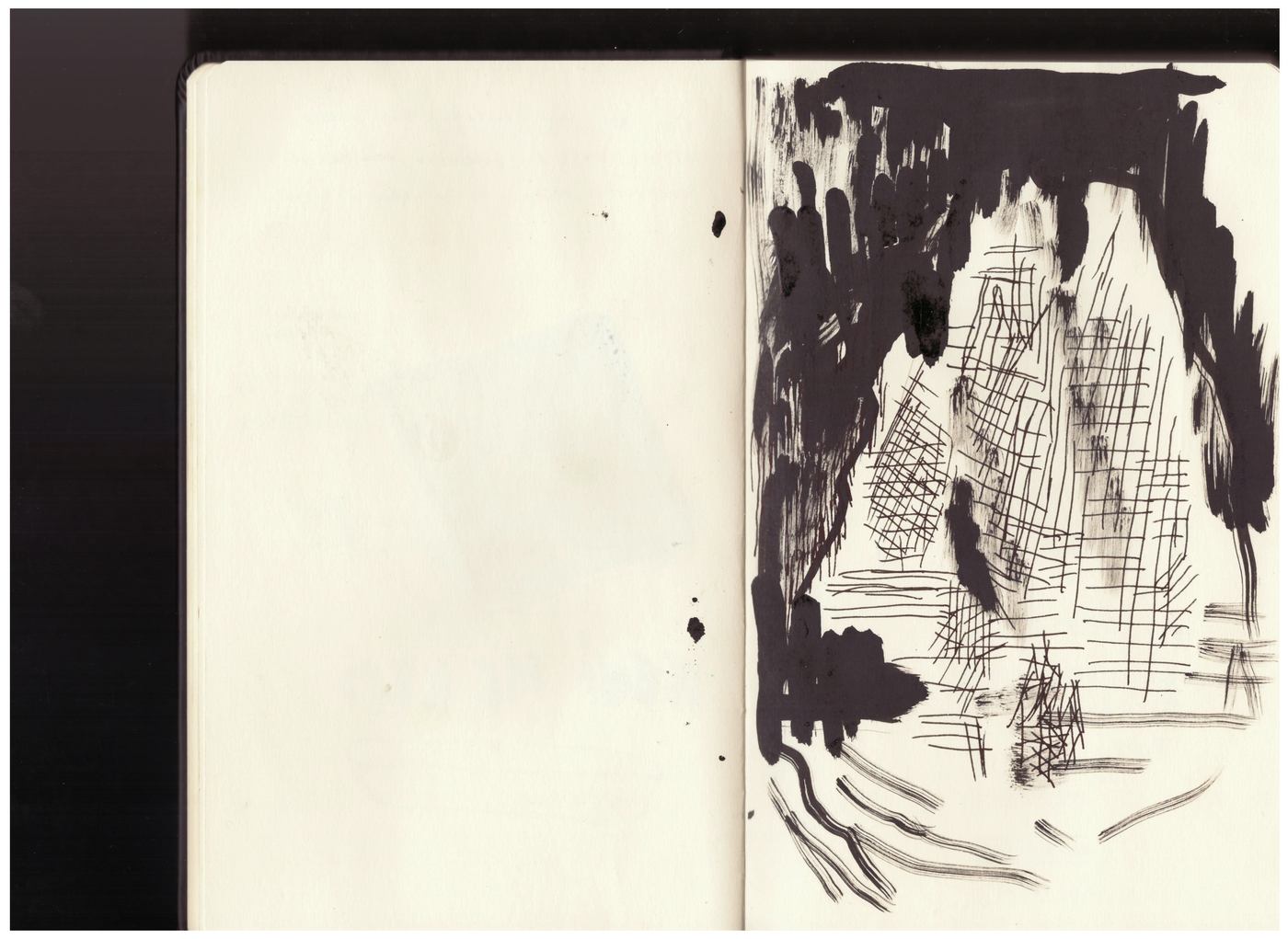
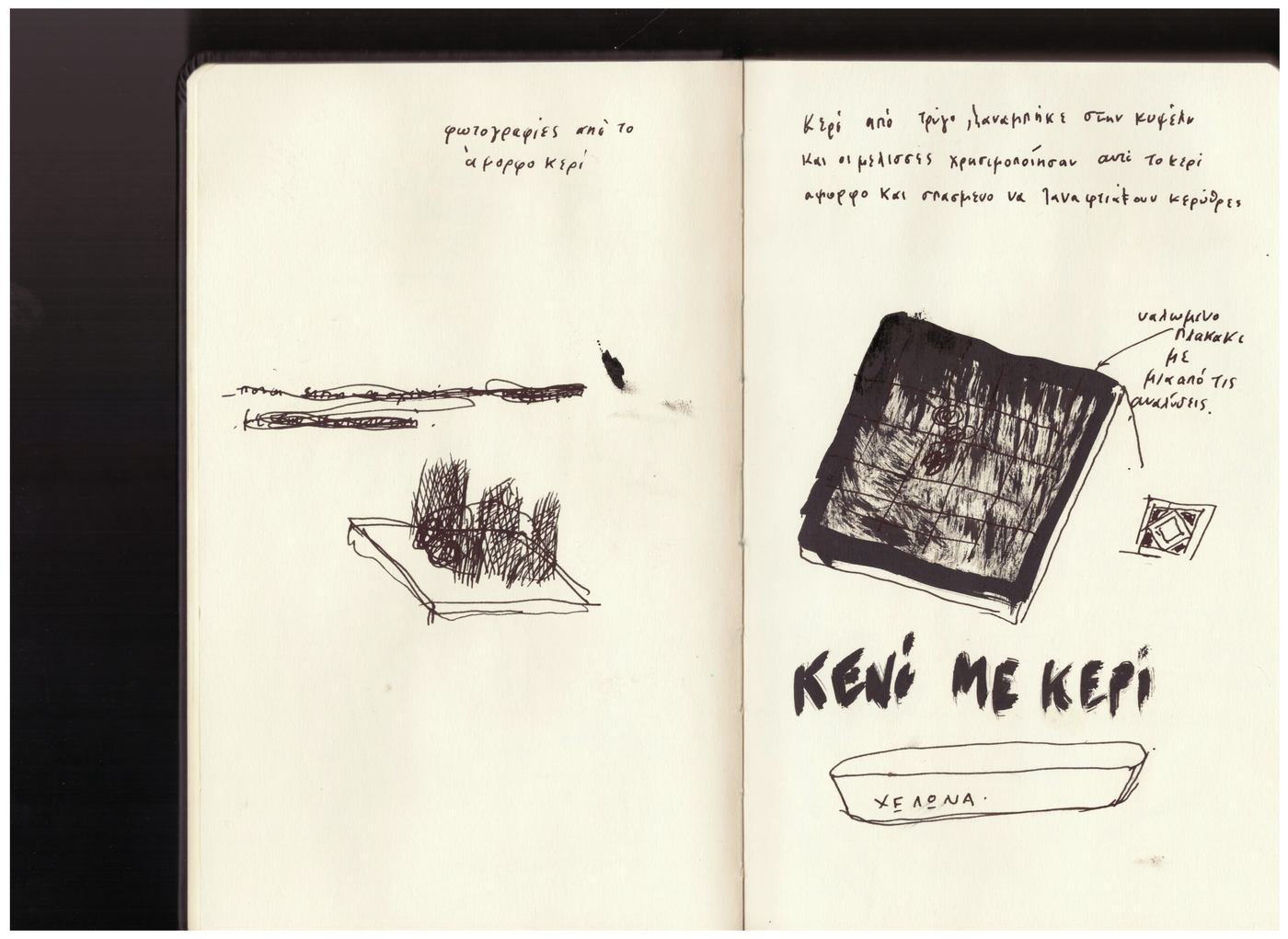
I use drawing as a way to process and develop visual information. Over the course of the residency I produced a collection of approximately ninety drawings.
The collection does not follow a sequence: ideas are developed, then abandoned; new ones appear and old ones return. They are predominantly gouache and watercolour studies, but also ink — loose fields of pigment, tested washes, and occasional written annotations.
The drawings establish ideas that seep into my studio practice — as thoughts about form or color, or as notes recording an influence from outside the work altogether.
Click any page to open it full width · click again to close · ← and → move between pages
See alsoWild comb in a hive
See alsoHoneycomb on a clay bar
See alsoCollection mapTiles 2026
See alsoThe Serpieri House
See alsoWorked slab, from above
See alsoHoneycomb on a clay barMud nest
See alsoComb eaten by wax moth